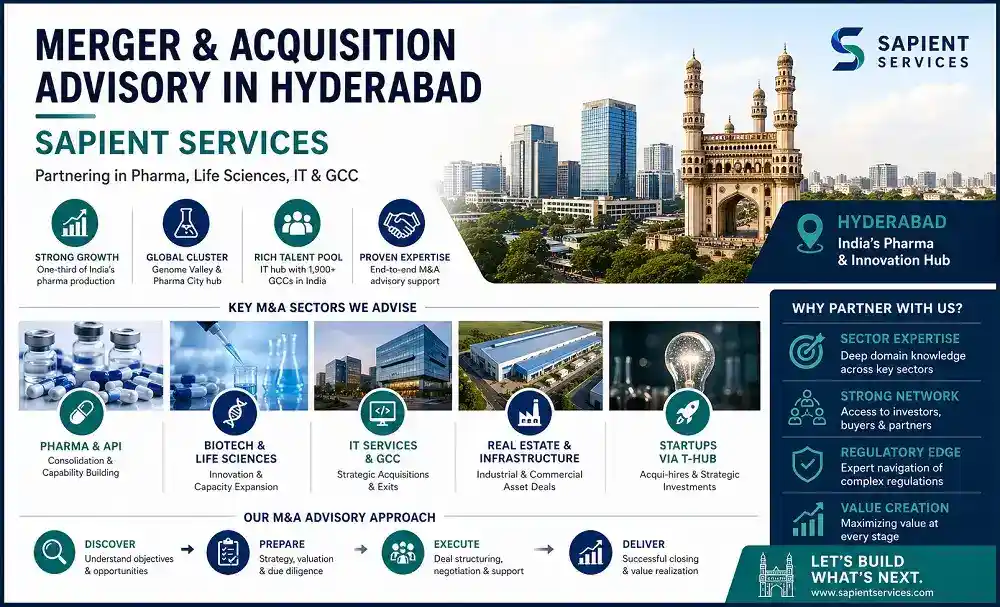
Hyderabad’s pharmaceutical and life sciences cluster has no Indian equivalent at this scale. Telangana contributes nearly one-third of India’s pharmaceutical production and one-fifth of its exports. The state hosts Dr. Reddy’s Laboratories, Aurobindo Pharma, Granules India, Hetero Group, Bharat Biotech, and dozens of growing CRO and CDMO companies — most of them headquartered within 30 kilometres of each other, in Genome Valley, Jeedimetla, Patancheru, and the Ranga Reddy pharmaceutical corridor.
The Hyderabad Pharma City project in Ranga Reddy is planned as the world’s largest integrated pharmaceutical cluster at 19,000 acres. By BioAsia 2025, total investment commitments to Green Pharma City had reached Rs 11,100 crore supporting over 22,300 jobs. At BioAsia 2025 specifically, 11 pharmaceutical companies pledged fresh investments of Rs 5,445 crore (India Pharma Outlook, February 2025).
Beyond life sciences, Hyderabad is India’s second-largest IT hub and hosts a growing GCC ecosystem under Telangana’s dedicated GCC policy — which includes capital subsidies, rental reimbursements, and payroll-linked incentives. T-Hub, India’s largest startup incubator, is based in Hyderabad and has supported over 4,000 startups since 2015. Sapient Services provides M&A advisory in Hyderabad across pharma, life sciences, IT services, and GCC transactions.
Hyderabad’s M&A Landscape by Sector
Sector | What Is Actually Happening | Transaction Drivers |
|---|
Pharmaceuticals and API | Aurobindo Pharma acquired the remaining 49% of GLS Pharma in early 2025, taking 100% ownership of the Hyderabad oncology company (ChemXpert, 2025). Granules India and Suven/Cohance completed an all-share CDMO merger backed by Advent International PE in 2025 (ChemXpert) | Consolidation for end-to-end CDMO capability; USFDA capacity demand; API backward integration by generics companies; global PE appetite for India pharma |
Biotech and Life Sciences | At BioAsia 2025: MSD (Merck USA) expanded into Telangana. ALS (Australia’s global testing major) established a cGMP biopharma testing laboratory in Genome Valley. Agilisium (US-based) launched a Life Sciences Innovation Lab at RMZ Spire Hyderabad (India Pharma Outlook, 2025) | Research-stage acquisitions; biosimilar manufacturing capacity; diagnostic company consolidation |
IT Services and GCC | Hyderabad is India’s second-largest IT hub. Telangana’s GCC policy provides capital subsidies, rental reimbursements, and payroll incentives. India crossed 1,900+ GCCs in 2025 (Lexology, 2026) | PE exits from IT services companies; foreign MNC GCC acquisitions; talent-focused strategic acquisitions |
Real Estate and Infrastructure | Large-scale industrial infrastructure around Genome Valley, HITEC City, Financial District, and the ORR corridor generates real estate-level M&A | Industrial plot acquisitions in pharma clusters; commercial real estate consolidation; data centre investments |
Startups via T-Hub | T-Hub, India’s largest startup incubator (based in Hyderabad), has supported over 4,000 startups. Active across edtech, agritech, logistics, and healthcare | Series B/C strategic acquisitions; acqui-hires by larger technology companies |
Life Sciences M&A in Hyderabad — Deal Patterns and Dynamics
CDMO Sector Consolidation
The Suven-Cohance CDMO merger in 2025 is the clearest recent example of where Hyderabad pharma M&A is heading. Suven Pharmaceuticals and Cohance Lifesciences merged through an all-share transaction backed by Advent International, creating a vertically integrated CDMO with API synthesis capabilities through small molecule development services. The rationale: global outsourcing contracts increasingly go to CDMOs that can handle the full development-to-manufacture lifecycle, not single-stage contractors.
Hyderabad has multiple mid-sized CDMOs that are either positioning for similar consolidation, actively seeking strategic partners, or drawing interest from global buyers. For these companies, sell-side preparation involves organising drug master files, regulatory dossiers (USFDA, EDQM), technology transfer agreements, and a clean run-of-show on any open regulatory observations before the process begins.
API and Generics Consolidation
Aurobindo Pharma’s 2025 acquisition of GLS Pharma — buying the remaining 49% to achieve 100% ownership of this Hyderabad oncology specialist — illustrates how larger Hyderabad pharma companies are consolidating niche capabilities rather than building them from scratch. For buyers, acquiring regulatory-clean, niche-specialty capability in oncology or complex generics is faster and cheaper than building the compliance track record internally.
Hyderabad’s API cluster in Jeedimetla and Patancheru generates consistent sell-side deal flow. Mid-sized API manufacturers with export capability to regulated markets (US, Europe) are attractive acquisition targets for larger generics players looking to backward-integrate their supply chains. Valuation hinges significantly on the quality and currency of regulatory filings.
Global Pharma Companies Entering Hyderabad
BioAsia 2025 signalled active inbound investment interest. MSD (Merck USA) expanded into Telangana. Hetero Group proposed Rs 1,800 crore for large-scale formulation units, projecting 9,000 jobs. Aurobindo proposed Rs 2,000 crore for complex generics, injectables, biosimilars, and biologics expansion (India Pharma Outlook, BioAsia 2025 coverage). For global pharma companies acquiring existing Hyderabad businesses, the FDI policy distinction between greenfield and brownfield pharmaceutical investment applies — a critical regulatory checkpoint that affects deal structure.
IT and GCC M&A in Hyderabad
While Bengaluru dominates India’s startup ecosystem, Hyderabad’s IT services sector is substantial and distinct. The city’s Financial District and HITEC City corridors host major IT services companies and hundreds of GCCs. Telangana’s active GCC policy is pulling more foreign companies into acquisition-based GCC setup — buying existing IT services companies rather than building from scratch.
For IT services exits in Hyderabad, the advisory considerations include: Telangana government incentive clawback provisions in existing industrial agreements (some incentives are tied to continued Indian ownership or employment thresholds), talent retention in HITEC City’s competitive hiring market, and client contract novation terms. These are manageable — but they need to be mapped before the transaction structure is agreed.
Regulatory Framework for Hyderabad M&A
Regulator | When Triggered | What to Navigate |
|---|
CCI | Individual assets above Rs 2,500 crore / turnover above Rs 7,500 crore; or deal value above Rs 2,000 crore with SBOI (September 2024) | Anti-competitive review; 150-day maximum; Green Channel for zero-overlap transactions |
FEMA and RBI | All transactions involving foreign acquirers | Pharma sector: automatic FDI up to 100% for greenfield; government approval above 74% for brownfield. FC-TRS within 60 days of transfer. RBI reporting |
DPIIT / SIA | FDI in pharmaceutical brownfield above 74% | Single window for pharma sector FDI requiring government approval. Brownfield defined as acquisition of existing plant and equipment |
CDSCO | Pharma company acquisitions | Drug manufacturing licence status, GMP certificates, any pending observations from CDSCO or international regulators — all assessed in due diligence |
NCLT | Mergers via scheme of arrangement; IBC cases | Scheme approval process (6-12 months); IBC resolution plan approval for distressed pharma asset acquisitions |
Telangana Govt / TSIDCO | Industrial estate land; incentive agreements | Original allotment terms; incentive clawback provisions on ownership change; HMDA approvals for Hyderabad metropolitan area transactions |
ITA 2025 (from 1 April 2026) | All deals structured from April 2026 | Capital gains and M&A tax structures reviewed against new Income-Tax Act 2025 framework |
Questions from Hyderabad Pharma and IT Professionals
1. How is a Hyderabad API or CDMO company valued for acquisition?
Ans: Revenue-generating API companies are valued on EV/EBITDA multiples — typically 7x to 15x, depending on product complexity, regulatory certification quality, and customer diversification. Companies with USFDA Drug Master Files (DMFs) or European Directorate for Quality of Medicines (EDQM) filings command meaningful premiums over those without. CDMO companies are valued on revenue multiples (2x-4x for stable CDMOs; higher for companies with clinical-stage development capabilities) plus EBITDA multiples.
2. What is the FDI policy for buying an existing Hyderabad pharma facility?
Ans: The distinction is greenfield vs brownfield. Greenfield pharmaceutical investment: 100% FDI via automatic route. Brownfield pharmaceutical investment (acquiring an existing facility): up to 74% FDI via automatic route; above 74% requires government approval through DPIIT/SIA (DPIIT Consolidated FDI Policy). For most international buyers acquiring existing Hyderabad pharma companies, government approval at DPIIT level will be required if ownership exceeds 74%.
3. What did the Suven-Cohance CDMO merger signal for the sector?
Ans: It signals that Indian CDMO companies are consolidating to compete for global outsourcing mandates that require end-to-end capabilities. The all-share structure, backed by Advent International PE, demonstrates that PE funds are willing to support CDMO consolidation plays. For other Hyderabad CDMOs, the implication is competitive: smaller single-stage CDMOs will find it increasingly hard to win large global contracts against consolidated end-to-end providers.
4. How does Telangana’s GCC policy affect IT services M&A?
Ans: When a foreign company acquires a Hyderabad IT services company to convert it into a captive GCC, any existing Telangana government incentive agreements must be reviewed for clawback provisions. Some incentives are conditional on continued Indian ownership percentages, specific employment levels, or capital investment timelines. If ownership change triggers a clawback, either the incentive repayment needs to be factored into deal economics, or the acquisition structure needs to be designed to avoid triggering it.
5. How does a Hyderabad pharma company prepare for a strategic sale?
Ans: Preparation takes 6-12 months before the market process begins. The checklist: clear any open CDSCO or USFDA observations on manufacturing facilities, organise all drug master files and regulatory dossiers, document technology transfer agreements (including any territory or exclusivity restrictions), resolve pending litigation, prepare 3-5 years of audited financials, and ensure TSIDCO/HMDA land documentation is clean. A pharma company that is regulatory-inspection-ready commands a materially better valuation than one with open observations.
6. What is the role of IP in pharma M&A due diligence in Hyderabad?
Ans: IP due diligence covers: patent status and expiry for key products, freedom-to-operate analysis (can the product be sold in target markets without infringement?), technology transfer agreements with any third parties (including territorial restrictions), know-how documentation, and manufacturing process IP. For API companies specifically, synthesis route trade secrets can be more valuable than the registered patent portfolio. Due diligence needs to establish that the IP sits with the company being acquired, not with individual founders or collaborators.
7. What is T-Hub and how does it connect to Hyderabad M&A?
Ans: T-Hub is India’s largest startup incubator, based at Hyderabad’s knowledge district near IIT Hyderabad. It has supported over 4,000 startups since its 2015 founding and runs an international expansion programme that connects Hyderabad startups with global corporates and investors. For acqui-hires and early-stage strategic acquisitions of Hyderabad startups, T-Hub’s network of resident companies and alumni is a relevant sourcing channel. The incubator also facilitates introductions between global corporates looking for technology acquisition targets and resident startups.
8. How does the ITA 2025 affect Hyderabad pharma M&A?
Ans: The Income-Tax Act 2025, effective 1 April 2026, preserves existing M&A tax treatment: capital gains on share and asset transfers continue on the same footing, and tax-neutral amalgamations remain available (Lexology, 2026). For Hyderabad pharma transactions — which often involve complex group structures with multiple IP-holding entities and manufacturing subsidiaries — deals structured from April 2026 onwards should have their tax structuring reviewed against the new Act by the transaction’s tax advisors.