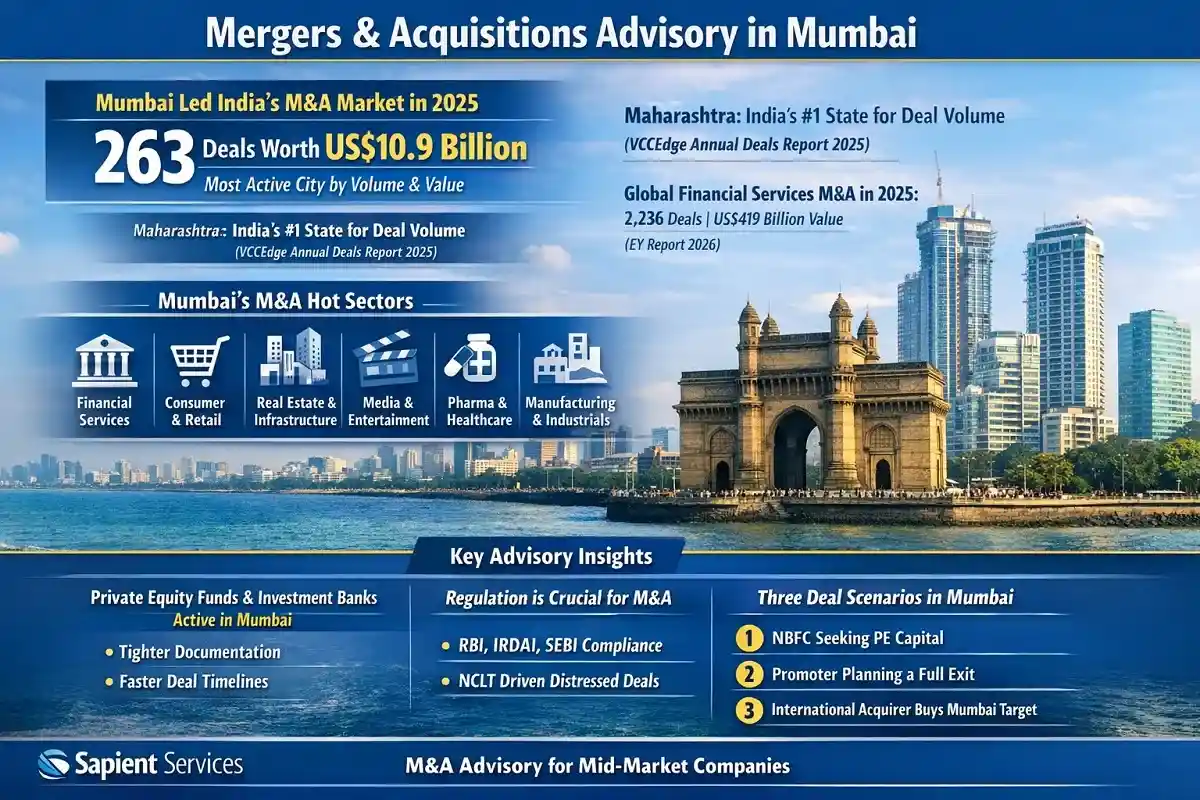
Mumbai led India’s M&A market in 2025 with 263 deals worth US$10.9 billion — the most active city nationally by both volume and value (VCCEdge Annual Deals Report 2025, February 2026). Maharashtra retained its position as India’s No. 1 state for deal volume for the second year running. The financial services sector globally ran at record pace in the same period: 2,236 financial services M&A deals were disclosed worldwide in 2025, with total value rising from US$282 billion to US$419 billion year-on-year (EY Global Financial Services M&A Report, January 2026).
What that means on the ground in Mumbai: the city’s PE funds, investment banks, family offices, and corporate development teams are actively running transactions. Both sides of deals — acquirers and sellers — have become more experienced. Documentation expectations are higher. Timelines are more compressed. And regulatory mapping — particularly for financial services transactions — has become a pre-condition, not an afterthought.
Sapient Services provides merger and acquisition advisory in Mumbai for mid-market companies, NBFCs, PE-backed businesses, consumer and manufacturing conglomerates, and media and real estate companies planning exits or acquisitions.
Mumbai’s Deal Profile by Sector
Sector | What Drives Transactions Here |
|---|
Financial Services (Banks, NBFCs, Insurance) | RBI’s ‘fit and proper’ requirements, IRDAI approvals, SEBI compliance for listed entities. The proposed increase in FDI limits for insurance to 100% is expected to generate significant consolidation if enacted (Lexology, India 2025). RBI’s November 2025 consolidation of 244 Master Directions has made NBFC compliance due diligence more detailed. |
Consumer, FMCG, Retail | PE-driven brand acquisitions, omnichannel consolidation, supply chain integrations. IP ownership, customer data, and distributor agreements are central to due diligence. |
Real Estate and Infrastructure | Asset-level transactions, NCLT-driven distressed acquisitions under IBC 2016. Mumbai NCLT bench is one of India’s most active insolvency courts. Title due diligence is intensive. |
Media and Entertainment | The Reliance-Disney merger in 2024, valued at US$8.5 billion, created India’s largest media company (Herbert Smith Freehills Kramer, Global M&A Report 2025). Smaller streaming, content, and OTT transactions remain active in Mumbai. |
Pharma, Healthcare, Diagnostics | Mumbai-based pharma CDMO and hospital chain transactions. Acquisitions involving CDSCO-licensed entities need regulatory standing review as part of due diligence. |
Manufacturing and Diversified | Mid-market manufacturers in chemicals, engineering, and FMCG. Promoter exit and succession-driven transactions with complex shareholding structures. |
Sapient’s M&A Advisory Work in Mumbai
Sell-Side: Transaction Structure Comes Before Documentation
A sell-side mandate in Mumbai almost always starts with a structural question, not a valuation question. What exactly is being sold — the operating company, a specific subsidiary, the IP holding entity, or the full group? Each structure carries different tax treatment, regulatory implications, and buyer risk perception. A share sale transfers all liabilities with the company. A slump sale transfers a specific undertaking. Getting this wrong costs months and sometimes the deal.
Sapient works through this with the promoter before any external party is involved. The analysis covers: capital gains tax impact on the seller for share sale vs slump sale, FEMA implications if foreign investors are on the cap table, promoter alignment if multiple families hold stakes, and whether any regulatory approvals (RBI, IRDAI, SEBI) apply to the ownership change.
Once structure is settled, the data room is built — financials, contracts, regulatory status, litigation, cap table. The Information Memorandum is prepared. And the buyer identification process is run: strategic acquirers from the relevant sector, PE funds with matching investment mandates, and family offices seeking control positions.
Buy-Side: Mumbai Financial Services Acquisitions
Buy-side work in Mumbai’s financial services sector is the most regulation-intensive advisory work Sapient does. An acquirer buying a significant stake in an NBFC must satisfy RBI’s ‘fit and proper’ criteria before the transaction closes. An acquirer of an insurance company stake needs IRDAI’s approval. And both transactions need to be structured so that governance rights the investor wants — board representation, information rights, reserved matters — are compatible with regulatory expectations for the specific entity type.
The November 2025 RBI consolidation replaced the 2016 KYC Master Direction and 9,445 older circulars with 244 entity-specific Master Directions. NBFC compliance due diligence now needs to work against these new directions. Acquirers who are still checking against the old framework will miss gaps.
IBC and Distressed Asset Acquisitions in Mumbai
Mumbai’s NCLT bench processes a significant volume of India’s insolvency cases. Distressed asset acquisitions under IBC 2016 are an active deal category in Mumbai — particularly in real estate, manufacturing, and some financial services segments. These transactions require careful due diligence: the resolution plan, NCLT approval process, existing secured creditor positions, and any operational liabilities that transfer with the asset all need to be assessed before bidding.
Regulatory Framework for Mumbai M&A
Regulator | When Applicable | What It Governs |
|---|
RBI | Acquisition of significant stake in bank or NBFC; cross-border transactions involving authorised dealers | Fit and proper criteria for significant shareholders; post-closing reporting; NBFC-specific compliance under new Master Directions (November 2025) |
IRDAI | Insurance company stake acquisitions above specified thresholds | Approval requirement; proposed 100% FDI limit increase pending enactment |
SEBI | Listed company acquisitions; intermediary registrations | Open offers under Takeover Code (SAST Regulations); insider trading compliance; LODR obligations during transaction period |
CCI | Transactions above Rs 2,500 crore assets / Rs 7,500 crore turnover; or deal value above Rs 2,000 crore with SBOI (from September 2024) | Anti-competitive effects review; 150-day maximum timeline; Green Channel for zero-overlap deals (21 of 124 filings used Green Channel between July 2024 and May 2025 — Chambers & Partners) |
NCLT | Mergers via scheme of arrangement under Companies Act 2013; IBC proceedings | Scheme approval; timelines typically 6-12 months for scheme mergers; IBC resolution plan approval |
FEMA (August 2024) | Any transaction involving foreign acquirer or Indian company investing abroad | Updated NDI Rules: share-for-share cross-border transactions now explicitly enabled; FC-TRS for secondary transfers within 60 days |
Three Deal Scenarios in Mumbai
Scenario 1: NBFC Seeking PE Capital
An NBFC in Mumbai bringing in PE capital needs to satisfy RBI’s ‘fit and proper’ criteria for new significant shareholders, negotiate governance rights within RBI’s permissible framework, and structure the investment so that the NBFC’s Scale-Based Regulatory (SBR) tier obligations are maintained post-investment. PE investors seeking observer appointments rather than full board representation have faced pushback from RBI on this — the governance terms need to be structured with RBI expectations built in from the start.
Scenario 2: First-Generation Mumbai Promoter Planning a Full Exit
A promoter planning to sell a Rs 200-500 crore Mumbai manufacturing or consumer business typically hasn’t run a formal sale process before. The preparation covers: three to five years of audited accounts, regulatory and labour law compliance clearance, customer and supplier contract review, resolution of any pending litigation, and a decision on share sale versus slump sale structure. Run well, this process takes 4-6 months before external buyers are approached. Run poorly, it takes two years with a failed process.
Scenario 3: International Acquirer Buying a Mumbai-Based Target
A foreign company acquiring a Mumbai technology or business services company uses the automatic FDI route (100% FDI allowed in technology and business services). The acquisition consideration is paid in foreign currency, requiring RBI reporting via FC-TRS within 60 days. If the deal value exceeds Rs 2,000 crore and the target has substantial India operations, CCI notification is required. Post-closing, transfer pricing documentation is needed for intra-group transactions. Sapient manages the Indian regulatory side; the international acquirer’s counsel covers their jurisdiction.
Questions from Mumbai M&A Professionals
1. What is the practical effect of the new CCI Deal Value Threshold on Mumbai deals?
From Sept 2024, deals above ₹2,000 crore with significant India nexus (10%+ users/GMV/turnover) need CCI approval. This impacts fintech and digital businesses heavily. Approval timelines range from 30 to 150 days.
2. How is an NBFC valued for a PE buyout?
NBFCs are mainly valued using P/BV multiples (1.5x–3x) based on asset quality, NIM, and capital strength. Stressed NBFCs rely on adjusted NAV. ROE helps assess if valuation is justified.
3. What did the August 2024 FEMA amendment change for cross-border deals?
It allows share-for-share deals between Indian and foreign companies. This enables cross-border mergers without cash, simplifying tax and repatriation issues. Both inbound and outbound deals benefit.
4. What is the Green Channel for CCI approval?
It offers automatic approval if there are no overlaps between parties. No waiting for CCI decision is required. Useful for unrelated or conglomerate transactions.
5. How does IBC distressed asset acquisition work in Mumbai?
Buyers bid for stressed companies through NCLT-approved resolution plans. Approved buyers get assets with liabilities handled under the plan. Due diligence is critical in such deals.
6. How has the Income-Tax Act 2025 affected M&A structuring?
Effective April 2026, it largely retains existing M&A tax rules. Capital gains and tax-neutral mergers continue. New deals should still be reviewed under the updated law.
7. What is a slump sale and when is it better than a share sale for a Mumbai seller?
A slump sale transfers a specific business unit, not the whole company. It helps ring-fence liabilities. Share sales transfer the entire entity, including licences and obligations.
8. What is the proposed insurance FDI increase and how would it affect Mumbai M&A?
FDI may rise to 100% from 74% in insurance. This could drive foreign acquisitions and consolidation. Full ownership without a local partner may become possible.