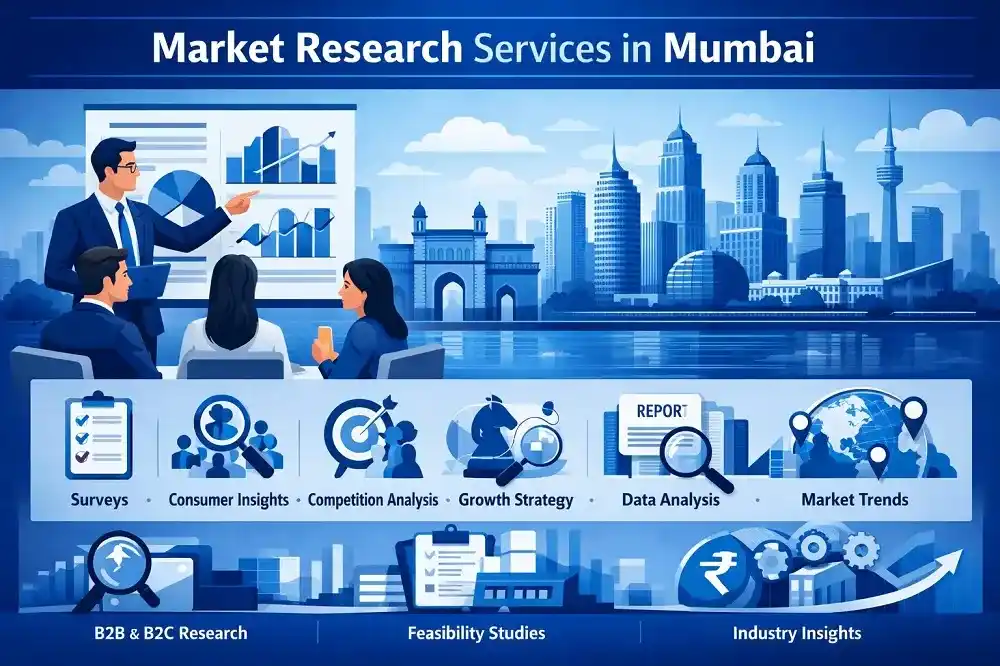
Sapient Services provides market research services in Mumbai for businesses that need evidence before they commit to a launch, a new location or an investment. Companies use the research to understand demand, customers, competitors and market conditions ahead of a commercial decision.
Our studies combine primary research with desk research from published sources. We collect data at field level across Mumbai and Maharashtra.
Share your research brief with our team and we will reply with a proposed approach and a scoped quote.
Quick Answer: Market research in Mumbai helps a business test demand, understand customers and compare competitors before it commits money. Sapient designs each study around the decision you need to make and reports the method and sample used. Send a brief and we will scope the study.
Market Research Services in Mumbai: What We Cover
The method depends on the question. A price question needs numbers from a survey. A question about why customers switch usually needs interviews.
| Method | Use It When | What You Receive |
|---|
| Customer surveys | You need figures on customer behaviour, preferences or usage | Tabulated results with the sample described |
| Structured and expert interviews | You need the reasoning of buyers or industry stakeholders | Themes with anonymised quotes |
| Competitor analysis | You need to compare offers, pricing and positioning | A comparison grid with sources |
| Demand analysis and market size estimates | You need to know how much demand exists and where it comes from | Estimates with the assumptions shown |
| Secondary and desk research | You need industry and trend background before spending on fieldwork | A source-referenced desk review |
| Feasibility and market entry research | You are deciding whether to enter or expand | A written assessment of what the findings mean for that decision |
Who Uses Market Research in Mumbai
Companies Entering Mumbai
Companies entering Mumbai from another city or country need to know how local buyers choose, what they pay and which competitors already hold the shelf or the contract. Entry research answers that before a lease or a hire is signed. If entry happens through a deal, our M&A advisory services in Mumbai cover the transaction side.
Businesses Choosing a Location
Catchment, competitor presence and customer profile change from one part of the city to the next. A location study compares candidate sites on that evidence before you commit to one.
Teams Testing a Product or Offer
A survey or a small set of interviews shows whether a concept holds up with the people expected to buy it, before production or a campaign.
Founders Preparing for Lenders or Investors
Lenders and investors often want a credible market section, and we can prepare one. For a lender-ready project report, see our DPR services in Mumbai. For a full techno-economic review, see our TEV study services in Mumbai. If the business itself needs a value, see our business valuation services in Mumbai.
How a Market Research Study Works
- Brief. We start with the decision you face, the budget and the date you need answers by.
- Design. We choose the methods, define who should be interviewed or surveyed, set the sample and write the questionnaire or discussion guide.
- Data Collection. Surveys and interviews run with the respondents defined in the design, across the agreed areas of Mumbai and Maharashtra.
- Analysis. Results are cut by the customer groups and areas that matter to your decision and compared with secondary sources.
- Report and Discussion. You receive a written report and a call to walk through it and agree next steps.
The schedule depends on the method and sample. Your proposal states it before you commit.
What You Receive
- A written report with the research question, method, sample and limits stated up front
- Findings organised around your decision. Depending on the scope, they can support a recommendation to enter, adjust the plan or defer
- Tables and charts for internal decisions and, where the data sources and engagement terms allow, for investor or lender material
- Where the agreed scope includes it, the questionnaire or discussion guide, which can support later research or tracking
- A walkthrough call to answer questions
Researching Mumbai and the Wider Region
Mumbai is wider than the island city. Customers, offices and trade spread across Greater Mumbai and the wider Mumbai Metropolitan Region, and commercial districts such as BKC, Andheri, Lower Parel and Nariman Point serve different customer groups. A sample drawn from one district can miss most of that range, so a good study sets quotas by area and customer group and states how respondents were reached.
Studies centred on the capital are covered on our Delhi market research page.
Data Protection and Research Standards
Research involving personal data should be planned with India’s Digital Personal Data Protection Act, 2023 in mind. The DPDP Rules were notified on 13 November 2025, and the main duties for businesses, including notice and consent, take effect on 13 May 2027. The Act’s exemption for research is partial, so which obligations apply depends on the purpose and nature of the processing. MRSI has published a guide to the Act for the research industry.
The Market Research Society of India adopted the ICC/ESOMAR 2025 Code and applies it to its members from 1 April 2026. The Code says researchers should limit personal data to what is reasonable and directly relevant to the purpose of the research, and give participants clear information about that purpose and about how long their data will be kept.
Ask any research provider, including us, to state in writing how respondent data is collected, used and stored.
Choosing a Market Research Company in Mumbai
The approaches below solve different problems. Pick the one that fits your decision.
| Approach | Works Well For | Limits |
|---|
| Desk research only | Early orientation and market background | No evidence from your own customers or trade |
| Survey only | Measuring preferences and price response across many people | Gives numbers without the reasons behind them |
| Custom primary study with secondary checks | Entry, location, pricing and investment decisions | Costs more and takes longer than a desk review |
Before you hire a market research company or agency, ask who does the fieldwork, how respondents are screened, how large the sample is and why, and how data is stored. Ask to see a sample report.
What Affects the Cost of Market Research
We do not publish a fixed price because the scope sets it. These factors move the quote.
| Factor | Why It Changes the Price |
|---|
| Sample size | More respondents mean more fieldwork and more analysis |
| Respondent type | Senior decision makers cost more to reach than general consumers |
| Method | Interviews need more time per respondent than surveys |
| Geography | Covering several parts of the region adds fieldwork |
| Language | Interviews in more than one language need matched interviewers |
| Depth of analysis | Demand estimates take longer than a summary of results |
| Deadline | Compressed schedules reduce what can be checked |
Common Mistakes That Weaken Research
Check each of these before fieldwork starts.
- The question was never tied to a decision, so the report answers something nobody asked.
- Survey questions lead respondents toward the answer the client hopes for.
- One area or one contact list is treated as the whole market.
- Published figures from another city stand in for Mumbai.
- Price is asked about directly, with no way to see what people actually choose.
Frequently Asked Questions
What Do Market Research Services in Mumbai Include?
They cover the work needed to answer a business question about the city: surveys, interviews, competitor analysis, demand analysis and market entry assessments. The mix depends on your decision, and the proposal confirms the methods before fieldwork begins.
How Much Does Market Research Cost in Mumbai?
There is no standard price. The cost depends on sample size, the type of respondents, the method, the areas covered, languages and the deadline. Share your brief and we will send a scoped proposal with the cost for that study.
How Long Does a Market Research Study Take?
The time depends on the method and sample. A desk review is shorter than a study with surveys or interviews, and hard-to-reach respondents add time. The proposal states the expected schedule.
What Is the Difference Between Primary and Secondary Research?
Primary research is new data collected from your own customers or industry stakeholders through surveys and interviews. Secondary research uses information that already exists, such as government statistics and industry reports. Most useful studies combine the two.
What Is the Difference Between Qualitative and Quantitative Research?
Quantitative research counts. It uses surveys to measure how many people prefer, buy or pay for something. Qualitative research explains why people choose as they do, usually through interviews. Many studies use interviews first to shape the survey questions and then a survey to measure the answers.
How Many Respondents Do I Need?
It depends on the question and on how finely you want to split the results. A study that compares four customer groups needs enough people in each group. Interview studies use far smaller numbers because they look for reasons, not percentages. The sample is recommended during design, with the reasoning.
What Does Market Entry Research for Mumbai Cover?
It looks at demand and customer profile, competitors and their pricing, the routes to reach buyers, and the risks the findings show. Depending on the scope, the findings can support a decision to enter, adjust the plan or wait.
Can You Research Business Buyers as Well as Consumers?
Yes. Structured interviews with industry stakeholders suit business customers, because that group is small and hard to survey. Consumer surveys cover the other side of the market.
How Is Respondent Data Protected?
Research involving personal data should be planned with the DPDP Act, 2023 in mind, and its main duties for businesses take effect on 13 May 2027. Ask for the data-handling terms in writing before a study starts, and expect them to cover how data is collected, used and stored.
Can the Research Support a Loan or Investor Presentation?
Often yes, as the market section of a business plan or information memorandum. Lenders and investors set their own requirements, so share them early and we will shape the report to fit.
What Is the Difference Between Market Research and a Feasibility Study?
Market research tells you about demand, customers and competitors. A feasibility study also tests whether the project works financially and operationally. Market research is often one input into a feasibility study.
Talk to Us About Market Research in Mumbai
Send us the decision you need to make and the date you need it by. A short brief covers the product or service, the customers you care about, the areas of Mumbai in scope and your budget range. Add your sector if you like, so the study fits its buyers and sales channels.
Sapient Services is based in New Delhi, and we will reply with a proposed approach and a scoped quote. Reach our team through the contact details on this page.