SAP S/4HANA Migration Services in India

SAP Consulting Services in India

Most Indian mid-market companies don’t struggle with SAP because they don’t understand the software. They struggle because the implementation was done without enough attention to how Indian business processes — GST, e-invoicing, TDS, IND-AS reporting — actually map into SAP’s configuration. A system that runs perfectly in a global template but can’t generate a valid e-invoice for the IRP portal, or that computes GST wrong on stock transfers between states, is worse than useless. It creates compliance exposure while giving management the false comfort that the system is working.

Sapient Services provides SAP consulting and ERP implementation support for manufacturing companies, trading enterprises, NBFCs, infrastructure businesses, and corporate groups across India. The focus is functional accuracy, Indian compliance configuration, and implementations that hold up after go-live — not just during it.

The Landscape for SAP in India Right Now

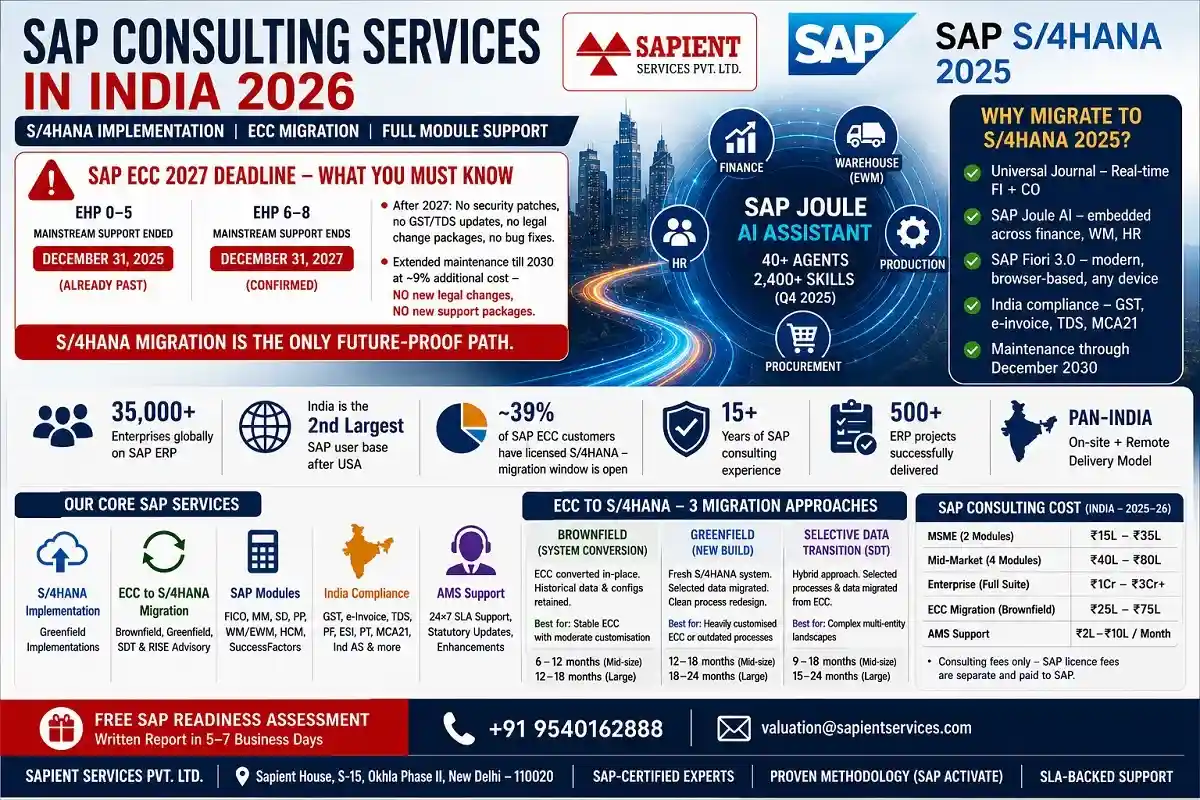
Two things are driving most SAP activity in India in 2025-26. First, the SAP ECC end-of-mainstream-maintenance deadline of December 31, 2027. Companies still on ECC need a migration plan. Extended support runs through 2030 but at a significant premium — and the longer a company defers S/4HANA migration, the harder the eventual transition becomes as ECC customisations accumulate.

Second, NASSCOM data shows that over 65% of Indian enterprises plan to migrate core applications to cloud ERP platforms, and SAP-certified consulting partners are essential to data migration and process restructuring at scale. SAP’s August 2025 announcement of SAP Cloud ERP — the cloud-first successor platform integrating SAP Business AI, SAP Business Data Cloud, and SAP Build under a clean-core architecture — makes the migration conversation even more urgent for companies on older ECC versions.

In India specifically, the compliance configuration layer is non-negotiable. GST, TDS, TCS, e-invoicing under CBIC’s IRP mandate (mandatory for companies with aggregate turnover above Rs 5 crore in the preceding financial year as per CBIC Notification 10/2023-CT), IND-AS financial reporting, and integration with government portals all require configuration that a standard global SAP template won’t handle correctly.

Sapient’s SAP Consulting Services

SAP S/4HANA Implementation

End-to-end S/4HANA implementation for companies going live on SAP for the first time (Greenfield) or migrating from legacy systems including SAP ECC (Brownfield/System Conversion). Sapient uses the SAP Activate methodology — the standard SAP implementation framework — across all phases: Discover, Prepare, Explore, Realise, Deploy, and Run. The methodology includes fit-to-standard workshops to reduce unnecessary customisation, keeping the system closer to SAP standard for easier future upgrades.

SAP ECC to S/4HANA Migration

Migration approach selection is the most critical decision in an ECC-to-S/4HANA project. System Conversion (Brownfield) preserves existing configuration and data with minimum disruption — right for stable businesses that want to migrate without redesigning processes. New Implementation (Greenfield) starts fresh — right when the business has changed significantly since the original ECC implementation. Selective Data Transition is a middle path, migrating selective data to a new S/4HANA system. Sapient helps companies assess which route is appropriate based on ECC customisation depth, data quality, and transformation objectives.

RISE with SAP Advisory

RISE with SAP is SAP’s subscription-based package that bundles S/4HANA Cloud Private Edition with SAP Business Technology Platform (BTP) access, cloud infrastructure, and transformation services under a single contract. For Indian companies considering moving to managed cloud rather than hosting SAP on-premises, RISE with SAP removes infrastructure management complexity. Sapient advises on whether RISE with SAP is the right commercial model for a given company’s size, IT maturity, and customisation requirements — it suits some businesses very well and others not at all.

Finance and Controlling (FICO)

FICO is where most SAP implementations create the most persistent problems when done incorrectly. Chart of accounts, controlling area design, cost centre and profit centre hierarchy, GST tax procedure configuration, TDS/TCS withholding tax setup, IND-AS parallel ledger for listed companies, and integration with bank reconciliation — all of these must be right from the start. Sapient’s FICO consultants configure these with Indian regulatory requirements built in, not added as an afterthought.

Materials Management and Production Planning (MM / PP)

For manufacturing and trading companies, MM covers the procurement cycle from purchase requisition to goods receipt to invoice verification — with GST-compliant invoice processing built in. PP covers production orders, bill of material management, work-in-progress tracking, and capacity planning. For process manufacturing environments (pharmaceuticals, chemicals, food), SAP PP-PI (Process Industries) handles batch management, production recipes, and quality integration specific to regulated industries.

SAP Application Management Services (AMS)

Post-go-live, most companies need ongoing support: incident resolution, configuration updates for regulatory changes (new GST notifications, revised TDS rates, CBIC e-invoicing changes), period-end and year-end closing support, and module rollouts when the business expands. Sapient provides AMS on retainer or per-incident — covering both technical and functional support for live SAP landscapes.

India-Specific SAP Configuration — The Key Areas

Compliance Requirement

SAP Module

What Gets Configured

e-Invoicing (IRP integration)

FICO / MM / SD

IRN generation, QR code embedding, GSTIN validation, automated push to CBIC Invoice Registration Portal

GST (CGST, SGST, IGST, Compensation Cess)

FICO / SD / MM

Tax determination logic, condition types, inter-state vs intra-state rules, GSTR-1 and 3B extraction

TDS / TCS (multiple sections)

FICO

Withholding tax types and codes, section-wise deduction logic, challan generation, Form 26Q data extraction

IND-AS financial reporting

FICO (Asset Accounting, GL)

Parallel ledger for IND-AS, Schedule II depreciation, IND-AS 116 lease accounting, IND-AS 109 financial instruments

Payroll — PF, ESIC, Professional Tax

SAP HCM

PF contribution logic, ESIC wage ceiling, state-wise Professional Tax slabs

Fixed Assets — Companies Act 2013

SAP Asset Accounting

Schedule II useful life tables, WDV/SLM depreciation, block assets, disposal accounting

Why Sapient’s SAP Implementations Hold Up

Most SAP implementation problems surface 6-12 months after go-live — not during it. Period-end closing fails because cost centre hierarchies weren’t set up correctly. GSTR-1 data doesn’t match because tax procedure was configured without testing all transaction types. User adoption drops because training was rushed in the final week before go-live.

Sapient structures implementations to prevent this: fit-to-standard workshops identify configuration gaps before development begins, user acceptance testing covers Indian compliance transactions specifically (not just global test scenarios), and go-live support includes the first two GST return cycles to catch any reconciliation issues while consultants are still on-site.

7 Questions on SAP Consulting in India

1. What is the difference between SAP ECC and SAP S/4HANA?

SAP ECC (ERP Central Component) is SAP’s older platform running on traditional relational databases. SAP S/4HANA runs on the HANA in-memory database, which enables significantly faster processing and embedded analytics. S/4HANA also simplifies data models — for example, the Finance module (New GL) in S/4HANA replaces multiple reconciliation accounts with a single table, eliminating most period-end reconciliation work. SAP mainstream maintenance for ECC ends December 31, 2027.

2. What is SAP Activate and why does it matter?

SAP Activate is SAP’s structured implementation methodology. It divides the project into six phases: Discover, Prepare, Explore, Realise, Deploy, and Run. The Explore phase includes fit-to-standard workshops where the client sees standard SAP processes and decides whether to adapt their processes to SAP standard (reducing customisation) or request gaps to be developed. Implementations that skip rigorous fit-to-standard tend to over-customise early and then struggle with upgrades and maintenance.

3. How long does a full S/4HANA implementation take for a mid-sized company?

For a manufacturing or trading company implementing FICO, MM, PP, and SD, a full S/4HANA project typically takes 8-14 months. Timeline depends on scope, quality of existing master data, degree of process standardisation the company is willing to accept, and user readiness. Phased implementations — Finance live first, then Operations — reduce risk at the cost of extending overall project duration.

4. What is RISE with SAP and is it right for every company?

RISE with SAP is a subscription package combining S/4HANA Cloud Private Edition, Business Technology Platform access, and cloud infrastructure services. It suits companies that want to move to a managed cloud model and avoid internal IT infrastructure management. It is less suitable for companies with very heavy customisation requirements or strict data sovereignty needs. Sapient advises on the RISE vs traditional on-premises decision based on the specific company’s profile.

5. Can the existing SAP ECC system handle Indian e-invoicing without migrating to S/4HANA?

Yes. SAP has released GST and e-invoicing add-ons and support notes for ECC. The IRP integration for e-invoice generation can be configured in both ECC and S/4HANA. However, ECC’s e-invoicing configuration is less native and requires more ongoing maintenance as CBIC updates the IRP schema. Companies remaining on ECC past 2027 will face increasing manual effort to keep compliance configuration current.

6. What does SAP AMS cover and when should a company move to an AMS model?

Application Management Services covers ongoing SAP support after go-live: incident resolution, regulatory update configuration (new GST rates, revised e-invoicing schema, TDS amendments), functional enhancements, period-end and year-end closing support, and user training. A company should move to a structured AMS arrangement once the implementation is stable — typically 2-3 months after go-live — rather than relying on the implementation team in an unstructured way.

7. What is SAP BTP and when does a company need it?

SAP Business Technology Platform (BTP) is the development and integration platform for extending SAP S/4HANA under SAP’s clean-core architecture. If standard SAP cannot handle a specific business requirement, BTP extensions are built instead of ABAP modifications to the core system. This keeps the core clean and upgradeable. BTP is used for: custom dealer/customer portals that integrate with SAP, integrations with non-SAP applications (banking APIs, logistics platforms), and advanced analytics that go beyond standard SAP reports.

GET IN TOUCH

Please take a moment to fill out the form.

    Sapient Services is focused on providing startup services, valuation services, transaction advisory, and due diligence services. Our team comes from various professional service backgrounds and draws on experience from different geographical regions. 

    Contact Info

    Let us help you get your project started.

    Contact

     +44(0)20 3156


     +1 866 512 0268

    Start your project