- Home
- About Us
- Service Locations
- Service in Delhi
- Due Diligence Services in Delhi
- Fire Safety Audit Services in Delhi
- Claims Management Services in Delhi
- Mergers & Acquisition Advisory Services in Delhi
- Techno-Economic Viability (TEV) Study Services in Delhi
- Pre-Dispatch Inspection Service in Delhi
- Valuation of Stressed Assets Services in Delhi
- Business Valuation Services in Delhi
- Stock Audit Services in Delhi
- EPCG Certification and Consultancy Services in Delhi
- Services in Mumbai
- Due Diligence Services in Mumbai
- Business Valuation Services in Mumbai
- Stock Audit Services in Mumbai
- Mumbai Plant & Machinery Valuation by Certified Engineers
- IPO Advisory Services in Mumbai
- Detailed Project Report (DPR) Service in Mumbai
- TEV Study Services in Mumbai
- Market Research Services in Mumbai
- Mergers & Acquisitions Services in Mumbai
- Valuation of Immovable Property Services in Mumbai
- Services in Bangalore
- Services in Hyderabad
- Services in Ahmedabad
- Services in Chennai
- Service in Delhi
- Our Services
- Chartered Engineering Services
- Business Consulting Service
- Valuation Advisory Services
- Valuation of Immovable Property
- Valuation of Plant and Machinery
- Valuation of Intangible Assets, Delhi NCR
- Business Valuation Services
- Aviation Valuation
- Valuation Of Financial Assets Services
- Valuation for Insolvency and Bankruptcy Code 2016
- Valuation of Stressed Assets Services
- Valuation for Financial Reporting
- Valuation of Reinstatement Value
- Insurance Advisory Services
- Careers
- Our Team
- Clients
- Blog
- Contact
- Home
- About Us
- Service Locations
- Service in Delhi
- Due Diligence Services in Delhi
- Fire Safety Audit Services in Delhi
- Claims Management Services in Delhi
- Mergers & Acquisition Advisory Services in Delhi
- Techno-Economic Viability (TEV) Study Services in Delhi
- Pre-Dispatch Inspection Service in Delhi
- Valuation of Stressed Assets Services in Delhi
- Business Valuation Services in Delhi
- Stock Audit Services in Delhi
- EPCG Certification and Consultancy Services in Delhi
- Services in Mumbai
- Due Diligence Services in Mumbai
- Business Valuation Services in Mumbai
- Stock Audit Services in Mumbai
- Mumbai Plant & Machinery Valuation by Certified Engineers
- IPO Advisory Services in Mumbai
- Detailed Project Report (DPR) Service in Mumbai
- TEV Study Services in Mumbai
- Market Research Services in Mumbai
- Mergers & Acquisitions Services in Mumbai
- Valuation of Immovable Property Services in Mumbai
- Services in Bangalore
- Services in Hyderabad
- Services in Ahmedabad
- Services in Chennai
- Service in Delhi
- Our Services
- Chartered Engineering Services
- Business Consulting Service
- Valuation Advisory Services
- Valuation of Immovable Property
- Valuation of Plant and Machinery
- Valuation of Intangible Assets, Delhi NCR
- Business Valuation Services
- Aviation Valuation
- Valuation Of Financial Assets Services
- Valuation for Insolvency and Bankruptcy Code 2016
- Valuation of Stressed Assets Services
- Valuation for Financial Reporting
- Valuation of Reinstatement Value
- Insurance Advisory Services
- Careers
- Our Team
- Clients
- Blog
- Contact
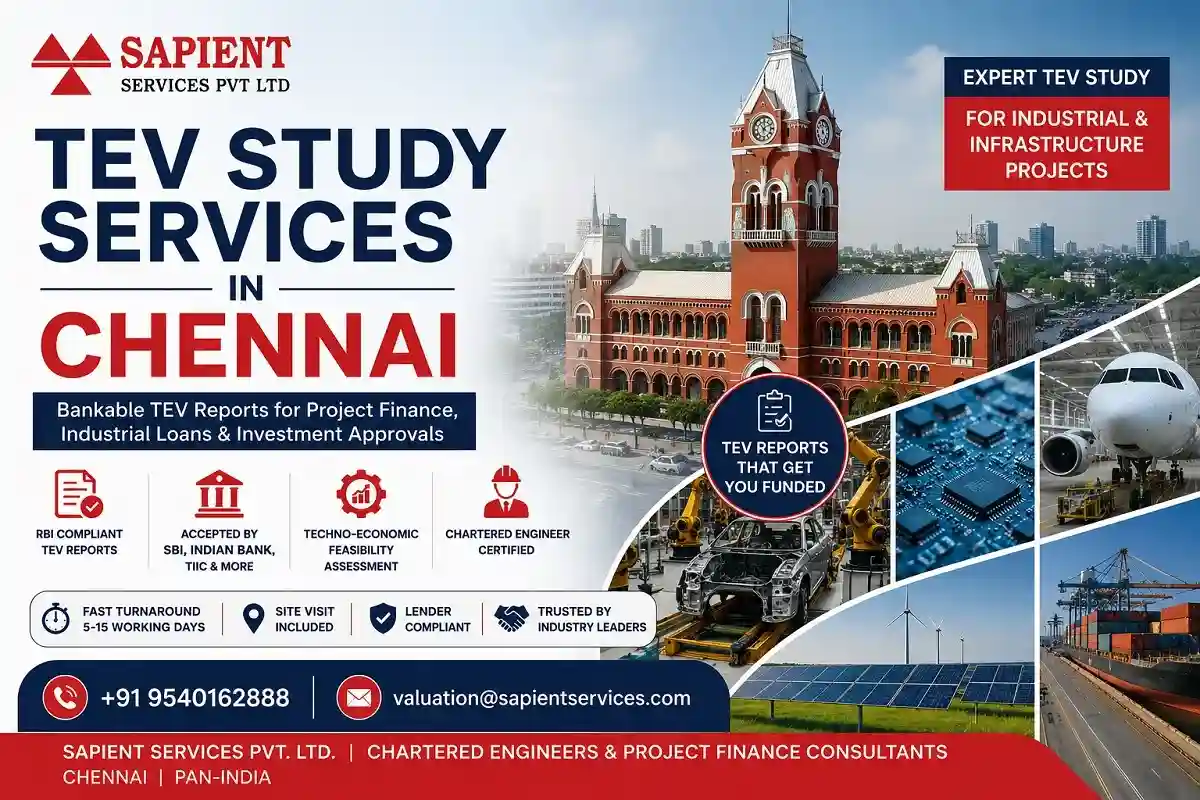
Chennai is in the middle of its largest industrial investment cycle in decades. Tamil Nadu received ₹311 billion in FDI in FY2024–25. Hitachi Energy announced a ₹2,000 crore expansion of its Chennai facility in October 2025. Dixon Technologies committed ₹1,000 crore for a laptop manufacturing plant at Oragadam. Mazagon Dock and Cochin Shipyard together committed ₹300 billion for Chennai shipyard projects. Every one of these — and hundreds of smaller manufacturing, renewable energy, and infrastructure projects in the pipeline — requires a project finance appraisal before a bank will disburse.
Under RBI Project Finance Directions 2025 (Circular RBI/2025-26/59, effective October 1, 2025), a Techno-Economic Viability (TEV) study is mandatory where aggregate lender exposure on a project equals or exceeds ₹100 crore. Below this threshold, individual bank policies apply — SBI, Indian Bank, Indian Overseas Bank, TIIC (Tamil Nadu Industrial Investment Corporation), and SIDBI all require bankable TEV reports for project loans above their internal thresholds.
Sapient Services prepares TEV studies for Chennai projects — Chartered Engineer-certified, bank-format compliant, covering technical feasibility, market assessment, project cash flow modelling, DSCR analysis, and regulatory clearance mapping.
| Request a Chennai TEV Study Quote → valuation@sapientservices.com | +91 9540162888 |
TEV Study in Chennai — Quick Reference
| What | A TEV (Techno-Economic Viability) study independently assesses a project’s technical soundness and financial viability — required by banks and financial institutions before sanctioning project finance or term loans. |
| RBI Mandate | RBI Project Finance Directions 2025 (Circular RBI/2025-26/59, effective Oct 1, 2025): TEV mandatory where aggregate lender exposure ≥ ₹100 crore. Below this, individual bank policies apply — many Chennai lenders require TEV from ₹5 crore onwards. |
| Chennai Sectors | Automotive and auto components, electronics and semiconductors, aerospace and defence (TNDIC corridor), IT and GCC, renewable energy, healthcare, logistics and port-based industries. |
| What Sapient Delivers | Chartered Engineer-prepared bankable TEV reports in formats required by SBI, Indian Bank, Indian Overseas Bank, TIIC, SIDBI, and other lenders — covering technical assessment, market analysis, financial viability, and risk evaluation. |
| Turnaround | Standard: 10–15 working days. Urgent: 5–7 working days. On-site visit to project location included. |
Sector-by-Sector TEV Study Requirements — Chennai
Chennai’s industrial base is more diversified than most Indian cities — automotive, electronics, aerospace, IT, healthcare, and port-based logistics all operate at scale. Each sector carries distinct technical, regulatory, and market variables that determine the scope and complexity of a techno-commercial feasibility study.
| Sector | Active Projects Requiring TEV in 2025–26 | TEV-Specific Technical Focus |
|---|---|---|
| Automotive & Auto Components | EV transition investments — new component manufacturing for EV OEMs at Oragadam, Sriperumbudur; capacity expansion for Tier-1 suppliers | Technology transition from ICE to EV components, OEM supply contract viability, installed capacity utilisation, power infrastructure for EV manufacturing |
| Electronics & Semiconductors | Dixon Technologies ₹1,000 crore laptop plant at Oragadam; Kaynes Circuits ₹49.95 billion electronics plant; PCB and semiconductor packaging projects | Technology supplier credentials, yield rates for electronics manufacturing, cleanroom requirements, import dependency assessment for components |
| Aerospace & Defence (TNDIC) | Aerospace & Defence Park at Sriperumbudur — 700 acres, 30 aerospace firms; defence corridor projects across Chennai, Hosur, Salem, Tiruchirappalli | MoD supply contract viability, technology transfer obligations, government programme dependency, defence FDI compliance — each affecting DCCO and revenue projections |
| Renewable Energy | Sembcorp ₹213.4 billion renewable investment; offshore wind projects; rooftop solar for industrial consumers at Oragadam and Mahindra World City | Grid connectivity and power evacuation viability, yield assessment, off-take agreement credibility, technology supplier track record |
| Healthcare & Pharma | Hospital capacity expansion, medical device manufacturing, pharma formulation plants in Chennai suburban zones | CDSCO and NABH regulatory clearance timelines, doctor/specialist recruitment risk, technology supplier validation for medical devices |
| Logistics & Port-Adjacent | Cold chain, warehousing, 3PL facilities near Chennai Port, Kattupalli Port, Ennore Port | Port connectivity and hinterland access, warehouse lease vs build economics, customs bond and FSSAI compliance costs for cold chain |
Three TEV Complexities Unique to Chennai Projects
1. EV Transition Risk in Automotive Projects
Chennai is India’s automotive capital — Hyundai, Renault-Nissan, BMW, TVS, and Ashok Leyland all manufacture here. As automotive OEMs shift toward EVs, auto component suppliers face technology transition risk that directly affects TEV conclusions. A supplier manufacturing ICE engine components who is seeking project finance to add capacity must answer: will the OEM’s EV transition timeline reduce demand for this component before the loan is repaid?
This is not a standard market assessment — it requires an assessment of the OEM’s published electrification roadmap, the component’s EV applicability, and the borrower’s transition plan. A TEV study that ignores EV transition risk for a Chennai automotive project is incomplete from a lender’s perspective.
2. Aerospace and Defence Projects — DCCO and Programme Risk
The Tamil Nadu Defence Industrial Corridor (TNDIC) has secured ₹23,000 crore in investments across five nodes including Chennai and Sriperumbudur, with a ₹75,000 crore target by 2032. Aerospace and defence projects financed by banks face a distinct risk: revenue is often dependent on a single government programme or defence contract, and DCCO (Date of Commencement of Commercial Operations) is tied to programme timelines that can shift by 12–24 months.
A bankable TEV for a defence or aerospace project must assess programme risk explicitly — what happens to debt servicing capability if the primary government contract is delayed by 18 months? Under RBI Project Finance Directions 2025, DCCO extension triggers mandatory revalidation of project viability, making this assessment essential at the time of original sanction.
3. Port-Adjacent Projects — Infrastructure Dependency Mapping
Chennai Port, Kattupalli Port, and Ennore Port create a concentration of logistics and industrial projects in the northern Chennai corridor. Project feasibility for a cold chain facility, container freight station, or port-adjacent warehouse depends heavily on port connectivity timelines, traffic volumes, and customs facilitation — infrastructure dependencies that are external to the project but directly affect revenue projections.
A TEV for a port-adjacent project must map these infrastructure dependencies and assess what happens to the project’s DSCR if connectivity improvements are delayed or port traffic volumes are lower than projected.
What Sapient’s TEV Study Covers for Chennai Projects
Technical Feasibility Assessment
On-site visit to the project location — Oragadam, Sriperumbudur, Ambattur Industrial Estate, Padi, Mahindra World City, or anywhere in Tamil Nadu. Assessment covers: plant layout, technology selection and supplier credentials, installed capacity vs projected utilisation, utilities availability, and implementation schedule realism. For electronics manufacturing, cleanroom specifications and process yield assumptions are separately assessed. For automotive EV projects, technology readiness level and transition timeline are evaluated.
Market and Demand Assessment
For Chennai projects, market assessment must account for both domestic and export demand — Chennai’s port access makes export viability a realistic revenue component for electronics, automotive parts, and industrial goods. Assessment covers demand-supply dynamics, pricing benchmarks, OEM/anchor customer relationships, contract transferability risk, and export incentive structures (PLI schemes applicable to the sector) that affect revenue projections.
Financial Viability — DSCR, Sensitivity, Stress Testing
Independent verification of the financial model. Key outputs:
- DSCR — a DSCR below 1.25x typically results in loan rejection; lender comfort range is 1.25x–1.50x depending on sector and tenor
- Sensitivity analysis — DSCR under 10–15% cost overrun, 10% price reduction, 6-month DCCO delay — mandatory for all Chennai project TEV studies
- IRR and NPV — assessed against Chennai sector benchmarks for investment feasibility
- Break-even capacity utilisation — at what utilisation level does the project generate enough cash to service its debt
Regulatory Clearances — Tamil Nadu Specific
Status mapping of required clearances: factory licence, environmental clearance from TNPCB (Tamil Nadu Pollution Control Board), consent to establish (CTE) and consent to operate (CTO), fire NOC, TIDCO and SIPCOT approvals for industrial estate projects, and sector-specific licences (drug manufacturing, medical device, defence production). Banks require a clearance mapping with timelines before first disbursement.
Risk Assessment and Mitigation
Structured project risk evaluation covering technology risk, market risk (including EV transition risk for automotive and programme risk for aerospace), construction and implementation risk, regulatory risk, and financial risk. Each risk is rated by probability and severity, with available mitigations assessed — in the format that Tamil Nadu banks’ credit appraisal committees expect.
Report Format — What Lenders in Chennai Receive
| Sapient’s TEV reports are prepared in the format required by the commissioning lender. For SBI, the report follows SBI’s TEV submission format. For TIIC (Tamil Nadu Industrial Investment Corporation), SIPCOT-backed financing, and Indian Bank or Indian Overseas Bank, format is customised to the lender’s submission requirements. All reports are certified by a qualified Chartered Engineer. |
| Report Section | Purpose in Credit Appraisal |
|---|---|
| Executive Summary | 2–3 page summary for credit committee — project overview, key financial ratios, TEV conclusion |
| Technical Assessment | Site visit findings, technology evaluation, capacity, EV/programme risk (sector-specific), implementation timeline |
| Market Assessment | Demand-supply, pricing, OEM/anchor customer analysis, export viability, PLI scheme applicability |
| Financial Projections | Independent DSCR, ICR, IRR, NPV, break-even, sensitivity analysis — stress-tested |
| Regulatory Clearance Map | TNPCB approvals, TIDCO/SIPCOT clearances, sector licences — status and timelines |
| Risk Assessment | Risk register with EV transition / programme risk flagged for relevant Chennai sectors |
| TEV Conclusion | Viable / Viable with conditions / Not viable — with supporting rationale for credit committee |
Lenders Sapient Prepares TEV Reports For — Chennai
Chennai projects access project finance from national PSU banks, Tamil Nadu-specific financial institutions, and development finance institutions. Sapient customises the TEV report format for each lender’s submission requirements:
| Lender | Type | TEV Requirement Context |
|---|---|---|
| SBI (State Bank of India) | National PSU — largest project finance lender | SBI-format TEV required for project loans; specific technical annexures for manufacturing |
| Indian Bank | Chennai-headquartered PSU bank | Leading lender for Tamil Nadu MSME and industrial projects; TEV in IBA/CMA format |
| Indian Overseas Bank | Chennai-headquartered PSU bank | Active in TN industrial lending; TEV required for manufacturing project loans |
| TIIC (Tamil Nadu Industrial Investment Corporation) | State DFI — Tamil Nadu government | TEV / DPR required for term loans; TIIC-specific format and subsidy scheme documentation |
| SIDBI | Development finance for MSMEs | TEV required for MSME project finance above threshold; cluster-specific formats for TN textile and auto component MSMEs |
| Bank of Baroda / PNB / Canara Bank | National PSU lenders | Active in large Chennai industrial project finance; TEV in bank-specified format |
| Get a TEV Study Quote in 24 Hours → valuation@sapientservices.com | +91 9540162888 |
TEV Study Fees — Chennai
Fees depend on project type, loan amount, sector complexity, and deliverable format. All figures are indicative — firm quote after initial project discussion at no charge.
| Project Type | Indicative Fee Range |
|---|---|
| Manufacturing project (₹5–25 crore loan) | ₹25,000 – ₹75,000 |
| Manufacturing project (₹25–100 crore loan) | ₹75,000 – ₹1,50,000 |
| Electronics / Aerospace / Defence project | ₹1,00,000 – ₹2,50,000+ (technical complexity) |
| Renewable energy project | ₹50,000 – ₹1,50,000+ |
| Healthcare / Pharma project | ₹75,000 – ₹2,00,000+ |
| Port-adjacent / Logistics infrastructure | ₹75,000 – ₹2,00,000+ |
| Stressed project / NPA revalidation | ₹1,00,000 – ₹3,00,000+ (scope-dependent) |
| TEV update / revalidation of existing report | ₹20,000 – ₹75,000 |
Frequently Asked Questions
Q1. What is a TEV study and when is it required for Chennai projects?
A TEV (Techno-Economic Viability) study is an independent assessment of a project’s technical soundness and financial viability, prepared for a bank or financial institution before loan sanction. Under RBI Project Finance Directions 2025 (effective October 1, 2025), it is mandatory where aggregate lender exposure equals or exceeds ₹100 crore. Many Chennai lenders require bankable TEV reports for project loans from ₹5 crore onwards under their internal credit policies.
Q2. Which lenders in Chennai accept Sapient’s TEV reports?
Sapient prepares TEV reports in the format required by the commissioning lender — SBI, Indian Bank, Indian Overseas Bank, TIIC (Tamil Nadu Industrial Investment Corporation), SIDBI, Bank of Baroda, and other scheduled banks operating in Chennai and Tamil Nadu. Reports are customised to each lender’s submission format and certified by a qualified Chartered Engineer.
Q3. What is TIIC and how does it differ from a commercial bank TEV requirement?
TIIC (Tamil Nadu Industrial Investment Corporation) is the state government’s development finance institution, providing term loans to medium and large industries in Tamil Nadu. TIIC requires a TEV or DPR as part of its appraisal — format and scope may differ from commercial bank requirements. Sapient prepares TIIC-format TEV reports alongside DPR documentation for state scheme applications.
Q4. How is a TEV study for a Chennai automotive project different from other sectors?
Chennai automotive TEV studies must assess EV transition risk — whether the component or product being manufactured will face demand reduction as OEMs electrify their fleets. This requires analysis of the specific OEM’s electrification roadmap and the component’s EV applicability. A standard market assessment without EV transition risk analysis is considered incomplete for Chennai automotive project finance in 2026.
Q5. What is DSCR and what is the typical requirement for Chennai project loans?
DSCR (Debt Service Coverage Ratio) measures how many times annual project cash flows cover annual loan repayment. A DSCR below 1.25x typically results in loan rejection. Lender comfort levels range from 1.25x to 1.50x depending on the bank, sector, and loan tenor. The TEV study independently verifies whether projected DSCR is achievable and stress-tests it under adverse scenarios.
Q6. What is DCCO and why is it important in Chennai defence and aerospace project TEV studies?
DCCO (Date of Commencement of Commercial Operations) is the contracted date by which a project must begin generating revenue. For TNDIC defence and aerospace projects, DCCO is often tied to government programme timelines that can shift by 12–24 months. Under RBI Project Finance Directions 2025, DCCO extension triggers mandatory revalidation of project viability — making a realistic DCCO assessment critical in the original TEV study.
Q7. Does a TEV study require a physical site visit in Chennai?
Yes, for manufacturing, industrial, and infrastructure projects. Sapient’s Chartered Engineers visit the project site — Oragadam, Sriperumbudur, Ambattur Industrial Estate, Padi, Mahindra World City, or anywhere in Tamil Nadu — to assess actual site conditions, utility availability, and construction progress. Site findings directly influence the technical assessment conclusion.
Q8. How long does a TEV study take for a Chennai project?
Standard turnaround is 10–15 working days from document submission and site visit completion. Urgent delivery is available in 5–7 working days. Electronics, aerospace, and defence projects with higher technical complexity may require additional time. Timeline is confirmed at the time of engagement.
Q9. Can a TEV study be prepared for a stressed project or NPA in Chennai?
Yes. Banks require an independent project evaluation for OTS (One Time Settlement) proposals, IBC resolution plans, and project restructuring. Sapient assesses the current project condition, prepares revised financial projections under the proposed restructuring, and provides an independent viability opinion for lender use. NPA revalidation TEV studies have been completed for automotive and manufacturing sector clients in Tamil Nadu.
Q10. What regulatory clearances does a Chennai TEV study cover?
Status mapping covers: TNPCB environmental clearance (consent to establish and consent to operate), factory licence, TIDCO or SIPCOT approvals for industrial estate projects, fire NOC, electricity connection approval, and sector-specific licences (drug manufacturing for pharma, CDSCO for medical devices, MoD approvals for defence). Pending clearances are listed with expected timelines — a standard bank disbursement requirement.
Q11. What is sensitivity analysis and why do Chennai banks require it?
Sensitivity analysis tests how the project’s DSCR changes under adverse scenarios — typically 10–15% cost overrun, 10% reduction in product price, and 3–6 month DCCO delay. For Chennai projects with EV transition risk (automotive) or programme risk (aerospace/defence), customised stress scenarios are included. Banks use sensitivity analysis to assess whether the project can service its debt under realistic downside conditions.
Q12. Is a TEV study required for renewable energy projects near Chennai?
Yes, for projects seeking project finance from banks. Renewable energy TEV studies in Tamil Nadu cover: grid connectivity and power evacuation viability, technology supplier credentials, yield projections based on site-specific irradiance or wind data, off-take agreement credibility, and PLI scheme applicability where relevant. Sembcorp’s ₹213.4 billion renewable investment in Tamil Nadu reflects the scale of project finance activity in this sector.
Q13. What PLI schemes apply to Chennai manufacturing projects and how do they affect TEV?
Several PLI (Production Linked Incentive) schemes are active for Chennai’s key sectors — electronics and IT hardware (PLI 2.0), automotive and auto components (Advanced Automotive Technology), and pharmaceuticals. PLI incentives directly affect the financial model by boosting revenue in the incentive period. The TEV study must validate PLI eligibility and model both PLI-included and PLI-excluded DSCR scenarios for lender comfort.
Q14. How does a TEV study differ from a project report submitted to a bank?
A project report (DPR) is prepared by the promoter — it presents the project’s case. A TEV study is an independent third-party validation by a Chartered Engineer — it assesses whether the promoter’s technical and financial assumptions are realistic. Many Chennai lenders require both; the TEV study carries more weight in credit appraisal because it is not the promoter’s own document.
Q15. What does a TEV study cost for a Chennai manufacturing project?
Indicative ranges: manufacturing project (₹5–25 crore loan): ₹25,000–₹75,000. Manufacturing (₹25–100 crore loan): ₹75,000–₹1,50,000. Electronics or aerospace project: ₹1,00,000–₹2,50,000+. Renewable energy: ₹50,000–₹1,50,000+. Stressed project/NPA revalidation: ₹1,00,000–₹3,00,000+. All figures are indicative — firm quote after initial project discussion at no charge.
Get Your Chennai Project Finance TEV Study Right
Chennai’s investment pipeline in 2025–26 is the largest the city has seen in a decade — automotive EV transition, electronics manufacturing, aerospace and defence, and renewable energy projects are all active. Each project seeking bank finance needs an independent project appraisal that lenders will accept at first submission, not after three rounds of queries.
Sapient Services prepares bankable TEV reports for Chennai and Tamil Nadu projects — Chartered Engineer-certified, sector-specific, and formatted for the lenders you are approaching. 10–15 working days standard turnaround. One team, end-to-end.
| Call: +91 9540162888 | Email: valuation@sapientservices.com | Sapient Services Pvt. Ltd. — TEV Study Services, Chennai & Pan-India |
GET IN TOUCH
Please take a moment to fill out the form.