Banks don’t lose money on projects because the promoter was dishonest. Most project finance losses happen because someone believed optimistic assumptions — about construction timelines, about technology performance, about market demand — without independent verification. By the time the DCCO gets extended and the DSCR drops below covenant levels, Rs 150 crore is already disbursed.
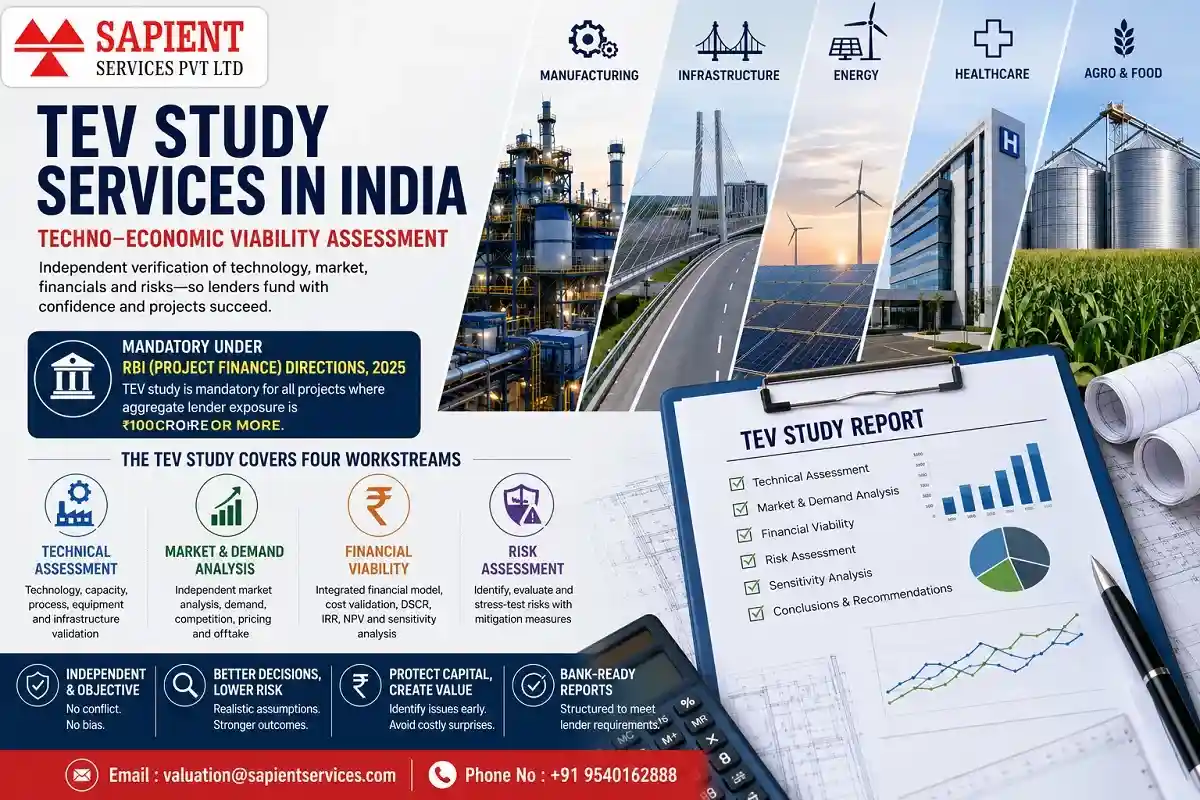
A Techno-Economic Viability (TEV) study is the independent verification that sits between a promoter’s project report and a bank’s disbursement. On June 19, 2025, the Reserve Bank of India formalised this requirement through the Reserve Bank of India (Project Finance) Directions, 2025 — mandating a TEV study for all projects where aggregate lender exposure is Rs 100 crore or more (RBI Project Finance Directions, 2025, confirmed by Lexology and FoxMandal, July 2025).
Sapient Services conducts TEV studies for banks, NBFCs, and project developers across India — covering manufacturing, infrastructure, energy, healthcare, and agro-industrial projects. Reports are prepared in the format required by the commissioning bank and structured to address the specific risk profile of each project.
The RBI Project Finance Directions, 2025 — What Changed
The RBI issued the Reserve Bank of India (Project Finance) Directions, 2025 on June 19, 2025. Before this, banks had varied internal policies on when TEV studies were required — some mandated them above Rs 50 crore, others above Rs 200 crore, some required them only for infrastructure. The 2025 Directions create a uniform mandatory threshold across all Regulated Entities (banks, NBFCs, All India Financial Institutions): aggregate lender exposure of Rs 100 crore or more requires a TEV study.
Other relevant provisions from the 2025 Directions:
- For PPP infrastructure projects, fund-based disbursement cannot begin before the appointed date is declared — and any modification to the DCCO requires reassessment of project viability
- Cost overruns up to 10% of original project cost (excluding IDC) are permitted without asset downgrade if financial metrics remain stable
- Lenders must conduct regular progress reviews through site visits, independent engineer reports, and monitoring committees throughout the construction period
- Early corrective action is required upon any material delay or cost overrun — not deferred until the project reaches NPA status
What a TEV Study Covers — The Four Workstreams
Technical Assessment
The starting point is whether the project’s technology actually works at the claimed scale. For a manufacturing project, this means: process technology validation (is this technology proven at commercial scale or still at pilot stage?), plant layout and capacity design review, equipment specification and vendor qualification, utility and infrastructure requirements, waste management and environmental compliance planning.
The most common source of cost overruns in Indian project finance is over-optimistic capacity assumptions — vendors quote best-case operating parameters, promoters put these in their DPR, and nobody checks whether 85% capacity utilisation in year one is realistic for that market and technology combination. The TEV study checks.
Market and Demand Analysis
The TEV study independently validates the market assumptions underlying the project’s revenue projections. For a manufacturing project, this covers: sector demand growth rates, competitive landscape, pricing trend verification, identification of confirmed offtake agreements or anchor customers (vs projected customers), and an assessment of whether the promoter’s market share assumptions are achievable given existing competition and capacity additions.
Banks have historically funded projects on the basis of promoter-provided market assessments. The TEV study provides the independent view — and frequently finds that demand assumptions were 15-25% more optimistic than market data supports.
Financial Viability Assessment
Sapient builds an integrated financial model covering the full project lifecycle: construction phase (project cost, draw-down schedule, IDC), ramp-up period, and steady-state operations. Key outputs:
- Project cost estimate validation — Sapient compares the promoter’s cost estimates against benchmarks for comparable projects to identify whether any significant cost items have been under-estimated
- Revenue projection — capacity utilisation assumptions, product pricing, receivables collection period
- Operating cost build-up — raw material costs, utilities, manpower, maintenance, overhead
- Debt Service Coverage Ratio (DSCR) — most lenders require average DSCR of 1.25x-1.50x over the loan tenure
- IRR and NPV — to assess whether the project generates adequate returns for the equity investor
- Sensitivity analysis — what DSCR looks like if capacity utilisation is 10-15% below projections, or if raw material costs rise 15%, or if market prices drop
Risk Assessment
Every project has risks. The TEV study’s value is identifying them before funds are disbursed. Sapient assesses: technology risk (new vs proven, vendor track record), execution risk (contractor capability, pending land acquisition, environmental clearances still outstanding), market risk (demand and pricing), input supply risk (raw material availability and cost stability), management risk (team depth and relevant track record), and regulatory risk (pending clearances, sector-specific changes).
The TEV study is an independent assessment — not advocacy for the project. If the financial model shows inadequate DSCR at realistic assumptions, or if the technical review reveals a material design flaw, Sapient reports it. In most cases, early findings lead to project redesign — revised technology choice, adjusted capacity, modified cost estimates — not abandonment. Finding a material issue in the TEV study costs a fraction of what it costs post-disbursement.
Who Needs a TEV Study
Situation | Why It’s Required |
|---|
Project loan with aggregate lender exposure above Rs 100 crore | Mandatory under RBI Project Finance Directions, 2025. Banks and NBFCs cannot sanction without it |
Infrastructure projects — roads, bridges, ports, power plants | Lenders require independent technical and financial viability confirmation before financial closure and disbursement |
Manufacturing plant expansion (greenfield or brownfield) | Bank term loans, NCD issuances, and PLI scheme disbursements all require TEV-backed financial projections and cost validation |
Healthcare — hospital, diagnostic centre, medical devices | Clinical capacity analysis, equipment selection validation, and revenue projection require independent sector expertise |
Renewable energy — solar, wind, biomass | SECI, IREDA, and PFC-backed projects require independent engineering assessment including energy yield analysis (CUF, P90 basis) |
MSME expansion — below Rs 100 crore but above Rs 5-10 crore | Many public sector banks and NBFCs require TEV-style appraisal notes even where the RBI threshold doesn’t apply |
Sectors Where Sapient Conducts TEV Studies
- Manufacturing — chemicals, pharmaceuticals, food processing, textiles, auto components, engineering goods, ceramics
- Infrastructure — roads, warehouses, cold chain logistics, industrial estates, data centres
- Energy — solar power, wind energy, biomass, small hydro, conventional thermal
- Healthcare — hospitals, diagnostic centres, pharmaceutical manufacturing, medical devices
- Agro and food industries — food parks, storage, processing, cold chain
- Telecoms and IT infrastructure — network expansion, tower projects, data centres
Sapient has conducted TEV studies for Scheduled Commercial Banks (public and private sector), NBFCs, and PE-backed project developers. Reports are structured to meet the format requirements of the commissioning lender.
The TEV Study Process at Sapient
Stage | Work Done | What’s Produced |
|---|
Scoping | Review DPR, identify data gaps, define study scope and timeline | Information checklist, scoping document |
Site Visit and Technical Review | Physical visit to proposed site; equipment vendor discussions; technology validation; infrastructure assessment | Technical assessment notes and field observations |
Market Analysis | Sector demand data, competitor analysis, pricing trends, offtake verification | Independent market assessment |
Financial Modelling | Integrated project financial model — capex, construction draw-down, operating model, DSCR, IRR, sensitivity analysis | Financial model with scenarios |
Risk Assessment | Identify key risks, score likelihood and impact, assess mitigation measures, stress-test model | Risk matrix |
Report Preparation and Submission | TEV report compiled in bank-specified format; management review; query responses to lender credit team | Final TEV report |
Questions on TEV Studies in India
1. Is a TEV study legally required for all project loans?
Under the RBI (Project Finance) Directions, 2025 (notified June 19, 2025), a TEV study is mandatory for all projects where the aggregate exposure of all lenders — not just one bank — is Rs 100 crore or more. This applies to all Regulated Entities: scheduled commercial banks, NBFCs, and All India Financial Institutions. For projects below this threshold, individual bank policies apply.
2. What is the DCCO and how does it connect to the TEV study?
DCCO (Date of Commencement of Commercial Operations) is the date by which the project must begin commercial production. It determines when the loan repayment schedule begins. Under the 2025 RBI Directions, any modification to the DCCO for PPP infrastructure projects requires reassessment of project viability — effectively a TEV revalidation. The initial TEV study supports the original DCCO determination based on a realistic construction timeline assessment.
3. What DSCR does the TEV study need to demonstrate?
Most scheduled commercial banks require average DSCR of 1.25x to 1.50x over the loan tenure. Infrastructure projects with long-term, contracted revenue streams may be acceptable at lower DSCR. The TEV study’s financial model must show DSCR above the lender’s floor even in a stressed scenario — typically modelled at 10-15% lower capacity utilisation or 10% higher operating costs than the base case.
4. What is the difference between a TEV study and a Detailed Project Report (DPR)?
A DPR is prepared by the promoter or their appointed consultant and presents the project favourably to support funding applications. A TEV study is an independent assessment commissioned by the bank — its job is to validate the DPR’s assumptions, not to endorse them. The promoter owns and pays for the DPR. The bank owns and pays for the TEV study. Both documents are part of the project financing record.
5. Can one TEV study serve multiple lenders in a consortium?
Yes. For consortium lending, a single TEV study commissioned by the lead bank is typically acceptable to all consortium members. The report should be addressed to all named lenders or structured with a forwarding framework that permits sharing. Sapient drafts TEV reports with this in mind for projects with anticipated consortium financing.
6. How is a TEV study for a solar energy project different from manufacturing?
Solar TEV studies require sector-specific technical assessment: CUF (Capacity Utilisation Factor) analysis, energy yield estimates at P50 and P90 confidence levels (the latter is what most lenders use for conservative DSCR calculation), module degradation assumptions over 25 years, grid connectivity and evacuation infrastructure, and PPA (Power Purchase Agreement) review if applicable. This requires engineering expertise in renewable energy specifically — different from the process engineering expertise needed for a chemical or pharmaceutical plant TEV.
7. What happens when the TEV study reveals that the project is not viable?
Sapient reports independently — if the numbers don’t work under realistic assumptions, that finding goes into the report. Most findings of this nature lead to project redesign rather than abandonment: revised technology selection, adjusted capacity, modified cost estimates, or restructured financing. Identifying a design flaw or cost underestimate before disbursement is far less expensive than identifying it after Rs 100-200 crore has been released.
8. Does Sapient prepare TEV studies for MSME projects below the Rs 100 crore threshold?
Yes. Many public sector banks and NBFCs require TEV-style project appraisal notes for term loans above Rs 5-10 crore — below the mandatory RBI threshold but above what most banks treat as pure assessment-only credit. Sapient prepares project appraisal notes and technical assessment reports at the appropriate scope and depth for these smaller project loans.