
Risk vs. Reward: Smart Decisions in Business & Finance
 By
By 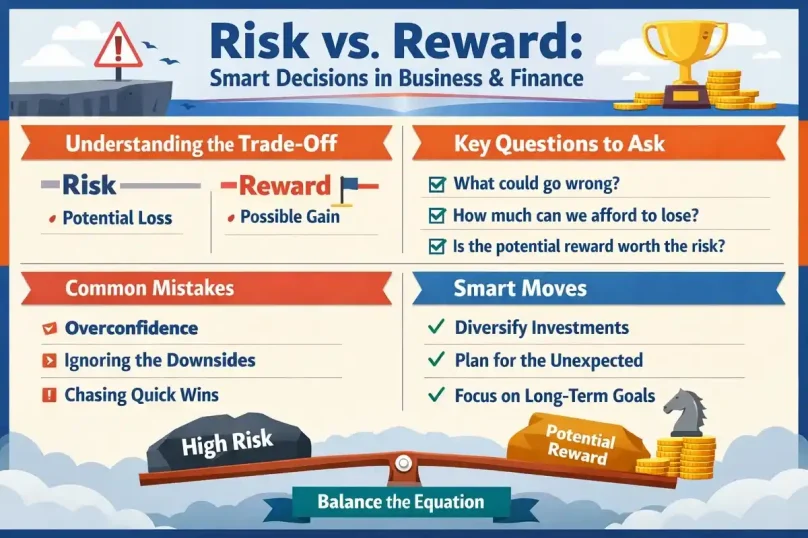
Most people like to say they understand risk. In reality, they only like risk when things go right.
In business and finance, almost every decision looks sensible in hindsight if it works — and irresponsible if it doesn’t. That’s why risk vs. reward isn’t a neat formula you apply and move on. It’s a judgment call you live with, sometimes for years.
Whether you’re investing money, expanding a business, or simply deciding not to act, you’re making a trade-off. The problem is, most of us underestimate how uneven that trade-off really is.
Risk Isn’t the Same as “Chance of Failure”
One common mistake is treating risk as a simple probability — like a coin toss.
In the real world, risk usually means:
- You don’t know when something will go wrong
- You don’t know how bad it will be
- And you don’t know how many things must go right before you see rewards
A business expansion can fail not because the idea was bad, but because cash flows tightened at the wrong time. An investment can lose money not because the company was weak, but because you needed liquidity at the worst possible moment.
That’s why experienced decision-makers worry less about whether something might fail and more about what failure would actually cost them.
Reward Looks Clear. Risk Rarely Is.
Reward is easy to imagine. We can see profits, growth, valuation, returns.
Risk hides in the background:
- Regulatory changes no one planned for
- Execution delays
- Cost overruns
- Management fatigue
- Market sentiment turning cold
This asymmetry is why people chase reward aggressively and treat risk as a footnote.
But smart decisions don’t come from optimism. They come from asking uncomfortable questions early — when you still have the option to walk away.
“Higher Risk = Higher Reward” Sounds Good. Reality Is Messier.
You’ll often hear that taking more risk leads to higher returns. That’s only partially true — and often misunderstood.
Higher risk increases the range of outcomes. It widens the gap between success and failure. It does not magically tilt the odds in your favor.
Plenty of high-risk decisions offer:
- Limited upside
- Severe downside
- And very little margin for error
That’s not courage. That’s poor pricing of risk.
The smarter approach is not asking “How much can I make?” but “Am I being compensated enough for what can go wrong?”
Business Risk Feels Different from Investment Risk
In investing, risk is often abstract. Numbers move on a screen.
In business, risk feels personal:
- Salaries depend on decisions
- Reputation is on the line
- One bad call can create years of recovery work
A delayed project can strain vendors. A failed acquisition can distract leadership for years. A poorly timed loan can suffocate an otherwise healthy company.
That’s why business leaders don’t think in percentages alone. They think in stress points:
- How long can we survive if revenue drops?
- What happens if this takes twice as long?
- Where do we lose control?
Those questions rarely appear in spreadsheets — but they decide outcomes.
Risk Appetite: The Quiet Driver Behind Every Decision
Two people can look at the same opportunity and reach opposite conclusions — and both can be right.
Why? Because risk appetite isn’t universal.
A large company with reserves can absorb losses that would break a smaller one. An investor with a 15-year horizon can tolerate volatility that someone nearing retirement simply can’t.
The mistake happens when people borrow decisions from others without borrowing their capacity to absorb risk.
Good decisions fit the decision-maker. Not the headline.
Risk Management Isn’t About Playing Safe
There’s a misconception that managing risk makes you conservative or limits growth.
In practice, risk management is what allows people to take risks without blowing up.
Diversification, buffers, staged investments — these aren’t signs of fear. They’re signs of respect for uncertainty.
The goal isn’t to avoid loss completely. That’s unrealistic.
The goal is to avoid irreversible loss.
Once that line is crossed, reward stops mattering.
Where People Usually Get Risk Wrong
From experience, a few patterns show up repeatedly:
- Overconfidence after early success
Past wins create the illusion of control. - Ignoring second-order effects
Decisions rarely fail for the reason you expect. - Confusing activity with progress
Doing something risky feels productive — even when it isn’t smart. - Focusing on best-case outcomes
Without spending equal time on worst-case scenarios.
None of this comes from lack of intelligence. It comes from being human.
When Analysis Stops Helping
Not all uncertainty can be measured. Some situations don’t come with reliable data:
- Regulatory shifts
- Technology disruption
- Sudden economic shocks
In such cases, pretending to calculate risk precisely is misleading. Judgment matters more than models. Experience matters more than formulas.
Sometimes the smartest decision is not maximizing reward — it’s preserving flexibility.
Who Should Think Hard About Risk vs. Reward
This mindset matters most if you:
- Allocate capital
- Run a business
- Make long-term financial decisions
- Are responsible for outcomes beyond yourself
It matters less if decisions are:
- Short-term and reversible
- Small relative to your total capacity
- Made purely for learning, not returns
Context changes everything.
The Question That Actually Matters
Risk vs. reward isn’t about bravery or caution. It’s about clarity.
The best decision-makers don’t ask:
“Can this work?”
They ask:
“What happens if it doesn’t — and can we live with that?”
If the answer is honest and well thought out, even a failed decision rarely becomes a disaster.
FAQs (Real Questions People Ask)
1. Is taking risk necessary to grow?
Yes — but only when the downside is survivable.
2. Why do safe decisions sometimes fail?
Because “safe” often ignores timing, liquidity, and external shocks.
3. Can risk be fully measured?
No. Some uncertainty will always remain.
4. Is avoiding risk the same as being smart?
No. Avoiding all risk often leads to slow decline.
5. How do businesses decide their risk limit?
Through cash buffers, debt capacity, and leadership judgment.
6. Why do similar businesses take different risks?
Different reserves, goals, and tolerance for stress.
7. Is diversification always good?
Usually, but over-diversification can dilute focus.
8. Do models guarantee better decisions?
They help — but judgment still matters more.
9. Can reward be non-financial?
Absolutely. Stability and control are rewards too.
10. What’s the biggest risk mistake?
Ignoring how long recovery might take if things go wrong
Suggested Services