FEMA Valuation Under RBI Guidelines 2026 for Cross-Border Deals
 By
By 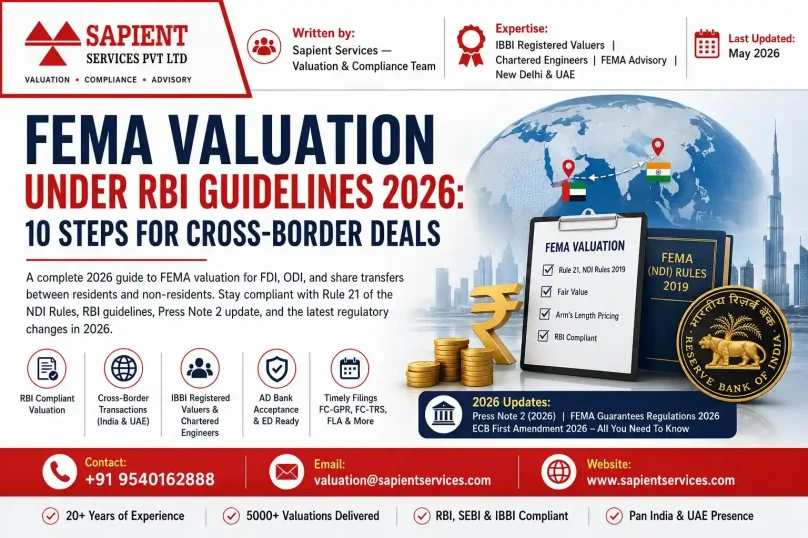
Thousands of cross-border equity transactions in India hit a regulatory wall every year — not because the deal was poorly structured, but because the FEMA valuation report was wrong, stale, or built on the right framework but the wrong professional. Authorised dealer banks returned more filings in 2025-26 than in any previous year, and the Enforcement Directorate has sharply increased scrutiny of FDI pricing compliance.
Under the Foreign Exchange Management Act (FEMA) 1999 and the FEMA (Non-Debt Instruments) Rules 2019, a formal valuation is mandatory for virtually every equity transaction between an Indian resident and a non-resident — whether it is FDI coming into India, an Indian company investing overseas, or a share transfer between the two sides.
2026 has brought three major FEMA regulatory changes: the Foreign Exchange Management (Guarantees) Regulations 2026 (January 6), the ECB First Amendment Regulations (February 16), and Press Note 2 (2026) issued by DPIIT on March 15, which eased — but also clarified — the FDI framework for land-border country investors. Each of these changes affects how cross-border deals are structured and documented.
This guide gives you the complete, 2026-updated 10-step process to get FEMA valuation right.

|
What Is FEMA Valuation Under RBI Guidelines? (Quick Answer) FEMA valuation is a mandatory, methodology-specific appraisal of the fair value of equity shares or convertible instruments involved in a cross-border transaction — covering FDI, ODI, share transfers between residents and non-residents, and compulsorily convertible instruments. Under Rule 21 of the FEMA (NDI) Rules 2019, the valuation must be certified by a SEBI-registered Category I Merchant Banker or a Chartered Accountant (for unlisted companies), or a Cost Accountant in certain cases. The method must be internationally accepted — DCF, NAV, Earnings Capitalisation, or Comparable Transaction Method. The report must be ready before the transaction is executed and must accompany the FC-GPR or FC-TRS filing on the RBI FIRMS portal. |
What Is FEMA Valuation and Why Does RBI Mandate It in 2026?
FEMA valuation is the regulatory mechanism by which RBI ensures that any cross-border equity transaction involving an Indian entity is priced at arm’s length — neither artificially low (which would drain capital from India) nor artificially high (which would waste foreign exchange reserves).
The legal framework rests on Rule 21 of the FEMA (Non-Debt Instruments) Rules 2019. It requires that for any issue or transfer of equity instruments involving a non-resident, the price must not fall below (for inward FDI) or exceed (for outward transfers) the fair value determined by an internationally accepted methodology, duly certified by a prescribed professional.
Three 2026 updates are directly relevant to FEMA valuation practice. First, the FEMA Guarantees Regulations 2026 (Notification No. FEMA 8(R)/2026-RB, January 6) replaced the 2000 framework and introduced mandatory quarterly reporting for all cross-border guarantees — including those in M&A deal structures. Second, the FEMA Borrowing and Lending First Amendment (FEMA 3(R)(5)/2026-RB, effective February 16) updated ECB end-use monitoring and clarified conversion of ECBs to equity under NDI Rules. Third, Press Note 2 (2026), issued March 15, amended the land-border FDI policy, introducing a 10% beneficial ownership threshold under PMLA definitions that now determines whether government route approval is needed.
What has not changed: the core pricing rule under Rule 21 of the NDI Rules, the prescribed professional categories, and the FC-GPR/FC-TRS reporting timelines. These remain the foundation of FEMA valuation compliance.
Which Transactions Require FEMA Valuation?
FEMA valuation is required across a wider set of transactions than most companies realise. Any movement of equity instruments across the resident/non-resident boundary triggers the requirement:
| Transaction Type | RBI Pricing Rule | Certifying Professional |
| FDI — Issue of equity shares to non-resident investor | Price must not be less than fair value (floor) | SEBI Category I Merchant Banker or CA (unlisted); SEBI MB only (listed) |
| Share transfer: Resident → Non-Resident | Transfer price must not be less than fair value (floor) | SEBI Category I Merchant Banker or CA |
| Share transfer: Non-Resident → Resident | Transfer price must not exceed fair value (ceiling) | SEBI Category I Merchant Banker or CA |
| ODI — Indian company investing in foreign entity | Valuation of foreign target required; sets ceiling | CA or internationally recognised valuer |
| CCDs / CCPS (compulsorily convertible instruments) | Valuation required at issuance AND at conversion; same methodology both stages | CA — consistent method at both stages |
| Downstream investment by FOIC (foreign-owned Indian company) | Each investment layer requires separate valuation | SEBI MB or CA |
| Convertible notes (DPIIT-recognised startups only) | Min ₹25 lakh per investor; must convert within 5 years; report via Form CN | CA — within 30 days of issuance |
| Swap of capital instruments | Valuation required irrespective of amount | SEBI-registered Merchant Banker or recognised foreign Investment Banker |
2026 update — Press Note 2: For investors from land-border countries (China, Pakistan, Bangladesh, Nepal, Bhutan, Myanmar, Afghanistan), the new 10% beneficial ownership threshold (under PMLA Rule 9(3) definitions) determines whether the automatic route or government route applies. If the foreign investor entity has LBC beneficial ownership above 10%, government approval is required before the transaction — and the valuation must be done after that approval is obtained. Press Note 2 takes effect from the date of the corresponding FEMA NDI Rules notification, which was published on May 1–2, 2026.
10 Steps for FEMA-Compliant Valuation Under RBI Guidelines
Step 1 — Classify the Transaction Precisely
The first task is accurate transaction classification. Is this FDI under the FEMA (NDI) Rules 2019? A share transfer under Schedule I of the NDI Rules? An ODI under the FEMA ODI framework? Does it involve a cross-border guarantee now governed by the FEMA Guarantees Regulations 2026? Each category carries different valuation requirements, pricing rules, and RBI filing forms.
Also confirm the entry route and sectoral FDI cap before anything else. If the investor is from a land-border country, apply the Press Note 2 (2026) beneficial ownership test. If the deal takes foreign shareholding above the automatic route limit — or requires government approval — proceed only after approval is in hand. Starting a valuation before a mandatory approval is obtained wastes time and money, since approval conditions can change the structure.
Step 2 — Engage the Correct Certifying Professional
Rule 21 of the NDI Rules prescribes specific professionals for FEMA valuation certification. Using the wrong professional is itself a FEMA contravention:
- Unlisted companies: Valuation must be certified by a Chartered Accountant, a SEBI-registered Category I Merchant Banker, or a practicing Cost Accountant — using an internationally accepted pricing methodology on an arm’s-length basis.
- Listed companies: Valuation is in accordance with SEBI pricing guidelines (ICDR Regulations) — not a separate FEMA report in the same form.
- ODI — foreign target valuation: A CA or an internationally recognised valuer. The AD bank may also suggest a Merchant Banker or Registered Valuer.
- Swap of capital instruments: SEBI-registered Merchant Banker or a recognised Investment Banker in the foreign country.
Note: The company’s statutory auditor can certify the FEMA valuation as a CA, but ICAI’s independence guidelines should be checked for the specific engagement. A dedicated valuation specialist avoids this risk.
Step 3 — Set the Valuation Date Correctly
The valuation date must be reasonably close to the transaction execution date. RBI does not set a single universal validity period for all transaction types, but AD bank practice — and ED inspection practice — treats reports older than 6 months as stale for most transactions. For fast-moving sectors (technology, fintech, renewable energy), 90 days is the working standard.
For compulsorily convertible instruments, two valuation dates apply: one at issuance and one at conversion. The price at conversion must not be lower than the fair value worked out at the time of issuance. The methodology must be consistent at both stages — a switch from DCF at issuance to NAV at conversion is a compliance gap that surfaces during ED inspection.
Step 4 — Select the Right Valuation Methodology
Rule 21 requires an ‘internationally accepted pricing methodology on an arm’s-length basis.’ In practice, the following methods are used and accepted:
| Method | Best Applied To | Key Requirement |
| Discounted Cash Flow (DCF) | Operating businesses; most commonly used by RBI practitioners | Justified WACC and terminal growth rate; audited financials; 3-5 year projections |
| Net Asset Value (NAV) | Holding companies; real estate; asset-heavy manufacturers | All assets at current fair market value — NOT depreciated book value |
| Earnings Capitalisation / P-E Multiple | Profitable businesses with stable, recurring earnings | Comparable listed company multiples with source citations |
| Comparable Transaction Method | M&A deals with available sector data | Recent arm’s-length transactions in the same industry |
| Market Price Method | Shares of comparable listed entities | Prevailing market price with adjustment for size and liquidity |
The report must state which method was chosen and explain why. A valuation number without documented methodology reasoning will not pass AD bank review in 2026. Multiple methods can be used with assigned weights — the report must reconcile them.
Step 5 — Gather All Required Documents Before Engaging the Valuer
Incomplete documentation is the most common reason for report delays and re-issuance. Collect the following before the valuation begins:
- Audited financial statements — last 3 financial years (mandatory)
- Management accounts or provisional financials if the audit for the current year is pending
- Board-approved business plan and 3-5 year financial projections (required for DCF)
- Memorandum and Articles of Association — share class rights, existing foreign shareholding
- Details of existing FDI: prior FCGPR filings, current foreign shareholding pattern
- Term sheet or draft transaction agreement — shows the price being negotiated
- Pending litigations, contingent liabilities, off-balance-sheet items
- Sector-specific data: comparable companies, recent M&A transactions, industry multiples
- For land-border country investors: government approval documentation and PN2 (2026) beneficial ownership analysis
Step 6 — Build and Stress-Test the Valuation Model
For DCF: the discount rate must be explicitly justified — typically WACC built from cost of equity (CAPM, with India-specific equity risk premium) and after-tax cost of debt. Terminal growth rate must be grounded in India’s long-run macroeconomic context. Projection period should reflect the company’s actual business planning horizon, not a default.
For NAV: every material asset — land, plant and machinery, intellectual property, listed and unlisted investments — must be independently valued at current fair market value on the valuation date. Book value is not fair value. For capital-intensive businesses, a Chartered Engineer’s independent assessment of plant, machinery, and real property values strengthens the NAV analysis and reduces the risk of an AD bank query on asset pricing.
Stress-test the key assumptions before finalising. The valuation conclusion should be defensible under a range of scenarios — optimistic, base, and downside — so that any challenge from the ED or the AD bank can be addressed with documented analysis, not ad hoc explanation.
Step 7 — Structure the Valuation Report Correctly
The FEMA valuation report is a substantive document, not a one-page certificate. A report that passes AD bank scrutiny in 2026 must include all of the following sections:
- Purpose of the valuation: specific transaction, parties involved, applicable FEMA provision (Rule 21, NDI Rules 2019)
- Scope and limitations: data relied upon, what was not independently verified
- Business overview: company background, industry context, regulatory environment
- Financial analysis: historical performance, trends, normalisation adjustments
- Methodology: full working, assumption sources, comparable selection rationale
- Valuation conclusion: point value or justified range; reconciliation if multiple methods used
- Certification: name, qualification, SEBI/ICAI/ICMAI registration number of the certifying professional
A two-to-three page report will not pass AD bank compliance review for transactions above ₹5 crore. Banks are specifically checking the methodology section for documented reasoning, not just numbers.
Step 8 — Confirm the Transaction Price Is Within the RBI Band
This is the compliance core of the entire process. The pricing rules under Rule 21 of the NDI Rules work as follows:
- FDI / Resident issuing shares to Non-Resident: Issue price must not be less than the fair value in the valuation report. No below-fair-value allotment to a non-resident is permitted.
- Resident selling existing shares to Non-Resident: Transfer price must not be less than fair value. The resident seller cannot transfer shares below their arm’s-length value.
- Non-Resident selling to Resident: Transfer price must not exceed fair value. The Indian buyer cannot overpay — this protects outflow of foreign exchange.
Test the agreed transaction price against the valuation conclusion before any binding document is signed. Repricing a deal after the agreement is executed creates both legal and regulatory complications. If the price is outside the RBI band, the deal must be restructured before execution.
Step 9 — File the Correct RBI Form Within the Prescribed Deadline
| Form | Transaction | Deadline | Portal |
| FC-GPR | FDI — fresh issue of shares to non-resident | Within 30 days of share allotment | RBI FIRMS (SMF) |
| FC-TRS | Transfer of shares between Resident and Non-Resident | Within 60 days of transfer or fund movement — whichever is earlier | RBI FIRMS (SMF) |
| Form CN | Convertible notes — DPIIT-recognised startups only | Within 30 days of issuance | RBI FIRMS (SMF) |
| Form ODI | Overseas Direct Investment by Indian company | Before remittance (Part I); APR annually by December 31 | AD Bank → RBI |
| FLA Return | Annual foreign assets and liabilities disclosure | July 15 each year — FY 2025-26 deadline: July 15, 2026 | FLAIR Portal (flair.rbi.org.in) |
| ECB-2 | Monthly reporting of External Commercial Borrowing transactions | Monthly, through AD Category I bank | AD Bank |
| Cross-Border Guarantee Report | New under FEMA Guarantees Regulations 2026 | Quarterly, through AD bank | AD Bank → RBI |
Critical timeline: Shares must be allotted within 60 days of receiving inward remittance from the foreign investor. If the allotment deadline is missed, the funds must be returned within 15 days after the end of that 60-day window. Failure to do either is an independent FEMA contravention.
Portal note: The FLA return is filed on the FLAIR portal (flair.rbi.org.in) — separate from the FIRMS portal used for FC-GPR and FC-TRS. This is a common error. Companies with outstanding foreign shareholding or overseas assets as on March 31 must file FLA annually, even if no new investment occurred during the year.
Step 10 — Retain Records for the 5-Year Compliance Window
FEMA compliance does not end at the time of filing. The Enforcement Directorate and RBI conduct inspections of AD banks and corporate clients. All records related to each transaction — valuation report and supporting financials, board resolutions, transaction agreements, filed forms, bank acknowledgements — must be retained for a minimum of 5 years from the transaction date.
For companies with multiple cross-border transactions, a centralised FEMA compliance register — one file per transaction, linked to the FIRMS portal filing reference — makes ED inspection straightforward. Companies that cannot produce complete documentation for past filings during an inspection face a presumption of non-compliance, regardless of whether the original transaction was correctly executed.
From the Desk of Sapient Services: A 2026 India-UAE FEMA Valuation Case
Situation: A Delhi-based manufacturer sought to transfer a 26% stake to a UAE-based holding entity. Deal value: approximately ₹40 crore. The company had used an internal CA-certified NAV valuation prepared for a board resolution.
Problem: The AD bank rejected the report on two grounds. One, the CA had used depreciated book value of plant and machinery rather than current fair market value. Two, the report did not cite the applicable provision — Rule 21 of the FEMA (NDI) Rules 2019 — or explicitly address the pricing floor for a resident-to-non-resident transfer. The bank also flagged the UAE entity’s beneficial ownership structure in light of the new Press Note 2 (2026) framework.
Sapient’s approach: We prepared a fresh FEMA-compliant report combining a DCF for the operating business with a Chartered Engineer-certified NAV for plant and machinery at replacement cost. The report cited Rule 21 of the NDI Rules, documented the pricing floor compliance, and confirmed that the UAE entity’s beneficial ownership did not trigger land-border FDI restrictions under Press Note 2.
Result: The AD bank accepted the revised report on first submission. Form FC-TRS was filed within the 60-day window. The transaction closed without a late submission fee or regulatory delay.
5 FEMA Valuation Mistakes That Delay Cross-Border Deals
Mistake 1 — Stale Valuation Report
A report prepared 9-12 months before the transaction reflects a different business and market environment. AD banks in 2026 are treating reports older than 6 months with increasing scrutiny. For technology or growth-stage businesses, 90 days is the practical standard. Always match your valuation date to the deal timeline from the start.
Mistake 2 — Wrong Certifying Professional
For unlisted companies, a CA, SEBI-registered Category I Merchant Banker, or Cost Accountant can certify. For swap transactions, only a SEBI Merchant Banker or a recognised foreign Investment Banker qualifies. Using an unregistered or incorrectly classified professional — or a report that does not clearly state the certifier’s registration number — is a standalone ground for AD bank rejection.
Mistake 3 — Book Value Treated as Fair Value in NAV
This is the single most common error in NAV-based FEMA valuations. Plant, machinery, land, and intellectual property carried at written-down book value are rarely at fair market value. The valuation report must state the basis for each asset’s fair value independently. Boards that rely on their balance sheet figures for FEMA valuation are building on the wrong foundation.
Mistake 4 — Single Valuation for Convertible Instruments
CCDs and CCPS require a valuation at issuance and again at conversion. The price at conversion must not be lower than the fair value at issuance — this is the regulatory requirement under RBI’s FAQ on FDI. Missing the conversion-stage valuation is a gap that surfaces during ED inspection or compounding proceedings, sometimes years after the original transaction.
Mistake 5 — Not Applying Press Note 2 (2026) Beneficial Ownership Test
Since March 15, 2026, any deal involving an investor entity where an LBC citizen or entity holds more than 10% beneficial ownership requires government route approval — regardless of the investor’s country of registration. Global funds with Chinese LP investors are a common example. Skipping this check before fixing the valuation date can mean the deal needs government approval mid-process, forcing a restart.
7 Practical Tips for FEMA-Compliant Deals
- Start 4-6 weeks before the deal close date. Rushed valuations produce weak documentation. Build in time for one revision cycle with the AD bank.
- Align FEMA valuation with income tax transfer pricing. For related-party cross-border transactions, the FEMA valuation and the Income Tax transfer pricing documentation must be consistent. Conflicting prices in the same transaction attract scrutiny from both RBI and the tax department.
- Lock in the method for convertible instruments at term sheet stage. State the valuation method in the term sheet itself. Switching from DCF to NAV between issuance and conversion creates a compliance risk.
- Use a Chartered Engineer for asset-heavy businesses. When NAV is the primary method, an independent CE assessment of plant, machinery, and real estate values strengthens the report and reduces AD bank queries.
- Confirm entry route and PN2 applicability before fixing the valuation date. Government route approvals can take months. Confirming the route before commissioning the valuation prevents a stale report by the time approval arrives.
- Don’t forget the new quarterly guarantee reporting requirement. Under the FEMA Guarantees Regulations 2026, all cross-border guarantees must be reported quarterly to the AD bank. If your deal structure includes parent company guarantees, factor in this new compliance layer.
- Build a FEMA compliance register from day one. One file per transaction: route confirmation, valuation report, board resolutions, filed form, bank acknowledgement, retention notes. This makes any future ED inquiry a documentation exercise, not a crisis.
Frequently Asked Questions
Q1. Is FEMA valuation mandatory for every FDI transaction in India?
Yes — for virtually every cross-border equity transaction. Rule 21 of the FEMA (NDI) Rules 2019 requires that shares issued or transferred to/from a non-resident be priced at or above (for inward FDI) or at or below (for outward transfers) the fair value certified by the prescribed professional. Limited exceptions apply to rights issues to existing non-resident shareholders subscribing at the same price as residents.
Q2. Who can certify a FEMA valuation report for an unlisted Indian company?
Under Rule 21 of the NDI Rules 2019, the valuation must be certified by a Chartered Accountant, a SEBI-registered Category I Merchant Banker, or a practicing Cost Accountant. For share swaps, only a SEBI Merchant Banker or a recognised foreign Investment Banker qualifies. The certifier’s name and registration number must appear in the report.
Q3. What valuation methods does RBI accept for FEMA compliance?
RBI requires ‘any internationally accepted pricing methodology for valuation on an arm’s-length basis.’ DCF, NAV, Earnings Capitalisation, Market Price, and Comparable Transaction methods are all acceptable. The report must document which method was used and why — unexplained methodology is the most common ground for AD bank rejection.
Q4. What is the FC-GPR filing deadline after FDI is received?
Shares must be allotted within 60 days of receiving funds from the non-resident investor. Form FC-GPR must then be filed within 30 days of allotment through the RBI FIRMS portal (Single Master Form). If allotment is missed within 60 days, the investor’s funds must be returned within 15 days after that window closes.
Q5. What is the FC-TRS filing deadline for a share transfer?
Form FC-TRS must be filed within 60 days of the transfer or of the movement of funds — whichever occurs earlier. Missing this window triggers a Late Submission Fee and can lead to compounding. AD banks may also hold future FDI-related filings pending regularisation of past non-compliance.
Q6. How does Press Note 2 (2026) affect FEMA valuation for cross-border deals?
Press Note 2 (issued March 15, 2026, effective from May 1-2, 2026) eased land-border FDI rules. Investor entities from China, Pakistan, and other land-border countries with non-controlling beneficial ownership up to 10% (per PMLA definitions) can now invest via the automatic route. Above 10%, government approval is still required. Deals involving such investors must apply the PN2 beneficial ownership test before fixing the valuation date and executing the transaction.
Q7. Is FEMA valuation required when a foreign VC invests in an Indian startup?
Yes. When a foreign fund acquires equity in an Indian startup — regardless of the company’s revenue stage — FEMA valuation is mandatory under the FDI rules. For pre-revenue companies, DCF with justified assumptions or a scorecard method is acceptable, provided the report meets RBI’s format and certification requirements.
Q8. What is the difference between a FEMA valuation and a standard business valuation?
A standard business valuation can be prepared for any purpose. A FEMA valuation must specifically cite the applicable NDI Rule, address the pricing floor or ceiling, be certified by RBI’s prescribed professional class, and be submitted with the FC-GPR or FC-TRS filing. A general valuation report does not satisfy these requirements and will be rejected by the AD bank.
Q9. What are the penalties for non-compliance with FEMA valuation requirements?
A missing or non-compliant FEMA valuation is a contravention under Section 13 of FEMA 1999. Penalties can reach three times the amount involved in the contravention, or ₹2 lakh if the amount cannot be quantified. For continuing violations, a daily fine of ₹5,000 applies. RBI can also restrict the company from raising future foreign capital.
Q10. Can Sapient Services prepare FEMA valuation reports for India-UAE transactions?
Yes. Sapient Services handles FEMA valuation for FDI from UAE-based structures into Indian operating companies, ODI into UAE businesses, and share transfers between Indian residents and UAE non-residents. Our team includes IBBI Registered Valuers and Chartered Engineers. Contact us at +91 9540162888 or valuation@sapientservices.com.
Conclusion
The volume of cross-border equity transactions involving Indian companies continues to grow, and the regulatory environment around them has become more detailed — not less — in 2026. Three major FEMA notifications in the first five months of this year alone mean that deal teams cannot operate on assumptions built in 2024.
The 10 steps in this guide reflect how FEMA valuation works in practice today — from the correct professional to engage and the methodology choices that hold up under ED scrutiny, to the filing deadlines that are tighter than most CFOs realise, and the new quarterly guarantee reporting requirement that catches deal structures off-guard.
The one principle that cuts through all the technical requirements: the valuation report must be defensible in writing. Regulatory scrutiny will always focus on what is documented — the methodology rationale, the assumption sources, the professional certification. Companies that treat the valuation as a compliance checkbox will keep having their filings returned. Companies that treat it as the foundational document of the cross-border deal will close faster and with a cleaner record.
|
Need a FEMA Valuation Report for Your Cross-Border Deal in 2026? |
Related Articles: