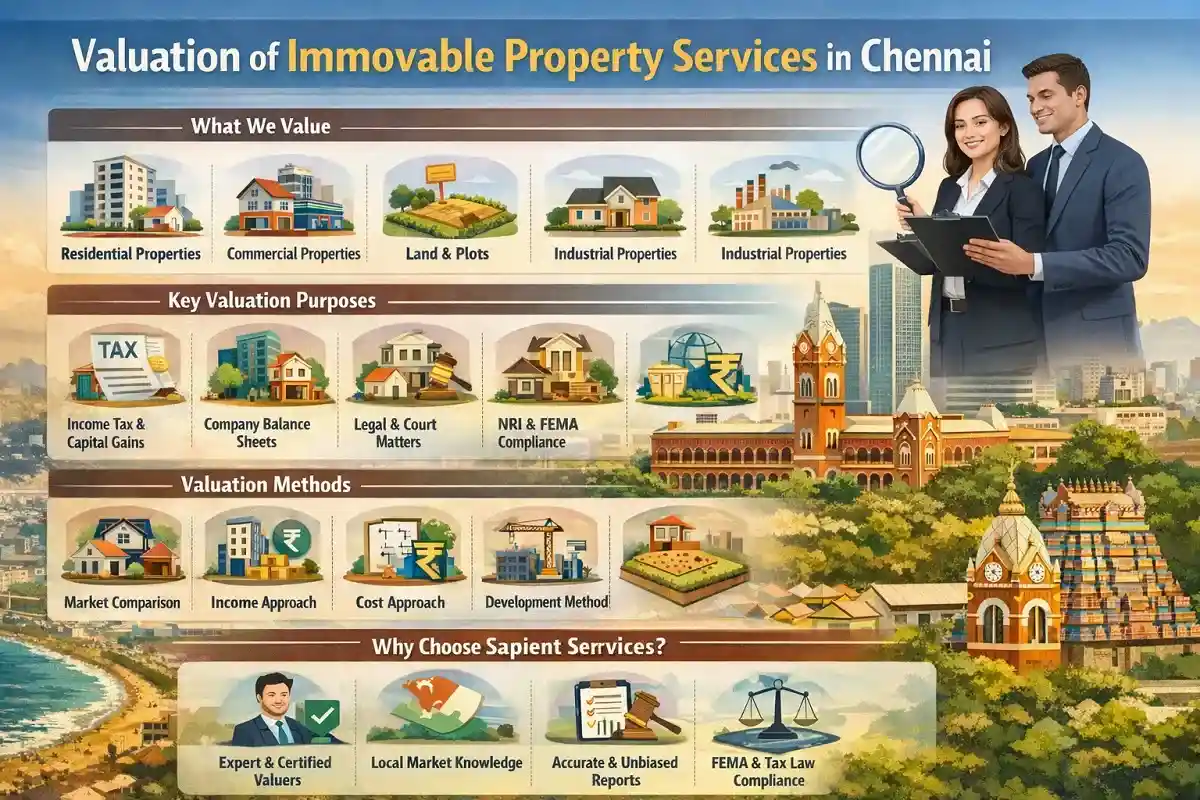
Property valuation in Chennai is not straightforward. The same city has guideline values as low as ₹40/sq. ft. in some areas and as high as ₹23,500/sq. ft. in commercial pockets like T. Nagar. A flat in OMR and a plot in Tambaram need completely different valuation logic — different methods, different market data, different regulatory context.
Sapient Services has been conducting immovable property valuations across Chennai for clients ranging from individual homeowners to large corporates. Our reports are accepted by banks, income tax authorities, courts, and regulatory bodies — and we prepare them to hold up under scrutiny, not just on paper.
What Is Immovable Property Valuation?
Immovable property is anything permanently fixed to the earth — land, buildings, hereditary allowances, fisheries. Under the Transfer of Property Act 1882, these cannot be moved from one place to another.
Valuation is the process of determining what that property is actually worth — at a specific point in time, for a specific purpose. The same property can have a different valuation for a bank loan versus a court proceeding versus an income tax matter. Method matters. So does who conducts it.
Properties we value in Chennai:
- Residential — houses, flats, apartments, villas, builder floors
- Commercial — retail shops, office spaces, IT parks, hotels, cinema theatres, petrol pumps
- Land — agricultural land, vacant plots, development parcels
- Industrial — factories, warehouses, manufacturing units
Why Chennai Needs a Local Approach
Chennai’s real estate market is genuinely micro-market driven. OMR moves on IT absorption. T. Nagar on retail density. North Chennai on industrial demand. Suburban corridors like Tambaram and Perungalathur on infrastructure announcements — ring road, metro Phase 2.
The Tamil Nadu government publishes official guideline values on the TNREGINET portal — these are the minimum values for registration. As of 2026, stamp duty is 7% and registration fee is 4%, applied on whichever is higher between guideline value and actual transaction price. But in localities like Nanganallur or Velachery, the market rate can be double the guideline value.
That gap has consequences — for tax computation, for loan eligibility, for what you can defend in a dispute. A valuer who does not know Chennai’s local data cannot give you an accurate number.
Types of Immovable Property Valuation We Offer
Income Tax Valuation — Capital Gains & Section 50C
When a property is sold, Section 50C of the Income Tax Act kicks in: if the stamp duty value is higher than the actual sale price, capital gains tax is calculated on the stamp duty value — not the price you actually received. Section 56(2)(x) applies on the buyer’s side for properties received at undervalue.
A registered valuer’s report is the accepted way to establish actual market value and challenge an inflated stamp duty assessment. We prepare these reports specifically for income tax purposes.
Valuation for Company Balance Sheet
Under the Companies Act 2013, companies that hold buildings or land may need certified valuations for asset revaluation, mergers, amalgamations, or corporate restructuring. This has to be done by a registered valuer under the Companies (Registered Valuers and Valuation) Rules, 2017 — not just any professional.
Valuation for Court Matters and Litigation
Family partition cases, divorce settlements, NCLT proceedings, disputes between business partners — courts need an independent valuation they can rely on. Our reports document methodology, assumptions, and data sources clearly, so they can stand cross-examination.
Valuation for NRI Property & FEMA
NRIs selling, gifting, or inheriting Chennai property need a certified valuation under FEMA, which the RBI governs. This covers foreign remittance approvals, repatriation of sale proceeds, and inheritance or gift transactions involving overseas individuals. Getting this wrong delays remittances significantly.
Bank Loans and Mortgage Security
No bank or housing finance company releases a loan against property without a valuation report. Our reports are accepted by SBI, HDFC, ICICI, and other scheduled banks operating in Chennai.
Visa Purpose Valuation
The US, UK, Canada, and Australian consulates require certified property valuation reports as part of financial asset documentation for visa applications. This must carry a registered valuer’s stamp and signature.
Valuation Methods We Use
Market Comparison Method
The most common method for residential properties. We pull recent registered transactions from the same locality, adjust for floor, age, size, condition, and derive a market-supported value. Comparable sales data from TNREGINET and sub-registrar records forms the base.
Income Capitalization Method
Used for commercial and rental properties. The value is calculated from net annual rental income divided by the capitalization rate applicable for that property type and area. For an OMR office space or an Anna Nagar retail unit, this reflects investor yield expectations accurately.
Cost Approach
Applied for industrial buildings, heritage structures, and properties where comparable sales don’t exist. We calculate the current replacement cost of construction, then deduct depreciation for age, condition, and functional obsolescence.
Development Method
For large land parcels with development potential. We estimate the projected value of the completed development, subtract development costs and a reasonable developer margin, and arrive at the current land value.
Method | Used For |
|---|
Market Comparison | Residential flats, independent houses, plots |
Income Capitalization | Rental properties, commercial units |
Cost Approach | Industrial, special-purpose structures |
Development Method | Large land parcels, redevelopment sites |
Where possible, we cross-check using more than one method. This is especially important in Chennai’s suburban markets where comparable data can be thin.
Our Valuation Process
Step 1 — Understanding the purpose Whether it’s for a bank, an income tax matter, or a court, the purpose shapes the method and the report format. We establish this before anything else.
Step 2 — Document review We go through title deeds, encumbrance certificates, patta and chitta records, CMDA or DTCP building plan approvals, property tax receipts, and occupancy certificates.
Step 3 — Site inspection Our valuers visit the property. Construction quality, built-up area, condition, boundary walls, encroachments, and neighbourhood — everything that affects value is assessed on-site.
Step 4 — Market research Recent transaction data, current rental rates, TNREGINET guideline values, nearby infrastructure projects — all of this feeds into the analysis.
Step 5 — Valuation and report We apply the appropriate method, run the calculations, and prepare a detailed report with photographs, data sources, methodology explanation, and the final value conclusion.
You receive a draft first. If you have questions on the methodology or assumptions, we discuss them before the final signed report is issued.
Guideline Value vs. Market Value — What’s the Difference?
This comes up in almost every Chennai property transaction.
Guideline Value is what the Tamil Nadu Registration Department has set as the minimum value for registering a property in a specific street or area. You cannot register below it. Stamp duty and registration fees are calculated on whichever is higher — guideline value or actual price.
Market Value is what buyers and sellers actually agree on. In prime areas, it is significantly higher than the guideline value. In some peripheral areas, they can be close.
When these two diverge, it creates tax implications — for seller under Section 50C, for buyer under Section 56(2)(x). A certified market valuation from a registered valuer is the recognized way to address this.
Why Choose Sapient Services
- Our valuers know Chennai’s micro-markets — not just city-wide averages
- Reports are prepared as per International Valuation Standards (IVS) and IBBI registered valuer norms
- We cover all purposes — tax, bank, court, balance sheet, FEMA, visa — with accurate and independent reports
- No stake in the transaction. The report reflects what the property is actually worth
- Draft shared before final issue. You can question any assumption or figure before the report is finalized
Frequently Asked Questions
Q-1: What does immovable property mean?
Ans: Any property fixed to the earth that cannot be moved — land, buildings, hereditary allowances, fisheries, leasehold land. The definition comes from the Transfer of Property Act 1882.
Q-2: What does valuation of immovable property mean?
Ans: Estimating the market value of an immovable asset for a specific purpose — sale, purchase, taxation, mortgage, legal proceedings.
Q-3: What factors affect property valuation in Chennai?
Ans: Location and locality, plot and built-up area, age and condition of construction, legal status, CMDA/DTCP approval, proximity to infrastructure like metro or ring road, rental yield for commercial properties, and the prevailing guideline value.
Q-4: Why is accurate valuation important?
Ans: Because an inflated or deflated figure creates real problems — excess tax liability, loan amount mismatch, or a valuation that gets rejected in court. Accuracy protects all parties.
Q-5: Does the age of the property affect valuation?
Ans: Yes. Older structures carry higher depreciation under the cost approach. But in Central Chennai, the land component can be large enough that building age has limited impact on the overall value.
Q-6: Does a legal dispute reduce market value?
Ans: Generally yes. Disputed properties sell at a discount, and banks typically won’t lend against them. We disclose legal flags clearly in our reports.
Q-7: Who needs property valuation in Chennai?
Ans: Individuals buying or selling, NRIs dealing with Indian property, companies with real estate on their books, anyone in a property-related legal matter, and those needing property proof for visa purposes.
Q-8: What is the income capitalization method?
Ans: It values a property based on what it earns. Divide the net annual rental income by the applicable capitalization rate for that market, and you get the income-based value of the asset.
Q-9: Can one report be used for multiple purposes?
Ans: Often yes. A bank loan report can also work for income tax or balance sheet purposes. But FEMA and court-specific reports may need particular formats — we clarify this before starting.
Get In Touch
Tell us about your property and what the valuation is for. We’ll confirm the process, timeline, and fees.
📞 +91 9540162888 ✉️ valuation@sapientservices.com