
How to Manage Risk in Business
 By
By 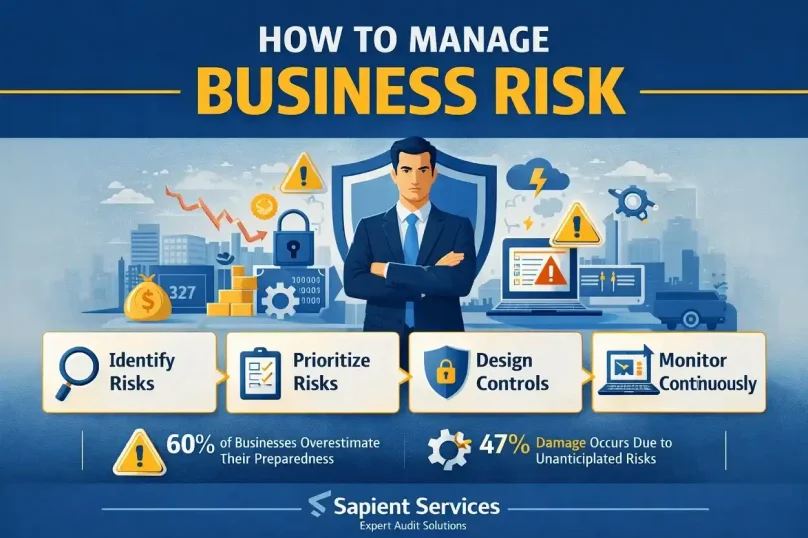
Every business takes risks. Some are visible. Many are not.
What separates stable companies from fragile ones is not how much risk they take — but how deliberately they manage it. In practice, risk management is rarely about dramatic crises. It is about small, ignored issues quietly compounding until they become expensive, disruptive, or irreversible.
This guide explains how businesses actually manage risk in the real world, beyond theory, frameworks, and compliance checklists.
What Business Risk Really Means (Beyond Textbook Definitions)
Business risk is anything that can prevent an organization from achieving its objectives, whether financial, operational, strategic, or reputational.
In real environments, risk is rarely isolated. One weak process often triggers multiple failures.
Examples seen across industries:
- A delayed regulatory filing leading to penalties and lender scrutiny
- Over-reliance on a single customer disrupting cash flow
- Poor internal controls enabling fraud that goes undetected for years
- Inaccurate data leading to wrong strategic decisions
Risk management is not about eliminating uncertainty. It is about making uncertainty visible and controllable.
- Check Out: Business Valuation Services in Delhi, India
Why Risk Management Fails in Most Businesses
Despite awareness, many organizations struggle with risk management because:
- Risks are treated as compliance obligations, not business threats
- Responsibility is pushed to audit or finance teams alone
- Early warning signals are ignored until losses appear
- Risk registers exist on paper but are not used in decisions
The result: businesses respond after damage occurs, not before.
Major Categories of Business Risk (Across Industries)
| Risk Category | What It Looks Like in Practice |
|---|---|
| Strategic Risk | Wrong expansion decisions, flawed pricing, poor M&A outcomes |
| Financial Risk | Cash flow gaps, over-leveraging, currency exposure |
| Operational Risk | Process failures, system breakdowns, human error |
| Compliance Risk | Regulatory penalties, license cancellations |
| Reputational Risk | Customer trust erosion, public disputes |
| Cyber & Data Risk | Data breaches, ransomware, IP theft |
Most real-world losses happen where multiple risks intersect, not in isolation.
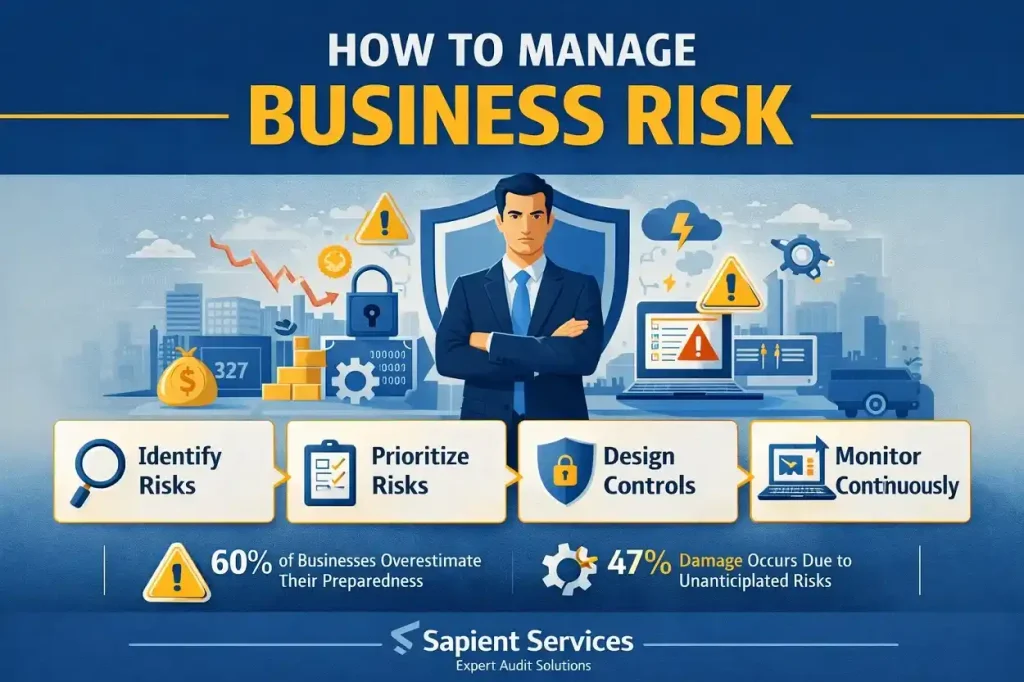
Step 1: Identify Risks the Way They Actually Occur
Effective risk identification does not start with templates. It starts with asking uncomfortable operational questions.
Practical sources of risk identification:
- Process walkthroughs (how work actually happens)
- Incident history and near-misses
- Customer complaints and disputes
- Audit observations and lender queries
- Employee exit interviews
- Vendor dependency analysis
Risk often hides in exceptions, not standard procedures.
Step 2: Prioritize Risks Based on Impact, Not Probability Alone
Many businesses underestimate rare but high-impact risks.
A simple, effective approach is evaluating:
- Financial impact
- Operational disruption
- Regulatory consequences
- Reputational damage
- Recovery time
| Risk Type | Probability | Impact | Priority |
|---|---|---|---|
| Supplier failure | Medium | High | Critical |
| Minor compliance delay | High | Low | Medium |
| Data breach | Low | Very High | Critical |
This prevents teams from wasting effort on low-impact risks while ignoring dangerous ones.
Step 3: Understand Your Risk Appetite (Most Businesses Don’t)
Risk appetite is how much risk a business is willing to tolerate to achieve its goals.
In reality:
- Growth-stage companies accept higher operational risk
- Regulated entities tolerate very little compliance risk
- Family-owned firms often avoid reputational risk at all costs
Without defining risk appetite, decisions become inconsistent and reactive.
Step 4: Design Controls That Work in Real Life
Controls fail when they are:
- Too complex
- Poorly understood
- Ignored under pressure
- Designed only for audits
Effective controls are:
- Simple
- Clearly owned
- Embedded into daily work
- Reviewed periodically
Examples:
- Segregation of duties in payments
- Approval thresholds tied to risk
- Automated alerts instead of manual checks
- Independent reconciliations
Firms like Sapient Services often see that control design matters more than control quantity.
Step 5: Monitor Risk Continuously (Not Annually)
Risk is dynamic. Annual reviews are not enough.
Effective monitoring includes:
- Key risk indicators (KRIs)
- Exception reporting
- Trend analysis
- Periodic internal audits
- Management review meetings
Industry data shows organizations using continuous monitoring detect control failures months earlier than those relying only on annual audits.
Step 6: Prepare for When Controls Fail (They Will)
No system is perfect.
Businesses should plan for:
- Incident response
- Crisis communication
- Business continuity
- Regulatory reporting
Prepared companies recover faster, lose less trust, and retain stakeholder confidence.
Financial Risk: Where Most Businesses Misjudge Exposure
Common blind spots:
- Over-reliance on short-term borrowing
- Concentrated customer receivables
- Inventory funded by debt
- Poor working capital discipline
Banking and advisory studies consistently show that liquidity risk, not profitability, causes most business failures.
Operational Risk: Small Lapses, Big Consequences
Operational risks include:
- Dependency on key individuals
- Manual processes with no backups
- Weak IT controls
- Inadequate documentation
These rarely trigger immediate losses — but when they do, recovery is slow and costly.
Compliance Risk: Not Just About Penalties
Compliance failures often lead to:
- Loss of licenses
- Contract termination
- Lender distrust
- Director liabilities
Regulatory bodies increasingly expect demonstrable compliance systems, not reactive fixes.
Technology & Cyber Risk: Now a Core Business Risk
Cyber incidents are no longer IT issues.
Real impacts include:
- Operational shutdowns
- Legal liabilities
- Customer attrition
- Insurance claim disputes
Risk management now requires business-level ownership of cyber risk, not just technical controls.
Using Data and Audits to Strengthen Risk Visibility
Audits are often misunderstood as fault-finding exercises.
In reality, audits:
- Highlight weak processes
- Identify emerging risks
- Validate control effectiveness
Independent audits and risk reviews help management see blind spots early. This is where experienced advisors like Sapient Services add value by translating findings into actionable decisions.
Common Risk Management Mistakes to Avoid
- Treating risk management as documentation
- Copy-pasting frameworks without adaptation
- Ignoring cultural and behavioral risks
- Over-engineering controls
- Failing to assign ownership
Risk management must evolve with the business.
Who Should Invest Seriously in Risk Management?
Particularly critical for:
- Growing companies
- Debt-funded businesses
- Regulated entities
- Companies planning expansion or M&A
- Businesses with thin margins
Risk management is not cost — it is loss prevention.
Who May Not Need Complex Frameworks?
- Very small owner-managed firms
- Low-risk, low-scale operations
- Early-stage startups (initially)
Even then, basic risk awareness is essential.
Frequently Asked Questions (FAQs)
1. Is risk management mandatory for all businesses?
Not legally for all, but increasingly expected by lenders, investors, and regulators.
2. How often should risk assessments be done?
At least annually, and whenever there is major change.
3. Can small businesses manage risk without consultants?
Yes, at a basic level — but complexity grows quickly with scale.
4. What is the biggest business risk today?
Liquidity risk combined with operational dependency.
5. Are risk registers actually useful?
Only if actively reviewed and updated.
6. Does insurance replace risk management?
No. Insurance transfers risk; it does not prevent it.
7. Who should own risk management internally?
Senior management, not just audit or finance teams.
8. Can audits identify all risks?
No. They identify control weaknesses, not strategic risks.
9. How does risk management help profitability?
By preventing losses, disruptions, and reputational damage.
10. When should external risk advisors be engaged?
During growth, restructuring, funding, or regulatory scrutiny.