
How to Manage Risk in Business
 By
Written by Sapient Services Valuation Team | Reviewed by Devendra Kumar Malhotra, Registered Valuer | Sapient Services Pvt. Ltd., New Delhi | Last Updated: November 2026
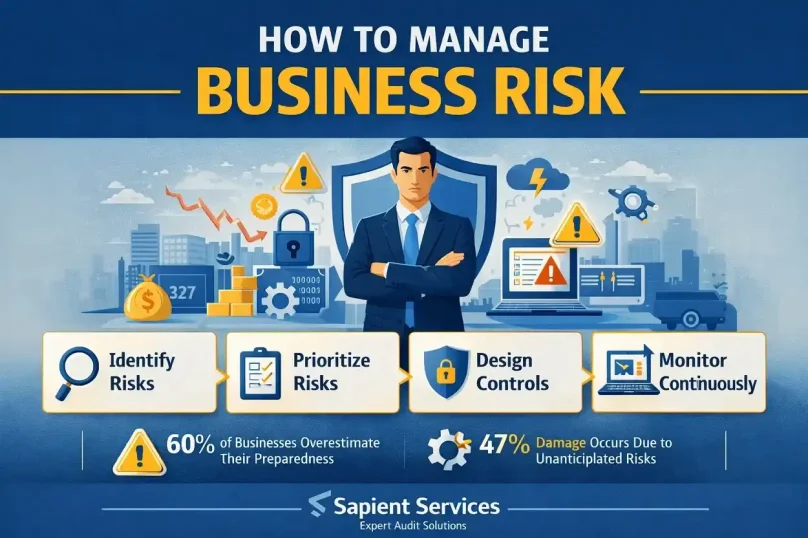
Knowing how to manage risk in business comes down to six repeatable steps: set your limits, find the risks, score them, choose a response, monitor, and plan for the day a control fails. Each step leaves a record that your Board, lender or auditor can read.
This guide walks Indian company owners and finance heads through each step, with a risk register template, the four ways to treat a risk, and what the Companies Act, SEBI and CERT-In expect from you.
The same steps work for a small firm and a listed group; only the depth changes, and the register you build stays short enough to read in one sitting.
Learn more about our compliance consultancy services in Delhi.
Quick Answer: To manage risk in a business, set your risk appetite, list the risks, and score each by likelihood and impact. Then choose one of four treatments (avoid, reduce, transfer or accept), give each risk a named owner, and review on a fixed schedule. In India, Section 134(3)(n) of the Companies Act, 2013 requires a company’s full Board’s report to include a statement on its risk management policy.
What Is Business Risk Management?
Business risk management is the routine of finding events that could affect a company’s objectives, scoring them, and deciding what to do about each one. In India, the Companies Act, 2013 expects the Board to report on its risk management policy, and SEBI’s listing regulations require a Risk Management Committee at the largest listed companies.
ISO 31000 defines risk as the effect of uncertainty on objectives, so a risk can be an opportunity as well as a threat. Commercially, it decides how early you spot a cash, compliance or supplier problem.
Why Risk Management Matters and Who Needs It
Risk management matters because a minor issue that nobody owns can grow into a cash, compliance or reputational loss. It helps most:
- Companies with bank or NBFC debt, where one missed filing can prompt a lender review.
- Businesses planning expansion, funding or an acquisition, where buyers test controls during financial due diligence.
- Thin-margin firms with one large customer or supplier.
Without a process, a lender, auditor or regulator can find the gap before you do. A very small owner-managed firm can start with a one-page register of its biggest risks, reviewed every quarter.
Types of Business Risk with Examples
Business risks fall into six types, and many losses sit where two types meet: a late regulatory filing (compliance) can trigger a lender review (financial). Tag each risk as internal (weak controls, data security) or external (an economic downturn, new regulation).
| Risk Type | Example |
|---|---|
| Strategic | Pricing below cost, a failed acquisition |
| Financial | Cash flow gaps, an interest rate rise, currency exposure |
| Operational | Supplier failure, key-person dependency, fraud, system outage |
| Compliance | Late filings, licence cancellation, penalties |
| Reputational | Loss of customer trust, public disputes |
| Cyber and Data | Breach, ransomware, data theft |
How to Manage Risk in Business: The Six-Step Process
Six steps take a company from setting limits to planning for failure. The order matters, because you cannot score a risk until you know how much risk you can accept.
Step 1: Set Risk Appetite and Scoring Criteria
Risk appetite is the amount of risk a business accepts to reach its goals. Write it as limits your board and lenders would recognise, such as a maximum cash shortfall or a cap on revenue from one customer, and tie them to your business plan. Fix the scoring scale and risk criteria here too.
Step 2: Identify Risks and Their Causes
Risk identification starts from what must go right: list the objectives and assets that matter, then ask what could stop each one. Near-misses, complaints and lender queries all point to risks.
Run a SWOT-style session with finance, operations, sales and compliance, and ask suppliers, lenders and insurers what they see.
Step 3: Assess and Prioritise Risks
Risk assessment multiplies likelihood by impact on a fixed scale, such as 1 to 5 for each, and plots the result on a risk matrix or heat map. Rate impact across cash, operations, regulatory exposure, reputation and recovery time, and take the highest.
Treat the matrix as a way to rank attention, not to forecast losses. Small companies can score qualitatively and add rupee estimates where data exists. A rare event with severe impact can outrank a frequent minor one, which is why probability alone misleads.
Step 4: Choose a Treatment and Design Controls
Risk treatment is the decision on what to do about a scored risk. Choose to avoid, reduce, transfer or accept it, and write the choice as a risk mitigation plan: the action, a named owner, a deadline and a budget.
Keep controls simple and in proportion to what they protect, such as dual approval above a payment limit.
Step 5: Monitor, Report, and Communicate
Risk monitoring tracks whether exposure is moving. Choose key risk indicators for each high risk, such as receivable days or the share of revenue from the top customer, and review them on a set schedule.
Repeat the full assessment at least once a year and after any major change, such as a new loan or acquisition. Brief every risk owner, train new joiners, and name a replacement when an owner leaves.
Step 6: Plan for the Day a Control Fails
A contingency plan sets out who does what when a control fails. It covers incident response, communication with lenders, customers and regulators, business continuity and any mandatory reporting.
Test it with a short drill, such as losing your largest supplier, and fix the gaps while fixing is cheap. At each annual review, check whether the register flagged the problems that occurred.
How to Build a Risk Register
A risk register, also called a risk log, records each risk with its score, treatment, owner and next review date. Write each risk as a scenario: cause, event and impact. Use the columns below as a risk register template.
The scale is illustrative: score likelihood and impact from 1 to 5, multiply, and treat scores up to 5 as low, 6 to 12 as medium and anything above 12 as high.
| Risk | Likelihood x Impact = Score | Treatment and Control | Owner | Review |
|---|---|---|---|---|
| Sole supplier of a critical component stops delivery, halting production and delaying orders | 3 x 5 = 15 | Reduce: qualify a second supplier, hold safety stock | Head of Procurement | Quarterly |
This row is an illustration, not Sapient client data.
Four Ways to Treat a Risk: Avoid, Reduce, Transfer, or Accept
Risk treatment means choosing one of four responses to a scored risk: avoid it, reduce it, transfer it or accept it.
| Option | Use It When | Example |
|---|---|---|
| Avoid | The risk exceeds your appetite and the activity can stop | Decline a contract with unlimited liability |
| Reduce (risk mitigation) | Controls bring the risk within appetite | Second supplier, dual approvals, tested backups |
| Transfer | Another party can carry the loss | Insurance (property, marine cargo or business interruption), contract indemnities, hedging |
| Accept | Treatment costs more than the exposure | Small losses inside your tolerance |
Insurance transfers the financial loss, subject to the policy’s limits and exclusions, but it does nothing about the cause. Where a property or stock policy is written below the value at risk, the insurer can apply the average clause and pay a claim proportionately. A valuation of reinstatement value gives you a documented basis for the sum insured, and our note on what insurance advisory services include shows how cover is reviewed.
Risk Management Requirements for Indian Companies
India does not prescribe one risk management framework for every business. Duties vary with legal structure, listing status and sector regulator, such as the RBI for banks and NBFCs.
Companies Act, 2013 and SEBI Listing Rules
| Provision | Applies To | What It Requires |
|---|---|---|
| Section 134(3)(n) | Companies preparing a full Board’s report. OPCs and small companies prepare the abridged report under Rule 8A, which does not list this statement | A statement on the company’s risk management policy, including risks that may threaten its existence |
| Section 177(4)(vii) | Companies that must have an audit committee | The audit committee evaluates internal financial controls and risk management systems |
| Rule 8(5)(viii), Companies (Accounts) Rules, 2014 | Companies covered by Rule 8 (Rule 8(6) excludes OPCs and small companies) | The Board’s report states the adequacy of internal financial controls. Our guide to IFC applicability for private limited companies covers who is exempt |
| Schedule IV | Independent directors | Satisfy themselves that financial controls and risk management systems are sound and defensible |
| Regulation 21, SEBI LODR | Top 1,000 listed entities by market capitalisation and high value debt listed entities (listed debt of Rs 5,000 crore or more since the January 2026 amendment) | A Risk Management Committee whose remit covers cyber security and business continuity |
Cyber and Data Rules
| Provision | Applies To | What It Requires |
|---|---|---|
| CERT-In Directions, 28 April 2022 | Service providers, intermediaries, data centres, companies and government organisations | Report incidents listed in Annexure I within 6 hours of noticing them, keep ICT logs for a rolling 180 days within India, and name a point of contact for CERT-In |
| DPDP Act, 2023 and DPDP Rules, 2025 | Organisations processing digital personal data | Reasonable security safeguards, and breach reporting: inform affected individuals and the Data Protection Board without delay, then give the Board detailed information within 72 hours unless it allows longer. Most duties start about 13 May 2027, 18 months after the Rules were published in November 2025 |
The DPDP Act sets a penalty of up to Rs 250 crore for failing to take reasonable security safeguards. The two log rules differ: CERT-In wants ICT logs kept 180 days in India, while DPDP Rule 6 (from May 2027) wants logs and related personal data kept one year, unless another law says otherwise. Thresholds and exemptions differ for private, small and listed companies, so confirm applicability with a company secretary.
Common Mistakes When You Manage Risk in Business
- Treating the register as paperwork. A register updated only before an audit shapes no decisions. Cite it when you approve capex, credit or a new vendor.
- Leaving risks without a named owner. When a department owns a risk, nobody acts on it.
- Treating insurance or audit as the whole programme. Insurance pays only within its policy terms, and audit and assurance services test selected controls, not every strategic risk.
Practical Tips for Managing Business Risk
- Write the cause into the risk. Supplier delay is vague. Sole supplier with no safety stock tells you what to fix.
- Put the review date in the register row. A risk with no review date tends to be forgotten, and the date shows what to revisit this quarter.
- Rank by recovery time as well as cost. A cheap failure that takes months to reverse can outweigh a costly one fixed in a week.
- Match your register to your Board’s report. Risks named in the report should sit in the register with owners and controls.
- Test your sum insured at renewal. Compare it with current replacement cost after major asset additions, and ask for a fresh valuation where the gap is large.
Frequently Asked Questions
1. What Are the Four Ways to Manage Risk?
The four responses are avoid, reduce, transfer and accept. Avoid removes the activity, reduce adds controls, transfer shifts the loss to another party such as an insurer, and accept keeps the risk because treatment costs more than the exposure.
2. What Is a Risk Register and What Should It Contain?
A risk register is a living table of identified risks. Each row holds the cause, event and impact, a likelihood and impact score, the treatment and control, a named owner and a review date.
3. Is a Risk Management Policy Mandatory for Private Companies in India?
Section 134(3)(n) of the Companies Act, 2013 asks the Board’s report to include a statement on the company’s risk management policy. One Person Companies and small companies prepare an abridged report under Rule 8A, whose list leaves out this statement. No separate risk management framework is mandated, so check your own position with a company secretary.
4. What Is the Difference Between Risk Appetite and Risk Tolerance?
In practice, risk appetite is the overall amount of risk a company will accept to pursue its objectives. Risk tolerance is the acceptable variation around a specific objective.
5. How Often Should a Business Review Its Risks?
Run a full assessment at least once a year and after any major change such as new borrowing, an expansion or an acquisition. Track indicators more often for fast-moving risks such as cash and cyber security.
6. Who Is Responsible for Risk Management in a Company?
The Board is responsible for the risk management policy. Where a company has an audit committee, Section 177(4)(vii) makes that committee responsible for evaluating risk management systems and internal financial controls. Day-to-day ownership sits with a named manager for each risk.
7. What Is ISO 31000, and Do Indian Businesses Have to Follow It?
ISO 31000 is an international standard of principles and guidelines for managing risk. Indian law does not require companies to adopt it. It is guidance and is not intended for certification, so use it to structure your own process.
8. What Must Be Reported to CERT-In, and How Quickly?
Under CERT-In’s directions of 28 April 2022, covered entities must report the incident types in Annexure I within six hours of noticing them and keep ICT logs for a rolling 180 days in India. Under the DPDP Rules, a breach also goes to the Data Protection Board without delay, with detail within 72 hours, from around May 2027.
9. How Does a Small Business Start Managing Risk?
Start with one page. List the risks that would hurt most, give each an owner, score likelihood and impact from 1 to 5, and set a review date. Where one supplier or customer carries the business, line up an alternative before building anything larger.
10. When Should a Company Bring in an External Risk Advisor, and What Should It Check?
Common triggers are a funding round, a lender query, a restructuring, an acquisition or regulatory scrutiny. Before you hire, ask for a sample register or report, and prefer an advisor separate from your statutory auditor, which keeps the audit independent.
Have more questions? Contact our team directly.
Conclusion: Your Next Step
This week, write down the five risks that would hurt most if they happened next month. Give each an owner, a score and a review date, then check that your Board’s report says the same thing as your register.
If you want a risk register, policy or control review done for your company, call +91 9540162888 | Email: valuation@sapientservices.com | Visit sapientservices.com.
You may also find helpful: IFC Applicability for Private Limited Companies
This article is general information as read in November 2026, not legal advice. Check the current text of each provision before relying on it.
Sources: Companies Act, 2013 (Sections 134(3)(n), 177(4)(vii), Schedule IV); Companies (Accounts) Rules, 2014 (Rules 8 and 8A); SEBI LODR Regulation 21; CERT-In Directions, 28 April 2022; DPDP Rules, 2025, Gazette of India; DPDP Act, 2023; ISO 31000:2018.