Business Valuation Services in India

Business Valuation Services in India

Your bank has asked for a certified valuation report before releasing funds. Your investors want an IBBI-compliant share valuation before the term sheet is signed. Your Resolution Professional needs two registered valuers within 7 days of CIRP commencement. In each of these situations, a report from an uncertified assessor does not work — legally or practically.

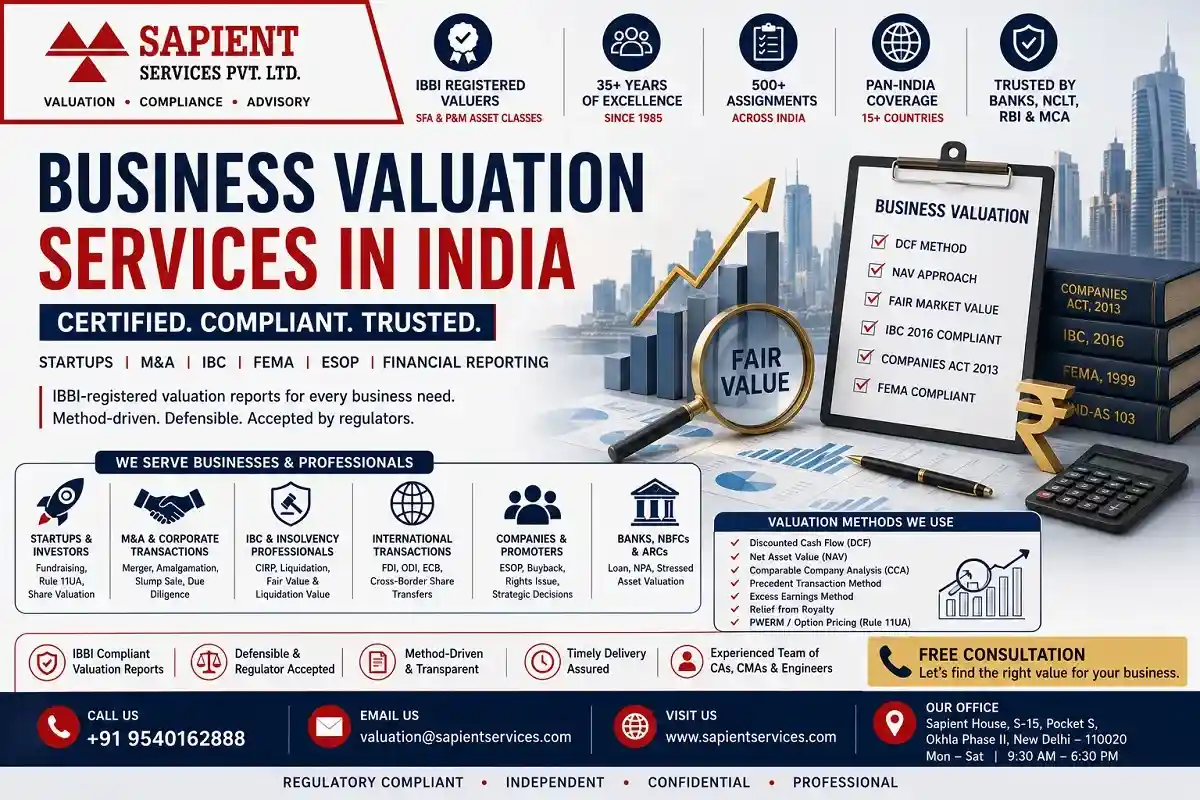
Sapient Services Pvt. Ltd. provides business valuation services across India, from our base in New Delhi. Our IBBI-registered valuers cover the full range — enterprise valuations, startup share valuations, IBC/CIRP assignments, FEMA-compliant certificates, ESOP pricing, and IND-AS financial reporting valuations. With 500+ completed engagements and 35+ years in the field, our reports are built to hold up in regulatory filings, bank reviews, and NCLT proceedings.

Request a Free Consultation → Call +91 9540162888 | Email: valuation@sapientservices.com

In Brief: Business Valuation Services in India

What: A certified determination of a business’s economic worth, using IBBI-prescribed methods and documented assumptions.
Who needs it: Startups raising funds, companies in M&A or IBC proceedings, exporters filing EPCG, FDI transactions, ESOP issuances.
Why Sapient: IBBI-registered (SFA class), 35+ years, 500+ assignments, reports accepted by NCLT, MCA, RBI, and banks across India.
Turnaround: Startup valuations: 5–8 working days. Enterprise valuations: 10–15 working days. IBC statutory window: within 47 days of appointment.
Coverage: Pan-India from Delhi NCR base — active across Mumbai, Bangalore, Chennai, Hyderabad, Kolkata. 15+ countries for cross-border work.

What Is Business Valuation — and When Does Indian Law Make It Mandatory?

Business valuation is the process of determining the fair economic worth of a company or its equity, using documented methodologies and verified financial data. In India, this practice is regulated under the Companies (Registered Valuers and Valuation) Rules, 2017, enforced from February 1, 2019.

From that date, only IBBI-registered valuers can issue reports for purposes covered by the Companies Act 2013, IBC 2016, SEBI regulations, and FEMA 1999. A report from an unregistered CA or consultant — however experienced — can be rejected by the MCA, NCLT, or courts in these specific contexts.

Business SituationWhat Is RequiredApplicable Law
Startup Fundraising / Angel RoundDCF-based share valuation — Rule 11UA compliantIncome Tax Act / IT Rules 2026 — Rule 11UA
M&A / Merger / AmalgamationEnterprise valuation + share exchange ratio reportCompanies Act 2013, Sections 230–232
ESOP / Sweat Equity IssuanceFMV of shares by IBBI-registered valuerSection 54 & 62, Companies Act 2013
Foreign Direct Investment (FDI)RBI-compliant FEMA valuation certificateFEMA 1999 — FDI Pricing Guidelines
IBC / CIRP InsolvencyTwo independent IBBI-registered valuers — mandatoryIBC 2016 — Regulations 27 & 35
Bank Loan Against Business / SharesBusiness or share valuation for collateralRBI Master Circulars on Loans & Advances
ESOP Perquisite Tax (Unlisted Companies)FMV certificate from SEBI-registered Merchant BankerIT Rules 2026 — Section 392(3), IT Act 2025
IND-AS Financial Reporting (PPA)Purchase price allocation, impairment testingIND-AS 103, 36, 38
Share Buyback / Rights IssueFair market value by registered valuerSection 68, Companies Act 2013
IPO / Pre-IPO RestructuringIndependent enterprise valuationSEBI ICDR Regulations
Succession / Estate PlanningFair value for transfer or inheritance of businessIndian Succession Act 1925, Income Tax Act
IT Rules 2026 Update: The Income-tax Rules, 2026 (notified March 20, 2026) carry forward the FMV framework for unlisted shares. DCF and NAV remain applicable for angel tax purposes. ESOP tax deferral for DPIIT-recognised startups extended to 60 months under Income Tax Act 2025.

Who Needs Business Valuation Services in India?

Any company or promoter facing a transaction, regulatory event, or dispute where the worth of a business or its shares becomes the central number. From practical experience handling assignments across India, these are the clients who need this most urgently.

  • Startups and growth-stage companies raising funds — Rule 11UA compliance is non-negotiable to avoid angel tax liability on excess consideration.
  • Promoters and companies in M&A, demergers, or slump sales where a defensible valuation determines deal pricing and share exchange ratios.
  • Resolution Professionals managing CIRP under IBC 2016 — two IBBI-registered valuers must be appointed within 7 days; missing this window creates legal liability.
  • Companies with FEMA exposure — inbound FDI, outbound ODI, ECB conversions, or cross-border share transfers all require FEMA-pricing-compliant certificates.
  • Companies issuing ESOPs, sweat equity, or handling preferential allotments — Section 247 of the Companies Act 2013 mandates an IBBI-registered valuer’s FMV certificate.
  • IND-AS companies carrying out PPA under IND-AS 103, goodwill impairment testing under IND-AS 36, and Level 3 fair value measurements for financial reporting.
  • Banks, NBFCs, and ARCs seeking independent NPA or stressed asset valuations before loan classification, resolution, or sale decisions.
  • Companies undergoing shareholder buyouts, succession planning, or litigation where a court-admissible, methodologically sound report is essential.

One common mistake: companies assume an informal valuation — or a certificate from a non-registered professional — will satisfy regulators and banks. It rarely does. By the time the gap is discovered, deal timelines and regulatory deadlines have already been missed.

Enterprise and M&A Valuation Services Across India

The type of valuation, applicable method, and report format depend on the purpose and regulatory context. Below are Sapient’s core service categories — each targeted at a specific use case and regulatory framework.

1. Enterprise Valuation for M&A, Fundraising, and Strategic Decisions

Enterprise valuation determines the total economic worth of a business — tangible assets, intangibles, cash flow capacity, and market standing. Used for M&A transactions, private equity deals, promoter buyouts, and business sales.

The report includes executive summary, industry context, methodology, financial model, sensitivity analysis, and a signed conclusion. Methods: DCF, Comparable Company Analysis (CCA), or a weighted combination.

  • Turnaround: 10–15 working days from receipt of complete documents
  • Output: Full written report + summary letter + financial exhibits + methodology appendix

2. Startup and Share Valuation — Rule 11UA and Angel Tax Compliance

Under the Income Tax Act 2025 and IT Rules 2026, if a startup raises funds above fair market value as prescribed, the excess is taxable as income from other sources. A Rule 11UA-compliant DCF valuation is the primary and most commonly accepted defense.

Our reports are built to hold up before the Income Tax department if challenged. We cover DPIIT-recognised and non-recognised startups, and account for the 10% safe harbour variation permitted under the current framework.

  • Turnaround: 5–8 working days
  • Covers resident and non-resident investor rounds including CCA and PWERM methods

3. ESOP Valuation — FMV Certification for Section 247 Compliance

Section 247 of the Companies Act 2013 requires an IBBI-registered valuer’s FMV certificate for ESOP grants, sweat equity, preferential allotments, and rights issues. Missing this is one of the most frequently flagged gaps in MCA secretarial audits — and creates personal liability for directors.

We factor in minority discount and marketability adjustments where applicable. For ESOP perquisite tax at unlisted companies, we coordinate with SEBI-registered merchant banker certification as required under IT Rules 2026.

IBC, FEMA, and Financial Reporting Valuation Services

4. IBC / Insolvency Valuation — CIRP and Liquidation

Regulation 27 under IBC 2016 requires the Resolution Professional to appoint two IBBI-registered valuers within 7 days of CIRP commencement. Both independently determine fair value and liquidation value. If their assessments diverge beyond the IBBI-prescribed threshold, a third valuer is appointed.

Sapient’s team has managed multiple NCLT-bound CIRP proceedings, fast-track CIRP, and voluntary liquidation assignments. Our valuers have appeared as expert witnesses at tribunal hearings — a standard few India-based firms can meet.

Real-World Context:

A Delhi-based manufacturing company with ₹120 crore in fixed assets and ₹65 crore in NPA exposure engaged Sapient during CIRP proceedings. Two of our IBBI-registered valuers were appointed within the statutory 7-day window. Fair value and liquidation value were independently determined for three asset classes — Plant & Machinery, Land & Building, and Financial Assets — and submitted within the 47-day regulatory deadline. The reports were accepted by the Resolution Professional and presented at the NCLT without challenge. The liquidation value determined by our team formed the basis of the liquidation order.

5. FEMA / FDI Valuation Certificate — RBI Compliance

Any equity transaction involving foreign parties — inbound FDI, outbound ODI, ECB conversions, or cross-border share transfers — requires a FEMA-pricing-compliant valuation certificate. Incorrect pricing leads to RBI compounding proceedings.

Our FEMA certificates are prepared per DIPP guidelines and accepted for RBI filings. Turnaround: 3–7 working days for straightforward structures.

6. Financial Reporting Valuation — IND-AS and IFRS

IND-AS companies carry out Purchase Price Allocation under IND-AS 103, Goodwill Impairment Testing under IND-AS 36, and Level 3 fair value measurements regularly. Statutory auditors require third-party specialist reports for each of these exercises.

Our work complies with IND-AS 103, 36, 38, and 113. We use recognised international methods — Relief from Royalty for patents and trademarks, MEEM (Multi-Period Excess Earnings Method) for customer relationships, and the Cost Approach where indicated.

Intangible Asset Valuation — Brand, Goodwill, Patents, and IP

Many businesses carry more value in their brand, customer contracts, or patents than in physical assets. Under IND-AS 38, intangibles must be separately identified and valued in acquisition accounting. This is also required when intangibles are pledged as security or when the promoter is exiting.

Intangible Asset TypeValuation MethodWhen Required
Patents & TechnologyRelief from Royalty MethodM&A, licensing agreements, IND-AS 38 recognition
Customer RelationshipsMEEM (Multi-Period Excess Earnings)PPA under IND-AS 103 post-acquisition
Brand / TrademarkRelief from Royalty / Income ApproachM&A, brand licensing, insurance, litigation
GoodwillExcess Earnings Method / Residual ApproachAnnual impairment testing (IND-AS 36), M&A
Non-Compete AgreementsIncome Approach — With / Without MethodPPA allocation in business combinations
In-Process R&DCost Approach / Multi-Period Excess EarningsTech company acquisitions, pharma deals

What most clients do not realise: statutory auditors increasingly challenge acquisition accounting where intangibles have not been separately valued. A consolidated ‘goodwill’ entry that covers unidentified intangibles is a red flag in IND-AS audits. Sapient identifies and values each category independently.

7. NPA and Stressed Asset Valuation for Banks and ARCs

Sapient has conducted stressed asset valuations for banks, NBFCs, and Asset Reconstruction Companies operating under RBI’s SARFAESI and IBC frameworks. Our Chartered Engineers physically inspect and verify asset condition before any number is assigned — producing significantly more defensible reports than desk-based assessments alone.

Valuation Methods — Which Approach Applies to Your Business?

There is no single correct method. The right approach depends on business type, stage, and the regulatory or commercial purpose. Using only one method without cross-checking against others is the primary reason valuation reports get challenged in proceedings.

MethodHow It WorksBest Suited ForKey Inputs
Discounted Cash Flow (DCF)Projects future free cash flows, discounts to present value using WACCStartups, growth companies, stable cash-flow businessesRevenue projections, WACC, terminal value
Net Asset Value (NAV)FMV of all assets minus total liabilitiesAsset-heavy businesses, holding companies, NBFCsAsset register, independent appraisals
Comparable Company Analysis (CCA)Applies EV/EBITDA, P/E multiples from listed peersPre-IPO, VC-backed, listed company benchmarkingPeer selection, relevant market multiples
Precedent Transaction MethodUses multiples from recent closed M&A dealsUnlisted sector M&A and distressed salesClosed deal data, sector-specific multiples
Excess Earnings MethodSeparates return on tangibles, attributes balance to intangiblesProfessional service firms, brand-driven businessesNormalised earnings, required return on tangibles
Relief from RoyaltyValues intangibles by estimating royalties saved by owning themPatents, trademarks, technology, licensingMarket royalty rates, revenue base, tax rate
PWERM / Option Pricing (Rule 11UA)Probability-weighted scenarios for different exit outcomesStartups with non-resident investors (post-2023 amendment)Scenario probabilities, exit multiples, discount rate

Sapient’s reports apply two or three methods and reconcile the outputs. The report states clearly which method was primary, why it was selected, and how others were used for cross-verification. For IBC cases, fair value and liquidation value are always determined separately — as required under Regulations 27 and 35 of IBC 2016.

How a Business Valuation Engagement Works — Step by Step

Here is what the process looks like from initial call to report delivery.

StepStageWhat HappensYour Involvement
1Initial ConsultationPurpose, applicable law, business type, scope, and fee confirmed30-minute call — free of charge
2Document CollectionFinancials (3–5 years), MCA filings, asset register, shareholder agreement, cap tableProvide documents via checklist we send
3Market ResearchSector analysis, peer benchmarking, regulatory context, comparable data sourcingNo action needed — we handle independently
4Valuation ModellingFinancial model built, method(s) applied, assumptions documented, sensitivity testedAvailable for clarification if needed
5Draft Report ReviewDraft shared — methodology, assumptions, preliminary conclusion presentedReview for factual corrections only
6Final DeliverySigned report, summary letter, financial exhibits, methodology appendix — ready to fileReport delivered for immediate use

Total turnaround from complete document receipt: 5–8 working days for startups and share valuations; 10–15 working days for enterprise and complex M&A assignments. IBC assignments follow the statutory 47-day window under Regulation 35.

Why Businesses Across India Choose Sapient Services

India has no shortage of valuation firms. The difference becomes clear when a report is challenged — in an MCA audit, a regulatory filing, or across a negotiating table.

What MattersSapient ServicesTypical Generic Provider
IBBI RegistrationRegistered under Companies (Registered Valuers) Rules 2017 — SFA and P&M asset classesOften unregistered; CA reports rejected in statutory contexts
Track Record35+ years (est. 1985 as M/s Malhotra Associates), 500+ engagementsLimited documented history, few large assignments
Geographic ReachPan-India from Delhi NCR — Mumbai, Bangalore, Chennai, Hyderabad, Kolkata; 15+ countriesCity-specific, limited cross-state capability
Report DefensibilityFull methodology disclosure, documented assumptions, sensitivity analysis — accepted by NCLT and MCA auditsBasic conclusion-only reports; often challenged in proceedings
Expert Witness CapabilityValuers have appeared as expert witnesses in NCLT proceedingsNot available for most firms
Fee StructureBased on scope of work — not a percentage of valuation. No conflict of interest.Percentage-based fees compromise valuation independence
Team CompositionCAs, CMAs, MBAs, and Chartered Engineers — critical for asset-heavy and manufacturing valuationsFinance-only teams without engineering expertise

From practical experience handling IBC assignments at NCLT: the quality of a valuation report — specifically, the depth of methodology documentation and the consistency of assumptions — determines whether it survives cross-examination or gets dismissed entirely.

Business Valuation Cost in India — Indicative Ranges for 2026

Fees depend on business complexity, data availability, regulatory purpose, and urgency. The ranges below reflect current market rates across India as of 2026.

Type of ValuationIndicative Fee RangeTypical TurnaroundKey Cost Drivers
Startup / Early-Stage Share Valuation₹30,000 – ₹75,0005–8 working daysStage, projection complexity, regulatory purpose (Rule 11UA / SEBI / FEMA)
Mid-Size Company Valuation₹75,000 – ₹2,00,00010–15 working daysRevenue size, asset base, group structure
Large Enterprise / M&A Valuation₹2,00,000 – ₹5,00,000+15–25 working daysBusiness complexity, data availability, asset classes in scope
IBC / NCLT Insolvency Valuation₹75,000 – ₹3,00,000+ per valuerPer statutory timelineCIRP nature, number of asset classes, site visits required
FEMA / FDI Valuation Certificate₹15,000 – ₹45,0003–7 working daysTransaction size, instrument complexity
ESOP / Share Valuation₹20,000 – ₹75,0004–8 working daysNumber of share classes, adjustments required
Intangible Asset / Brand Valuation₹60,000 – ₹3,00,000+12–20 working daysNumber and type of intangibles, method required
Financial Reporting (IND-AS / IFRS)₹80,000 – ₹4,00,000+12–22 working daysAssets in scope, reporting standard complexity

A clear, itemised quote is provided after the free initial consultation — before any work begins. No retainer without confirmed scope. Pricing is based on scope, not on the valuation conclusion.

Get a Project Estimate in 24 Hours: valuation@sapientservices.com | +91 9540162888

Common Mistakes Companies Make with Business Valuation in India

What most clients do not realise until it is too late: the biggest valuation problems are procedural, not mathematical.

  1. Using an unregistered valuer for statutory purposes: Since February 2019, reports from non-IBBI-registered professionals are legally invalid for Companies Act, IBC, SEBI, and FEMA purposes. MCA audits flag these routinely. Sapient is IBBI-registered under SFA and P&M asset classes.
  2. Using the same method for different regulatory purposes: A DCF valuation built for fundraising will not satisfy NCLT’s liquidation value requirement under IBC. Each regulatory context requires a specific approach. Our reports state the purpose, method, and applicable standard explicitly.
  3. Commissioning the valuation after the deadline: IBC Regulation 27 requires valuer appointment within 7 days of CIRP commencement. Waiting until the filing date for ESOP grants or FDI transactions creates compliance gaps. We advise engagement at least 15–20 working days before any regulatory deadline.
  4. Getting a percentage-based fee report: When a valuer’s fee is tied to the valuation conclusion, the independence of the report is compromised. Every Sapient engagement is priced on scope of work, not on the number we produce.
  5. Submitting a report that cannot be defended: Banks, courts, and regulators will ask how the valuer arrived at the number. A report without documented assumptions, sensitivity analysis, and methodology disclosure will not survive scrutiny.

Frequently Asked Questions

Q1. Is an IBBI-registered valuer mandatory for business valuation in India?

For statutory purposes — yes. Since February 1, 2019, valuations under the Companies Act 2013, IBC 2016, SEBI, and FEMA require an IBBI-registered valuer. For internal or informal assessments where no regulatory filing follows, registration is not legally required — but any assignment that might face regulatory review should use a registered valuer.

Q2. What documents are needed to start a business valuation?

Typically: audited financial statements for 3–5 years, MCA filings (annual returns, charge registers), shareholder agreement, asset register, and key contracts. Startups also need financial projections, a cap table, and any existing term sheets. Sapient sends a detailed document checklist at the start of every engagement.

Q3. How long does a business valuation take in India?

Startup share valuations: 5–8 working days from complete document receipt. Enterprise valuations for M&A or fundraising: 10–15 working days. IBC/CIRP valuations follow statutory windows — valuers must submit within 47 days of appointment under Regulation 35. Urgent assignments can be accommodated; fees reflect the turnaround required.

Q4. What is the difference between enterprise value and equity value?

Enterprise Value (EV) is the total economic worth of a business including debt. Equity Value is what shareholders retain after subtracting net debt from the EV. Most investor conversations and fundraising discussions reference equity value or per-share value. Sapient’s reports explicitly state which value is being reported, why, and how the two relate.

Q5. How is a pre-revenue startup valued in India?

The Discounted Cash Flow (DCF) method using a 5-year projection model is the standard approach. Under IT Rules 2026 Rule 11UA, FMV is the higher of DCF or NAV for angel tax purposes. For non-resident investor rounds, the Comparable Company Multiple, PWERM, and Option Pricing methods introduced in the 2023 amendments are also available. Assumptions must be grounded in sector benchmarks — not aspirational estimates.

Q6. Can a business valuation report be used as evidence in NCLT or court?

Yes — provided it is from an IBBI-registered valuer with full methodology disclosure and documented assumptions. Report quality determines whether it survives cross-examination. Sapient’s valuers have appeared as expert witnesses in NCLT proceedings, which means our reports are built for that level of scrutiny from the start.

Q7. What is the IBC 2016 timeline for appointing a registered valuer?

Under Regulation 27 of the IBBI (Insolvency Resolution Process for Corporate Persons) Regulations 2016, the Resolution Professional must appoint two registered valuers within 7 days of CIRP commencement. Both independently submit fair value and liquidation value reports within 47 days. If their assessments differ beyond the prescribed threshold, a third valuer is appointed.

Q8. Do you handle business valuations outside Delhi?

Yes. Sapient Services is headquartered at Okhla, New Delhi, but handles assignments across all major Indian cities — Mumbai, Bangalore, Chennai, Hyderabad, Kolkata, Ahmedabad, and Pune. Cross-border assignments have been completed in 15+ countries. For most financial reporting and share valuation work, physical site visits are not required and virtual engagement is fully available pan-India.

Q9. What is Rule 11UA and why does it matter for startups?

Rule 11UA under the Income Tax Act (now IT Act 2025 and IT Rules 2026) prescribes the method for calculating fair market value of unlisted equity shares. If a company issues shares at a price exceeding the FMV under Rule 11UA, the excess is taxed as income from other sources — the angel tax provision. A Rule 11UA-compliant DCF report from a registered professional is the standard defense. Our reports are built to this standard.

Q10. What is the cost of business valuation in India?

Startup share valuations typically range from ₹30,000 to ₹75,000. Enterprise and M&A valuations: ₹75,000 to ₹5,00,000+ depending on complexity. IBC insolvency valuations: ₹75,000 to ₹3,00,000+ per valuer per asset class. FEMA certificates: ₹15,000 to ₹45,000. Fees at Sapient are based on scope of work, not a percentage of the value concluded. A firm quote follows the initial consultation.

Q11. What makes a valuation report legally defensible?

Three things: the valuer must be IBBI-registered, the report must fully document the methodology and assumptions, and the conclusion must include sensitivity analysis. Reports that state only a value without showing the working are routinely challenged in regulatory proceedings. Every Sapient report includes all three elements.

Q12. What is the difference between fair value and liquidation value under IBC?

Fair value under IBC is the estimated realisation from sale of assets in an arm’s length transaction, assuming a going-concern basis. Liquidation value is the estimated realisation under a forced or time-constrained sale — typically lower. Both must be independently determined by each registered valuer under Regulation 35. These are distinct numbers and serve different purposes in the resolution process.

Q13. Do you offer NPA and stressed asset valuation services?

Yes. Sapient conducts NPA and stressed asset valuations for banks, NBFCs, and ARCs operating under SARFAESI and IBC frameworks. Our Chartered Engineers physically inspect and verify asset condition before any value is assigned — this makes our reports significantly more reliable than desk-based assessments for collateral or resolution decisions.

Get a Certified Business Valuation for Any Purpose in India

Whether you are a promoter preparing for a fundraising round, a Resolution Professional under CIRP, a corporate finance team handling a cross-border M&A, or a company issuing ESOPs — getting the valuation right matters more than most people expect until something goes wrong.

Sapient Services Pvt. Ltd. is an IBBI-registered valuation firm based in New Delhi, serving clients across India and internationally. Our team brings together Chartered Accountants, CMAs, and Chartered Engineers — the cross-functional depth that asset-heavy, regulated, and complex assignments require. With 35+ years in operation and 500+ valuation assignments across IBC, M&A, FEMA, SEBI, and financial reporting contexts, we have seen what makes reports hold up and what makes them fail.

Regulatory deadlines for IBC valuations, ESOP grants, and FDI transactions are strict. Early engagement avoids the compounded cost of errors and missed timelines.

Start With a Free Consultation — No Commitment Required

Call: +91 9540162888  |  Email: valuation@sapientservices.com
Sapient House, S-15, Pocket S, Okhla Phase II, New Delhi — 110020
Mon – Sat  |  9:30 AM – 6:30 PM  |  Pan-India & International Assignments Accepted

GET IN TOUCH

Please take a moment to fill out the form.

    Sapient Services is focused on providing startup services, valuation services, transaction advisory, and due diligence services. Our team comes from various professional service backgrounds and draws on experience from different geographical regions. 

    Contact Info

    Let us help you get your project started.

    Contact

     +44(0)20 3156


     +1 866 512 0268

    Start your project