Complete Guide to Mergers & Acquisitions in India
 By
By 
India’s M&A market reached USD 123.8 billion in 2025 — up 18% year-on-year, with cross-border deals surging 155% to USD 33.2 billion (EY India M&A Report, May 2026). Q1 2026 recorded 710 deals worth USD 20 billion. The market is active and, from a regulatory standpoint, more complex than it has ever been.
Three changes since late 2024 directly affect how Indian M&A deals are structured: the CCI Deal Value Threshold (DVT), operational from 10 September 2024, brought high-valuation digital acquisitions under mandatory CCI review. The MCA fast-track merger amendment of 4 September 2025 opened the NCLT-bypass route to most unlisted companies. And the Income Tax Act 2025, effective 1 April 2026, overhauled M&A tax provisions with new section references.
This guide covers all key aspects of mergers and acquisitions in India — transaction types, regulatory approvals, deal process, tax treatment, due diligence, valuation, and the mistakes that are costing deals their timeline.
|
Planning an acquisition, merger, or business restructuring? Sapient Services provides M&A advisory, valuation, and due diligence — pan India. Visit sapientservices.com |
|
Quick Answer: What Is M&A in India and What Approvals Are Required in 2026?
|

What Are Mergers and Acquisitions? Transaction Types Explained
A merger (amalgamation) combines two companies — the transferor ceases to exist and shareholders receive shares in the surviving entity. An acquisition purchases a controlling interest through shares, assets, or business transfer — the target continues to operate, only its ownership changes.
The right structure depends on what the buyer wants to own, what tax position the seller requires, and what regulators demand. Choosing the wrong structure at term sheet stage adds months to execution.
| Structure | What It Means and When to Use It |
| Merger / Amalgamation | Transferor company ceases; shareholders get shares in surviving entity — Sections 230–232, Companies Act 2013; NCLT sanction required |
| Demerger / Spin-off | Business division split into separate company — tax-neutral if Section 2(19AA) of IT Act 2025 conditions are met |
| Share Acquisition (SPA) | Buyer purchases equity from existing shareholders — target continues with all liabilities; most common structure |
| Slump Sale (BTA) | Entire undertaking transferred as going concern, lump sum — no individual asset pricing; Section 77, IT Act 2025 |
| Asset Purchase | Specific assets acquired only — plant, land, IP; liabilities stay with seller; no NCLT required |
| Fast-Track Merger (Sec 233) | Regional Director approval instead of NCLT — small companies, holding-WOS, eligible unlisted (post 4 Sept 2025 amendment) |
| IBC / CIRP Acquisition | Resolution Plan for distressed company — clean slate from all past liabilities on NCLT approval |
| Cross-Border Merger (Sec 234) | Indian + foreign company merger in RBI-notified jurisdiction — NCLT + RBI + FEMA compliance required |
Regulatory Approvals: The Six-Statute Stack Every Indian M&A Deal Navigates
One deal can trigger six simultaneous compliance tracks. Missing any one can delay or block closing.
| Statute / Regulator | What It Governs | Key Trigger in 2026 |
| Companies Act 2013 (Sec 230–240) | NCLT merger / demerger schemes | All companies seeking court-approved combination |
| Companies Act 2013 (Sec 233) | Fast-track merger — no NCLT needed | Eligible unlisted, small cos, holding-WOS, start-ups |
| SEBI SAST Regulations 2011 | Open offer — listed company takeovers | Acquirer crosses 25%; or 5%+ from a 25–75% base |
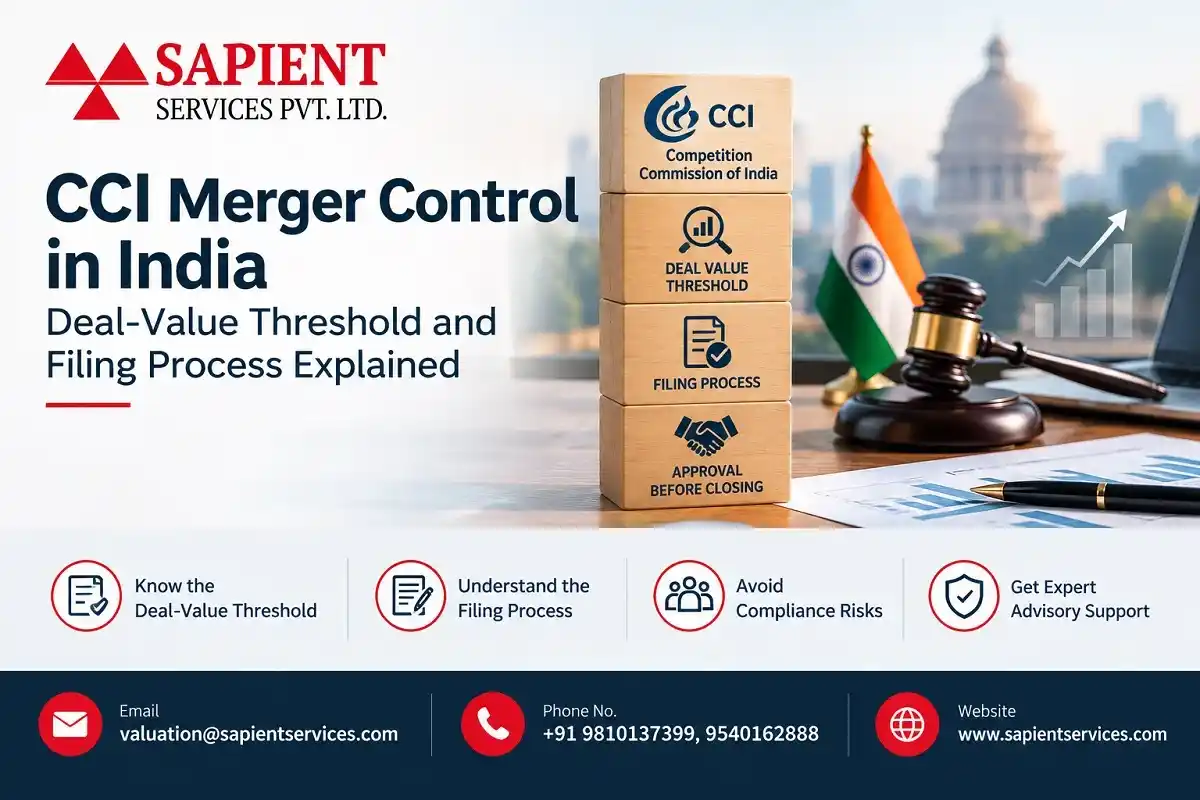
| Competition Act 2002 + DVT | CCI merger control — pre-closing mandatory | Deal value > INR 2,000 crore + SBO test (from 10 Sept 2024) |
| FEMA 1999 + NDI Rules 2019 | Cross-border pricing, FDI/ODI, reporting | Any transaction involving a non-resident party |
| Income Tax Act 2025 (eff. 1 Apr 2026) | Merger, slump sale, capital gains tax treatment | All deals effective on/after 1 April 2026 |
CCI Deal Value Threshold: Mandatory CCI pre-approval applies where deal value exceeds INR 2,000 crore AND the target has substantial India operations (10%+ users, revenue, or GMV from India). This closes the gap on high-valuation digital businesses with negligible Indian turnover. Penalty for gun jumping under Section 43A of the Competition Amendment Act 2023: up to 1% of the higher of total assets, total turnover, or deal value.
SEBI SAST open offer: When an acquirer of a listed company crosses 25% shareholding, a mandatory open offer for at least 26% of total shares is required at the SAST floor price. Post the SEBI SAST Amendment of 3 December 2025, open offer pricing for infrequently traded shares must be certified by an independent IBBI Registered Valuer.
|
Structuring an acquisition or merger? Sapient Services handles valuation, CCI filings, and M&A compliance. Contact us — +91 9540162888 |
The M&A Deal Process in India: 7 Stages
| Stage | What Happens |
| 1. Deal Origination + NDA | Strategic mandate or inbound approach; Non-Disclosure Agreement signed before data exchange |
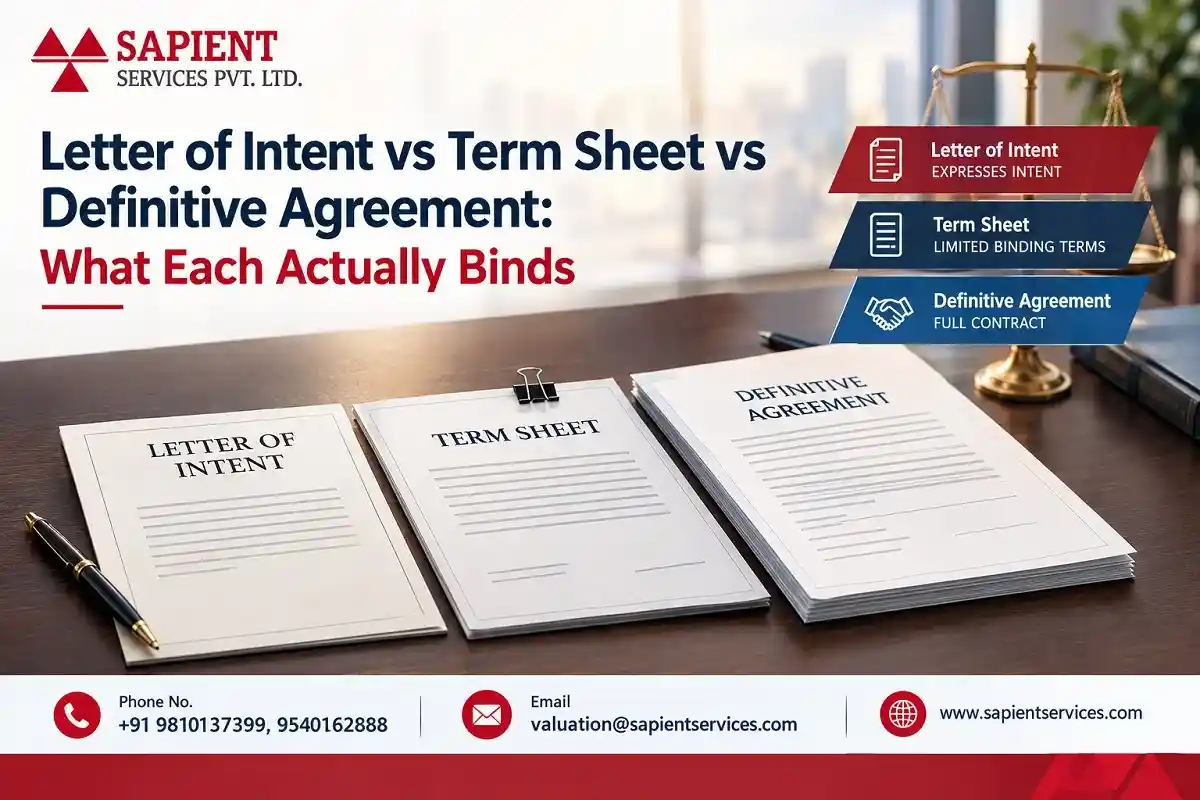
| 2. Term Sheet / LOI | Deal structure agreed (SPA, slump sale, NCLT scheme), indicative value, exclusivity period, break fee |
| 3. Due Diligence (4–12 weeks) | Financial DD (quality of earnings, net debt, working capital), legal DD (title, licences, contracts), tax DD, DPDP compliance DD |
| 4. Valuation | IBBI Registered Valuer for NCLT scheme swap ratio; Rule 53 FMV for slump sale; Merchant Banker for FEMA; two IBBI valuers for CIRP |
| 5. Definitive Agreements | SPA / BTA / scheme document negotiated — representations & warranties, indemnity caps, MAC clause, standstill for CCI |
| 6. Regulatory Approvals | CCI (30 days Phase I; up to 150 days Phase II), NCLT (4–6 months), SEBI Observation Letter (30 days), RBI for cross-border |
| 7. Closing + Integration | Conditions precedent satisfied; consideration paid; ROC and FIRMS portal filings; PMI plan activated from Day 1 |
TEV Study note: For manufacturing or infrastructure targets, Sapient Services conducts a Techno-Economic Viability study alongside financial DD — covering plant condition, remaining useful life, and capex requirements. This is mandatory for project finance-linked acquisitions.
M&A Tax Treatment Under the Income Tax Act 2025
The Income Tax Act 2025 replaced the 1961 Act from 1 April 2026. All deals with an effective date on or after 1 April 2026 use new section references. The fundamental tax scheme did not change — only the section numbers.
Qualifying Amalgamation — Tax-Neutral (Section 116)
A merger where shareholders receive shares in the successor company is tax-neutral — no capital gains arise at the merger date. The successor company inherits accumulated losses for the remaining balance of the original 8-year carry-forward period only — not a fresh 8 years from the merger date. Section 116 (old Section 72A). Any M&A model assuming a full 8-year shield post-merger is overstating tax synergies.
Slump Sale — Section 77 + Rule 53
Capital gains are computed on the higher of FMV1 (asset-based per Rule 53 formula) or FMV2 (consideration-based). Net worth of the transferred undertaking is the cost of acquisition. LTCG applies if held more than 36 months. An accountant’s certificate in Form No. 28 under Rule 54 must be filed with the ITR — old Form 3CEA and Rule 11UAE do not apply to post-April 2026 transactions.
| M&A Structure | Tax Treatment — IT Act 2025 |
| Qualifying amalgamation (shares as consideration) | Tax-neutral; Section 116 loss carry-forward — original 8-year window only |
| Non-qualifying merger (cash consideration) | Capital gains taxable in transferor; shareholder gains taxed at exchange |
| Qualifying demerger | Tax-neutral; proportionate loss transfer — Sections 105-106 conditions must be met |
| Slump sale | LTCG on higher of FMV1/FMV2 (Rule 53) if held > 36 months; Form No. 28 with ITR |
| Share purchase — unlisted | LTCG 12.5% if held > 24 months; STCG at applicable slab rate |
| IBC Resolution Plan acquisition | Clean slate — all past tax liabilities extinguished on NCLT approval |
M&A Valuation: Who Certifies and What Method Applies
Every Indian M&A transaction requires a formal valuation. The authorised professional and the methodology depend on the structure and governing statute.
- IBBI Registered Valuer (Securities class) — DCF + CCA; independent directors’ recommendation; SEBI Observation Letter for listed companies. NCLT merger scheme (swap ratio):
- IBBI Registered Valuer — higher of FMV1/FMV2 per Rule 53; Form No. 28 under Rule 54 filed with ITR. Slump sale FMV:
- SEBI Category I Merchant Banker — DCF or CCA under internationally accepted method; FC-GPR on FIRMS portal within 30 days. FDI/ODI cross-border deals:
- Two independent IBBI Registered Valuers — Fair Value + Liquidation Value; IVS-compliant per IBBI Circular IBBI/RV/93/2026 from April 2026. IBC CIRP (Regulation 35):
- Independent IBBI Registered Valuer — mandatory post 3 December 2025 SAST Amendment. SEBI SAST open offer (infrequently traded):
The most contested point in any M&A negotiation: the discount rate (WACC) in the DCF valuation. Seller’s adviser uses a lower WACC for a higher value; buyer’s adviser uses a higher WACC for a lower bid. A documented WACC — risk-free rate from 10-year G-Sec, equity risk premium, beta from listed comparables — determines which side holds the stronger position.
M&A Due Diligence: What to Check Before You Sign
Due diligence is not a reason to walk away — it is the basis for pricing the deal correctly. Four workstreams run in parallel.
| Workstream | Key Focus Areas |
| Financial DD | Quality of earnings (is EBITDA truly recurring?), normalised working capital, full net debt — bank loans, Ind AS 116 lease liabilities, contingent tax demands |
| Legal DD | Title to property, licence validity and change-of-control clauses, material contract assignment rights, pending litigation, labour compliance |
| Tax DD | Pending income tax assessments (transfer with the company in an SPA), transfer pricing, GST reconciliation, IT Act 2025 section mapping |
| DPDP Compliance DD | Mandatory for fintech, healthtech, edtech, D2C targets — consent mechanisms, data inventory, breach protocol, third-party processor contracts (DPDP Rules notified 14 November 2025) |
| Need financial DD, tax DD, or TEV Study support? Contact Sapient Services — +91 9540162888 | valuation@sapientservices.com |
Common M&A Mistakes — What Costs Deals Their Timeline
- CCI DVT analysis done after the SPA is signed. The INR 2,000 crore threshold applies to deal value — not Indian revenue. A high-valuation data business with minimal Indian turnover still triggers mandatory CCI filing. Run DVT and SBO test at term sheet stage.
- Assuming a fresh 8-year loss carry-forward after merger. Section 116 of the IT Act 2025 caps the window at the remaining original period — not a new 8 years from merger date. M&A models that assume a full 8-year shield are overstating the tax synergy.
- Using old Income Tax Act sections post-April 2026. Section 50B (slump sale) and Section 72A (amalgamation losses) are not in the IT Act 2025. The correct references are Section 77 and Section 116. Old sections in valuation reports or ITR schedules create compliance discrepancies.
- Closing before CCI approval (gun jumping). Standstill obligation is unconditional. Penalty under Section 43A, Competition Amendment Act 2023: up to 1% of total assets, turnover, or deal value — whichever is highest. NTPC and Massachusetts Mutual Life Insurance were penalised for this.
- No DPDP compliance DD for data-intensive targets. A data compliance gap found post-closing creates ongoing regulatory exposure — not just an SPA indemnity claim. Standard for fintech, healthtech, and D2C acquisitions in 2026.
M&A Advisory Services in Delhi NCR
Sapient Services is based in New Delhi (Okhla Phase II) and handles M&A mandates across Delhi, Noida, Gurgaon, Ghaziabad, and Faridabad. Our team conducts on-site due diligence, TEV studies, and NCLT-related valuation work for the Delhi bench — covering manufacturing groups, technology companies, and mid-market corporates across the National Capital Region.
Frequently Asked Questions
Q1. What is the difference between a merger and an acquisition?
A merger (amalgamation) combines two companies — the transferor ceases to exist. An acquisition purchases a controlling stake — the target continues to operate with new ownership. Both are governed by the Companies Act 2013 but follow different legal processes.
Q2. How long does an M&A transaction take in India?
Unlisted share acquisition: 3–6 months. NCLT merger scheme: 9–18 months. CIRP acquisition: 180–270 days from insolvency commencement. Cross-border deals needing RBI and NCLT: 12–24 months.
Q3. What is the CCI Deal Value Threshold?
Operational from 10 September 2024: CCI pre-approval mandatory where deal value exceeds INR 2,000 crore AND the target has 10%+ users, revenue, or GMV from India. Applies regardless of the target’s Indian assets or turnover.
Q4. What triggers a mandatory open offer under SEBI SAST?
Acquirer crossing 25% shareholding, or acquiring 5%+ in a financial year from a 25–75% base, triggers a mandatory open offer for at least 26% of total shares. Post 3 December 2025 SAST Amendment, pricing for infrequently traded shares must be certified by an independent IBBI Registered Valuer.
Q5. What is a slump sale and how is it taxed in 2026?
A slump sale transfers a business undertaking as a going concern for a lump sum — no individual asset prices assigned. Under Section 77 of the IT Act 2025, capital gains are the higher of FMV1 or FMV2 per Rule 53. Form No. 28 must be filed with the ITR under Rule 54.
Q6. What is a fast-track merger under Section 233?
Section 233 allows merger via Regional Director approval — bypassing NCLT. After the MCA amendment of 4 September 2025, eligible parties include small companies, holding-WOS structures, eligible unlisted companies, and start-up combinations.
Q7. How are merger losses treated under the Income Tax Act 2025?
Under Section 116 (replacing old Section 72A), the successor inherits the predecessor’s accumulated losses only for the remaining balance of the original 8-year carry-forward period — not a fresh 8 years from the merger date.
Q8. What is the clean slate benefit of IBC acquisitions?
Under the Supreme Court’s settled position (Essar Steel, 2019), all past liabilities — tax demands, penalties, litigation — are extinguished on NCLT approval of the Resolution Plan. The IBC Amendment Bill 2025 also removed mandatory pre-CoC-vote CCI approval.
Q9. Who certifies share valuation for FDI under FEMA?
FEMA 20(R) and the RBI Master Direction on FDI require a SEBI-registered Category I Merchant Banker for FDI and ODI share pricing — not an IBBI Registered Valuer alone. FC-GPR must be filed on FIRMS portal within 30 days of allotment.
Q10. What due diligence is required before an M&A transaction in India?
Four workstreams: financial DD (earnings quality, working capital, net debt, TEV study for manufacturing), legal DD (title, licences, contracts, labour compliance), tax DD (assessments, transfer pricing, GST, IT Act 2025 mapping), and DPDP compliance DD for data-intensive businesses.
|
Planning a merger, acquisition, or business transfer? Contact Sapient Services — M&A Advisory, Valuation, Due Diligence. +91 9540162888 | valuation@sapientservices.com |
Conclusion
India’s M&A market reached USD 123.8 billion in 2025. Three regulatory changes — CCI DVT, SEBI SAST Amendment (December 2025), and the Income Tax Act 2025 — changed how deals must be structured, priced, and closed in 2026.
The deals that succeed are the ones where the regulatory compliance map is built at term sheet stage, the valuation methodology matches the transaction structure, and integration planning begins before Day 1. Sapient Services provides M&A advisory, IBBI-registered valuation, financial and tax due diligence, and regulatory compliance support across all deal structures. Contact us at +91 9540162888 or visit sapientservices.com.