
Buy-side vs Sell-side M&A Advisory: 2026-27 Guide for India
 By
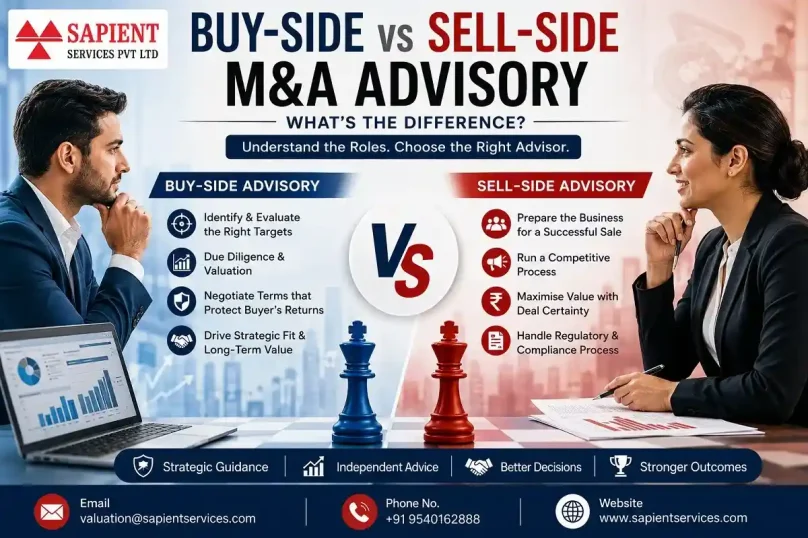
Every acquisition has two sides, and the advisor you hire decides whose interests get protected. Buy-side vs sell-side M&A advisory is the first choice a promoter or acquirer makes, and it is easy to get wrong when an offer arrives unannounced.
Grant Thornton Bharat counted 255 Indian M&A deals in the third quarter of 2026. Domestic transactions made up 188 of them, nearly three-fourths of the total.
By the end you will know which mandate fits your position, how fees and conflicts work, and what to check before you sign an engagement letter.
Sapient Services advises on both sides of such deals from Delhi. See our M&A advisory services in Delhi NCR to learn how we work.
Quick answer: A sell-side advisor works for the owner selling a business and aims for the best price and terms. A buy-side advisor works for the acquirer and aims to buy the right asset at a defensible price. Each side normally pays its own advisor, usually a retainer plus a success fee at closing, and one firm should not act for both parties in the same deal. In India, crossing 25% of a listed company’s voting rights triggers an open offer for at least 26%.
What is buy-side and sell-side M&A advisory?
Buy-side M&A advisory is professional help for the party acquiring a business. Sell-side M&A advisory is the same help for the party selling one.
In India the work runs through the Companies Act, 2013, SEBI’s takeover and merchant banker rules, FEMA for foreign investment and the Competition Act, 2002, depending on the deal.
Several of these laws require a valuation certificate or a regulated intermediary, so the advisor affects whether a deal can close.
Owners usually sell to exit, plan succession or bring in a growth investor. Buyers acquire for scale, new capability or market access.
Either mandate can go to an investment bank, a boutique firm, a business broker or a valuation and advisory firm. The advisor works alongside deal lawyers, who draft and negotiate the agreements.
In capital markets, “buy side” also means institutional investors such as funds, and “sell side” means banks that sell securities and research. This guide uses the M&A meaning only.
Who needs a buy-side or a sell-side advisor?
The mandate follows your position in the deal. If you are being paid, you need a sell-side advisor. If you are paying, you need a buy-side advisor.
| Your situation | Mandate | Why |
|---|---|---|
| You plan to exit or bring in a majority investor | Sell-side | Preparation and buyer competition move the price more than any single negotiating point. |
| A buyer has approached you without notice | Sell-side | One offer says little about market value. Test it against other buyers before you reply. |
| You want to sell a division or a stake and stay on as owner | Sell-side | A partial sale still needs a buyer search, a price and negotiated terms. |
| You are making your first acquisition | Buy-side | You have no benchmark for price, diligence scope or structure. |
| You acquire regularly but face a larger or unfamiliar deal | Buy-side | An in-house team may handle routine deals but not a new sector or a cross-border target. |
| A private equity fund is exiting one company and buying another | Both, as separate mandates | The same fund sits on opposite sides in two different transactions. |
Skipping the advisor has a price. Sellers who go to market with unreconciled numbers are re-priced in diligence. Buyers who rely on the seller’s information pay for earnings that do not hold up.
How sell-side M&A advisory works
A sell-side advisor prepares the business for sale, finds buyers and negotiates the best price the market will pay on workable terms. The work runs from a readiness review to the closing table.
- Readiness review: reconcile financials, normalise earnings and fix gaps a buyer would find anyway.
- Vendor due diligence where the deal size justifies it, so problems surface on the seller’s timetable.
- Valuation that sets a defensible asking range.
- A teaser and a confidential information memorandum (CIM) that tell the equity story without naming the owner before an NDA is signed.
- Controlled outreach, run as a limited auction or as bilateral talks with one buyer. Strategic buyers pay for synergies, while financial buyers such as private equity funds pay for cash flow and exit potential.
- Bid management: comparing indications of interest, running management meetings and weighing letters of intent (LOI) and exclusivity terms.
- Negotiation of price mechanics and the share purchase agreement, then closing support.
How buy-side M&A advisory works
A buy-side advisor helps an acquirer find the right target, pay a defensible price and avoid inheriting hidden problems. The work runs from the acquisition thesis through to integration planning.
- Acquisition thesis: what the target must add in size, geography, products or capability.
- Target screening and approaches to owners, often before a business is formally for sale.
- Preliminary valuation and a price ceiling agreed internally before negotiation starts.
- Due diligence coordination across financial, tax, legal and operational reviews, with a risk register that feeds price and protections.
- Structure and funding choices between a share purchase, a business transfer and a scheme, with their tax and approval consequences.
- Coordination of regulatory filings with the buyer’s lawyers and, where required, a SEBI-registered merchant banker.
- Closing support and post-merger integration planning.
Buy-side vs sell-side M&A advisory: side-by-side comparison
The two mandates look alike from outside and pull in opposite directions in practice. This table shows where they separate.
| Aspect | Sell-side advisor | Buy-side advisor |
|---|---|---|
| Client | Owner or shareholders selling | Acquirer or investor |
| Goal | Highest price and clean terms, with certainty of closing | The right asset at a defensible price, protected against hidden risk |
| Valuation posture | Normalised earnings, growth case and buyer synergies | Downside cases, risk-adjusted price and a walk-away ceiling |
| Process design | Create competition among several buyers | Screen several targets, then negotiate one deal |
| Due diligence role | Prepare and defend disclosures | Test and challenge disclosures |
| Negotiation focus | Price, payment timing, limited indemnities | Warranties, indemnities, escrow, working capital adjustment |
| Typical failure | The buyer re-prices after diligence | Paying for earnings that do not hold up |
The deal process, stage by stage
Both mandates follow the same stages, and the work inside each stage differs.
| Stage | Sell-side | Buy-side |
|---|---|---|
| 1. Strategy | Exit goals, timing and the minimum acceptable terms | Acquisition thesis, budget and funding |
| 2. Preparation or screening | Clean financials, normalised earnings, vendor due diligence | Longlist and shortlist of targets against the thesis |
| 3. Market approach | Teaser, NDA, CIM and controlled buyer outreach | Confidential approach to owners and first meetings |
| 4. Valuation | Asking range and supporting model | Price ceiling and downside cases |
| 5. Offers | Compare indications of interest, hold management meetings, manage LOIs, term sheets and exclusivity | Submit an indication of interest and negotiate the LOI and term sheet |
| 6. Due diligence | Run the data room and answer queries consistently | Financial, tax, legal and operational review with a risk register |
| 7. Agreement | Protect price and limit post-closing exposure under the share purchase agreement | Secure representations, warranties, indemnities, escrow and closing conditions |
| 8. Closing | Satisfy conditions and receive consideration | Complete filings and begin integration |
Timelines depend on deal size, sector and approvals, so no single figure fits.
Valuation and due diligence: how each side uses them
Both sides value the same company and reach different numbers because they ask different questions. The seller asks what a buyer who believes in the growth would pay. The buyer asks what the business is worth if the forecast falls short.
Both use discounted cash flow, comparable company multiples and precedent transactions, with different assumptions. Our guide to business valuation covers the methods.
How sellers use vendor due diligence
Sellers commission vendor due diligence to fix issues before buyers find them. A review of historical financials, working capital, debt-like items and tax compliance shortens buyer diligence and leaves less reason to cut the price.
How buyers price risk in due diligence
Buyers run diligence to price risk as well as to confirm numbers. Each finding should change the price, a warranty or a closing condition. See what due diligence involves for the workstreams.
Price mechanics: earn-outs, escrow and working capital peg
These terms decide how much of the headline price the seller keeps. A working capital peg, an earn-out, an escrow and rollover equity each move value between the parties after signing.
Indian rules that shape either mandate in 2026-27
Our guide to mergers and acquisitions in India explains these five checkpoints.
| Checkpoint | When it applies | What it changes in the mandate |
|---|---|---|
| CCI | Deal value above ₹2,000 crore with substantial Indian operations, or the asset and turnover tests are met | The acquirer notifies CCI and closing waits for approval. CCI has 30 calendar days for a prima facie view and 150 days overall. Closing early can attract a penalty. |
| SEBI Takeover Regulations | 25% or more of the voting rights in a listed company | An open offer for at least 26% follows, run through a SEBI-registered merchant banker. A SEBI amendment notified on 3 December 2025 requires an independent registered valuer for open offer pricing and share-swap pricing, with a nine-month transition for ongoing work. |
| FEMA | A non-resident buys, sells or subscribes to shares of an Indian company | Rule 21 of the NDI Rules, 2019 sets a pricing floor for sales to a non-resident and a ceiling for purchases from one. For unlisted shares, a chartered accountant, merchant banker or cost accountant certifies the valuation. |
| Companies Act, 2013 | A merger or demerger between Indian companies | Unlisted companies with borrowings up to ₹200 crore and no default can use the Section 233 fast-track route. Other schemes go to the NCLT under Section 232. Listed companies also need a registered valuer’s report and a fairness opinion. |
| Income-tax Act, 2025 | A business transfer or amalgamation | The Act applies from 1 April 2026, so FY 2026-27 is its first year. A slump sale and a tax-neutral amalgamation cost the seller different amounts of tax. |
General information, not legal advice. Confirm with your lawyers.
How M&A advisors charge: retainers, success fees and tail
M&A advisors are normally paid through a retainer plus a success fee that is due only when the deal closes. The exact structure sits in the engagement letter, and no two letters are identical.
| Component | How it works | What to confirm |
|---|---|---|
| Retainer | A fixed monthly or project fee covering preparation and market work | Whether it is credited against the success fee |
| Success fee | A percentage of transaction value, flat or tiered, payable at closing. Tiered formulas, including Modified Lehman-style structures, lower the rate as value rises | What counts as transaction value: earn-outs, deferred payments, rollover equity and assumed debt |
| Expenses and tail | Out-of-pocket costs, and a period after termination when a fee can still apply | The expense cap, the tail length and any minimum fee |
Fixed percentages are not published here because they depend on deal size and scope. Ask every advisor to quote the total cost at three different deal values.
Can one firm advise both sides?
No. A firm paid to raise a seller’s price cannot also work to lower it for the buyer. A conflict of interest arises whenever one advisor serves both parties in the same transaction.
A firm can act for sellers in some deals and for buyers in others, which is normal. Ask for written confirmation of the side it represents in your deal.
Valuation is a separate question. One firm can value a company and also advise on price, but where the law requires a registered valuer, the valuation report has to stay independent.
Buy-side and sell-side M&A in Delhi NCR
Sell-side mandates in Delhi NCR usually come from promoters planning an exit, owners holding an unsolicited offer and funds selling a holding. Buy-side mandates come from MSMEs buying a competitor or supplier, listed companies preparing a takeover, foreign companies entering India and funds adding a portfolio company.
Resolution applicants under the Insolvency and Bankruptcy Code, 2016 need one mandate or the other, depending on the case.
Geography changes the paperwork. The state of the registered office decides which Registrar and which NCLT bench handles a scheme, so a Gurugram or Noida target can follow a different path from a Delhi one.
An illustrative scenario
This is a hypothetical example written to show how the process works. It is not a Sapient client case.
Situation: the owner of a family-run auto components manufacturer in Faridabad receives an unsolicited offer from a larger buyer. Challenge: the price sounds attractive, but there is no benchmark, the books carry unreconciled related-party balances and the buyer wants 60 days of exclusivity from day one.
A sell-side advisor would reconcile the accounts, value the business on normalised earnings and approach a small group of other buyers under NDA. Exclusivity would come only after a priced letter of intent is on the table.
Outcome: the owner negotiates against real alternatives, and the first buyer’s offer can be judged against them. If you are in a similar position, contact our mergers and acquisitions advisory in Delhi team.
Common mistakes on each side
A common misconception is that one valuation can serve both sides.
- Going to market with unreconciled numbers. Buyers find the gaps in diligence and use them to cut the price. Reconcile financials and normalise earnings before outreach.
- Talking to one buyer. A single bidder has no reason to pay the top of their range. Run a limited, confidential process even when one buyer is keen.
- Pricing a target off the seller’s EBITDA. Add-backs in a CIM need testing. Rebuild earnings from the ledger.
- Letting the data room drift. Inconsistent answers across a long process make buyers doubt the numbers. Give one person ownership of every query.
- Hiring on the headline success fee. A low rate with a long tail, a high minimum and uncapped expenses can cost more than a higher rate. Compare total cost at three deal values.
Six practical tips before you sign an engagement letter
- Decide your side first, then shortlist advisors by the mandate they cover.
- Ask who will do the work. Senior people often win the mandate and juniors run it.
- Get the tail and the minimum fee in writing. Both decide what you owe if the deal closes late or lower.
- Sign an NDA before any identifying detail leaves your company, and keep the first outreach list short.
- Plan approvals early. A CCI filing, NCLT petition or FEMA certificate can add weeks, so run them alongside diligence.
- Use the right certifier. A valuation from the wrong professional can be rejected at filing.
Frequently asked questions
What is the difference between buy-side and sell-side M&A advisory?
Sell-side M&A advisory represents the party selling a business and works to raise price and certainty of closing. Buy-side M&A advisory represents the acquirer and works to find the right target, set a price ceiling and limit inherited risk. One firm should not serve both sides of the same deal.
Is an M&A advisor the same as an investment banker?
Not always. An investment bank is one kind of M&A advisor, usually for larger deals. Boutique firms, business brokers and valuation and accounting firms handle many mid-market and MSME deals. Steps that need a SEBI-registered merchant banker, such as an open offer, must go through one.
Can one firm act for both the buyer and the seller?
Not in the same transaction. The advisor’s duty is to improve one party’s outcome, and the other party’s interest runs the opposite way. A firm can act for sellers in some deals and buyers in others if it confirms the side in writing each time.
When should a business owner hire a sell-side advisor?
Hire one before you approach any buyer, and well before your target exit date, because preparation takes time. An unsolicited approach is also a good moment to get advice, since one offer says little about what the market would pay.
When does an acquirer need a buy-side advisor?
Acquirers gain most on a first acquisition, a deal in an unfamiliar sector or a cross-border target. An advisor adds a price benchmark, a diligence plan and negotiation support that an in-house team may lack. Repeat acquirers often bring one in for deals larger than their usual size.
How are M&A advisory fees structured in India, and who pays?
Most mandates combine a retainer with a success fee payable at closing, flat or tiered, and the rate usually falls as the deal gets larger. Each side pays its own advisor, and a seller’s fee is normally deducted from the proceeds at closing.
How long does an M&A process take?
It depends on deal size, sector and approvals, so any single figure is a rough guide. Preparation or screening, due diligence, structuring and regulatory filings each add time, and a CCI review alone can run up to 150 days. Starting approvals early is the best way to shorten the total.
What documents does a seller need before approaching buyers?
A seller needs several years of audited financial statements, current-year management accounts, tax returns, material contracts and statutory compliance records. Debtor and creditor ageing, litigation details and a shareholding statement are also standard. Organised in one place, they speed up diligence and give a buyer less reason to re-price.
Does CCI approval apply to a mid-sized deal?
It can. A deal worth more than ₹2,000 crore needs CCI approval if the target has substantial business operations in India, even when its own assets and turnover are small. Below that, the usual thresholds and exemptions decide. Closing before approval can attract a penalty.
Do I need a registered valuer in an M&A deal?
It depends on the law that applies. Valuations required under the Companies Act, 2013 must come from a valuer registered with IBBI. For FEMA pricing of unlisted shares, a chartered accountant, SEBI-registered merchant banker or practising cost accountant can certify.
How do I choose an M&A advisor in India?
Pick the advisor for your side first. Then check who will do the work, how the fee, tail and minimum are set, and whether the firm confirms in writing which side it represents. Ask for experience with deals of your size and sector.
Does the process differ for Gurugram, Noida or other NCR businesses?
The stages are the same, but the state of the registered office decides which Registrar and NCLT bench a scheme goes to. Sapient advises from Okhla, New Delhi, across Delhi NCR. For mandates elsewhere, see our M&A advisory services in India.
Have more questions about a deal? Contact our team directly on +91 9540162888 or at valuation@sapientservices.com.
Next step: decide your side before you call anyone
The mandate you need follows from where you sit in the deal. Sellers gain most from preparation and competition among buyers. Buyers gain most from screening and diligence that change the price.
Before you speak to any advisor, work through this short list:
- Write down whether you are being paid or paying in this deal.
- Collect the last several years of audited financials, tax returns and material contracts.
- List the approvals that could apply: CCI, SEBI, FEMA or NCLT.
- Ask each advisor, in writing, which side it represents and how its fee, tail and minimum work.
If you need a compliant valuation report or deal support in Delhi NCR, call Sapient Services on +91 9540162888, write to valuation@sapientservices.com or visit Sapient House, S-15, Okhla Industrial Area, Phase II, New Delhi 110020.
Reviewed by Devendra Kumar Malhotra, Registered Valuer under the Companies Act, 2013.