
A Complete 2026 Guide to GST Audit: Meaning, Procedure & Compliance
 By
By 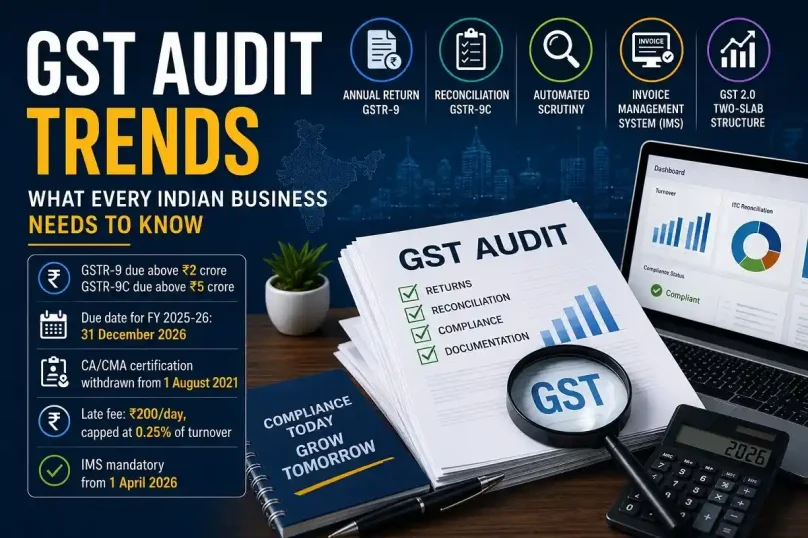
By Devendra Kumar Malhotra, Registered Valuer under the Companies Act, 2013 and Wealth Tax Act, Sapient Services Pvt. Ltd., New Delhi
Last updated: 1 October 2026
The mandatory CA-certified audit is gone. The risk it covered is not. For a GST audit in 2026, officers start from your return data, and a gap between GSTR-1, GSTR-3B and GSTR-2B can open a notice before anyone asks for a single document.
This guide covers how an audit runs, what auditors ask for, what IMS and the 2025 rate changes did to ITC reconciliation, and what a shortfall costs. The dated plan near the end gets your FY 2025-26 reconciliation done by 31 December 2026. Want a second review first? Sapient’s compliance consultancy page lists what we offer.
|
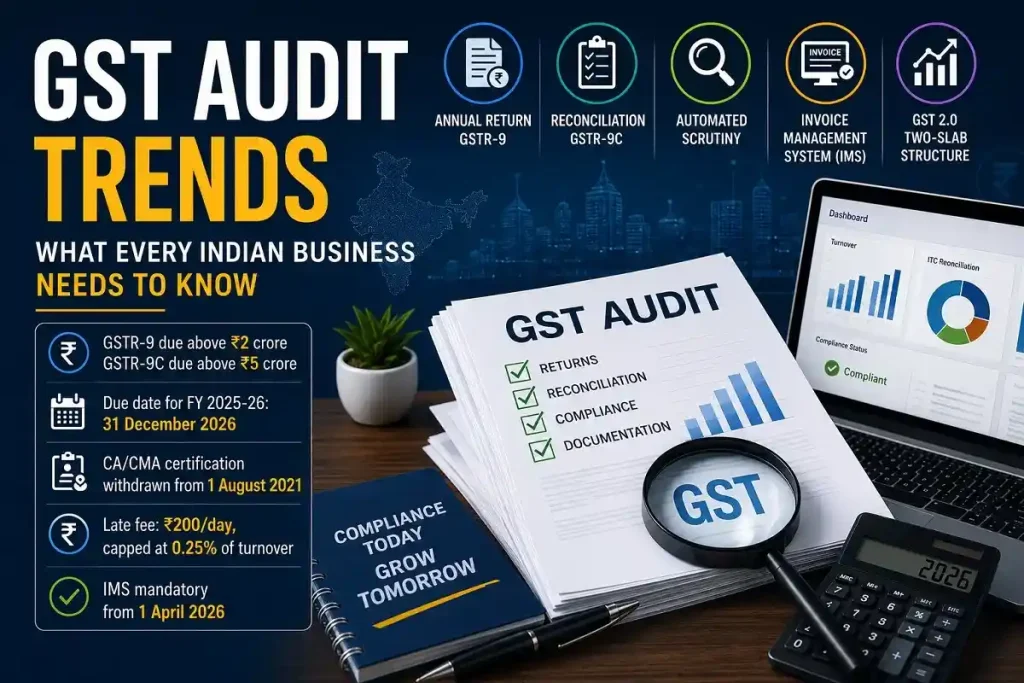
Quick answer A GST audit checks whether your returns, books and input tax credit (ITC) agree. Under Section 65, tax officers can audit any registered person. There is no turnover threshold, the notice must give at least 15 working days, and the audit must finish within three months of commencement, extendable by up to six. GSTR-9 and the self-certified GSTR-9C (above ₹5 crore) are filing obligations, not audits. For FY 2025-26 both are due by 31 December 2026, unless CBIC extends the date. |
Six ways GST compliance can be examined
A GST audit examines your records, returns and documents to check turnover, tax paid, refunds and ITC (Section 2(13), CGST Act, 2017). Not every route below is an audit, but each can end in a demand. Until FY 2019-20, businesses above ₹2 crore also needed a CA or cost accountant to audit their accounts. That ended from FY 2020-21 (Notification 29/2021-Central Tax, 30 July 2021).
| Route | Law | Started by | Worth knowing |
|---|---|---|---|
| Annual return and reconciliation | Section 44, Rule 80 | You | A filing, not an audit. GSTR-9 above ₹2 crore turnover (optional up to ₹2 crore, subject to notified exemptions). GSTR-9C above ₹5 crore, self-certified. |
| Scrutiny of returns | Section 61, Rule 99 | Officer | Desk review of filed returns. Notice comes in Form ASMT-10. |
| Departmental audit | Section 65, Rule 101 | Commissioner or authorised officer | No turnover threshold. |
| Special audit | Section 66, Rule 102 | Commissioner, via a nominated CA or cost accountant | No turnover threshold. |
| Assessment | Sections 62 to 64 | Officer | Non-filers, unregistered supplies, summary assessment. |
| Inspection and search | Section 67 | Authorised officer | Suspected evasion. Separate from audit. |
Only the first route is in your hands. Whoever signs GSTR-9C vouches for the reconciliation, so your own review has to do the work the CA audit used to do.
How a GST departmental audit works
A departmental audit under Section 65 is an examination of your records and returns by tax officers to verify compliance. Section 65 and Rule 101 set the sequence.
| Step | What happens | Time limit |
|---|---|---|
| 1. Notice | The officer issues Form ADT-01 with the audit period and start date. | At least 15 working days before the audit starts. |
| 2. Records | You produce the records demanded (Section 71(2)). | Up to 15 working days from the demand, or longer if the officer allows. |
| 3. Audit | Held at your premises or the officer’s office. | Within three months of commencement. The Commissioner can extend by up to six. |
| 4. Observations | The officer may share discrepancies, and you can reply (Rule 101(4)). | Before findings are finalised. |
| 5. Findings | Findings, your rights and the reasons come in Form ADT-02. | Within 30 days of concluding the audit. |
| 6. Follow-up | Short-paid tax can lead to proceedings under Section 73, 74 or 74A. | See the penalties section. |
Two clocks run in an audit. Section 71(2) gives you up to 15 working days from a demand to produce records. The officer’s three months starts only when those records are made available or the audit is actually instituted, whichever is later (Section 65(4)). Late records push the department’s clock back, which is no reason to produce them late.
Special audit under Section 66
You can be directed to have your records audited by a CA or cost accountant the Commissioner nominates. The direction comes in Form ADT-03, the report in ADT-04 within 90 days (extendable by 90), and the department pays the fees.
Documents required for a GST audit
Section 71(2) names the core records. Officer manuals add the rest. Keep these ready:
- Returns and registration: registration certificate, plus GSTR-1, GSTR-3B, GSTR-9 and GSTR-9C with filing proof.
- Sales: sales register, tax invoices, credit and debit notes, e-invoice and e-way bill data, export papers.
- Purchases and ITC: purchase register, supplier invoices, GSTR-2B and IMS records, reverse charge and ITC reversal workings.
- Accounts: trial balance, audited financial statements, ledgers, bank statements, and any cost audit or income tax audit report.
- Stock, job work and refunds: stock registers, job work challans, refund files with shipping bills.
Add one working paper that no list asks for: a turnover bridge tying GST turnover to income tax turnover and the books. The Model All India GST Audit Manual lists a mismatch between those two figures among its exception reports, so the explanation is worth having on file before anyone asks.
GST audit trends 2026: how audits are selected
The department works from data. The Model Manual describes analytics tools run by GSTN and the Directorate General of Analytics and Risk Management, and lists the exception reports officers use to pick cases. It is guidance, not law, and a mismatch does not by itself establish liability.
| Mismatch an officer can see | What to do |
|---|---|
| ITC claimed above GSTR-2B | Find out why before you claim: supplier reporting, timing, reverse charge or imports, other ITC rules. |
| GSTR-1 and GSTR-3B turnover differ | Reconcile sales data before each filing. |
| GST and income tax turnover differ | Keep a documented bridge that explains the legitimate differences. |
| ITC involving a supplier whose registration was cancelled | Check the cancellation date against the invoice date. |
| Turnover below e-way bill movement | Match e-way bill data to the sales register. |
| Blocked credit claimed under Section 17(5) | Tag blocked categories in the accounting system. |
IMS and GSTR-2B: what changed for ITC reconciliation
IMS has been live on the GST portal since October 2024. Each supplier invoice, debit note and credit note saved in GSTR-1 lands on your dashboard, and you accept it, reject it or hold it pending. You can act until you file GSTR-3B for the month. If you do nothing, the record is deemed accepted when GSTR-2B is generated (GSTN advisory). Section 38 was amended from 1 October 2025, and GSTR-2B now reflects what you accept or are treated as accepting.
- Accept: the record enters ITC available in GSTR-2B and auto-populates GSTR-3B.
- Reject: the record moves to ITC rejected and does not auto-populate GSTR-3B. The supplier can see your action.
- Pending: the record stays out of GSTR-2B and GSTR-3B and waits on the dashboard. The Section 16(4) cut-off still applies.
Acceptance does not make a credit eligible. Sections 16 and 17 still decide that.
Three details trip people up. GSTR-2B is sequential: it is not generated for a period until you file the previous period’s GSTR-3B. Acting after the 14th means recomputing GSTR-2B from the IMS dashboard. Some records, such as certain reverse charge supplies, skip IMS and go straight to GSTR-3B.
Say a supplier uploads an invoice at the wrong value. Left alone, it is deemed accepted and you claim credit on that figure. Treat IMS as part of the monthly close, before the draft GSTR-2B appears on the 14th.
GST 2.0: where the audit risk sits
The 56th GST Council meeting on 3 September 2025 recommended a standard 18% rate and a merit 5% rate, with a special 40% rate for a select few goods and services (press release). Most rate changes took effect on 22 September 2025. Pan masala, gutkha, cigarettes, zarda, unmanufactured tobacco and bidi followed a separate transition. Compensation cess ended on 22 September 2025 for most goods, and for pan masala and tobacco on 1 February 2026 (Notification 03/2025-Compensation Cess (Rate), 31 December 2025; GST Council newsletter).
The audit risk is a stale rate master: an invoice issued at the old rate shows up as a gap between the rate charged and the rate due. Re-map every HSN and SAC code. Reverse ITC under Section 17(2) where a supply became exempt. For the FY 2025-26 GSTR-9C, review transactions around 22 September 2025 separately, and apply the time-of-supply rules to decide which rate applied.
Interest, late fee and penalties: Sections 73, 74 and 74A
The section that applies depends on the financial year. Sections 73 and 74 cover periods up to FY 2023-24, and Section 74A covers FY 2024-25 onward. Interest under Section 50 applies in every case.
| Period and case | Sec. | Notice window | Penalty | Paying early |
|---|---|---|---|---|
| Up to FY 2023-24, no fraud | 73 | 3 years from annual return due date | 10% of tax or ₹10,000, whichever is higher | No penalty if you pay tax and interest before the notice or within 30 days of it. |
| Up to FY 2023-24, fraud or suppression | 74 | 5 years from annual return due date | Equal to the tax | 15% before the notice, 25% within 30 days of it, 50% within 30 days of the order. |
| FY 2024-25 onward, no fraud | 74A | 42 months from annual return due date. Order within 12 months of notice, extendable by up to 6. | 10% of tax or ₹10,000, whichever is higher | No penalty if you pay tax and interest before the notice or within 60 days of it. Exception: self-assessed or collected tax not paid within 30 days of its due date (Section 74A(11)). |
| FY 2024-25 onward, fraud or suppression | 74A | 42 months from annual return due date | Equal to the tax | 15% before the notice, 25% within 60 days of it, 50% within 60 days of the order. |
In non-fraud cases the statute gives you a no-penalty window to pay tax and interest. In fraud cases the penalty percentage climbs at each stage, so delay costs money.
Late filing of GSTR-9 attracts a late fee under Section 47. Per Notification 07/2023-Central Tax, it is ₹50 a day up to ₹5 crore turnover, ₹100 a day above ₹5 crore up to ₹20 crore, and ₹200 a day above ₹20 crore (CGST and SGST together). The caps are 0.04%, 0.04% and 0.5% of turnover in the State or Union territory. In a hypothetical case, a ₹10 crore business files 30 days late. The fee is 30 × ₹100 = ₹3,000, well below the 0.04% cap of ₹40,000.
How to reply to a GST audit notice
Read the form number first, because ADT-01, ASMT-10, DRC-01A and a show cause notice follow different rules.
- Note the period, the form and the deadline. An ASMT-10 reply goes in Form ASMT-11 within 30 days, and the officer can extend that (Rule 99; CBIC Instruction 02/2023-GST, 26 May 2023).
- Reconcile the period the notice names: returns, books, GSTR-2B and IMS records.
- Separate timing differences from genuine errors. Pay a genuine shortfall through Form DRC-03 with interest.
- Reply on the GST portal under View Notices and Orders, with supporting documents attached.
- If you need more time for a hearing, ask for an adjournment before the date. The law allows no more than three (Section 75(5)).
Before a show cause notice under Section 73, 74 or 74A, the officer may send a pre-notice intimation in Part A of Form DRC-01A (Rule 142(1A)). It is an intimation, not an order. Check the officer’s computation against the underlying discrepancy before you pay. If you pay the tax and interest in full at that stage through DRC-03, no notice is served for the amount you paid.
GST audit and income tax audit
For FY 2025-26, tax audit stays under the Income-tax Act, 1961, because the year relates to assessment year 2026-27. The Income-tax Act, 2025 applies from tax year 2026-27, and its Section 63 replaces Section 44AB.
| GST | Income tax | |
|---|---|---|
| Law | CGST Act: Sections 44, 61, 65, 66 | Section 44AB, Income-tax Act, 1961 (FY 2025-26). Section 63, Income-tax Act, 2025 (tax year 2026-27 onward). |
| Trigger | GSTR-9 above ₹2 crore, GSTR-9C above ₹5 crore. Departmental audit has no threshold. | Business turnover above ₹1 crore (₹10 crore if cash receipts and payments stay within 5%). Professional receipts above ₹50 lakh. |
| Who signs | Taxpayer self-certifies GSTR-9C. | A chartered accountant issues the report. |
An illustrative reconciliation (hypothetical figures)
Books show ITC of ₹12.4 lakh and GSTR-2B shows ₹11.1 lakh. The ₹1.3 lakh gap splits into ₹0.9 lakh from vendors who filed GSTR-1 late and ₹0.4 lakh claimed on a blocked category under Section 17(5). The first part looks like timing: claim it in the period it appears in GSTR-2B, inside the Section 16(4) cut-off. The second is an error, so correct it through DRC-03 with interest. Keep both workings with the return.
A dated plan to 31 December 2026
| When | What to do |
|---|---|
| Every month, before the 14th | Review IMS records, reconcile purchases with GSTR-2B, and match GSTR-1 with the sales register and GSTR-3B. |
| Every quarter | Compare GST turnover with income tax turnover, and re-check HSN and SAC codes against current rates. |
| By 30 November 2026 | Claim any remaining FY 2025-26 ITC, or do it before you file GSTR-9 if that is earlier (Section 16(4)). |
| By 31 December 2026, unless CBIC extends the date | Review transactions around 22 September 2025, reconcile, file GSTR-9 and GSTR-9C, and pay any shortfall through DRC-03 with interest. |
Need a second review of a reconciliation or a notice reply? The Audit and Assurance and Compliance Consultancy pages describe Sapient’s services, and you can contact us to discuss scope.
Frequently asked questions
Q: Is CA certification of GSTR-9C mandatory in 2026?
A: No. Taxpayers above ₹5 crore turnover self-certify the GSTR-9C reconciliation, and the CA audit requirement ended from FY 2020-21. The department can still audit any business under Section 65.
Q: Who must file GSTR-9 and GSTR-9C, and by when?
A: GSTR-9 is mandatory above ₹2 crore aggregate turnover and optional up to ₹2 crore, subject to notified exemptions. GSTR-9C is also required above ₹5 crore. For FY 2025-26, both are due by 31 December 2026 unless CBIC extends the date, and composition taxpayers do not file GSTR-9C.
Q: What is the difference between GST scrutiny and a departmental audit?
A: Scrutiny under Section 61 is a desk review of your filed returns, and it starts with a notice in Form ASMT-10. A departmental audit under Section 65 examines your books and records, starts with Form ADT-01 and ends with findings in ADT-02. Either can lead to a demand.
Q: Can the department audit a business below ₹5 crore?
A: Yes. Section 65 has no turnover threshold, and Section 61 scrutiny applies to any registered person. Falling below ₹5 crore only removes the GSTR-9C filing.
Q: How much notice does an audit give, and how long can it run?
A: At least 15 working days’ notice in Form ADT-01. The audit must finish within three months of commencement, and the Commissioner can extend that by up to six months. Findings follow in ADT-02 within 30 days of the audit concluding.
Q: What happens if I take no action on an IMS record?
A: It is deemed accepted when GSTR-2B is generated and moves into ITC available, subject to the usual ITC conditions. Pending keeps it out for that month. You can act until you file GSTR-3B, but acting after the 14th means recomputing GSTR-2B.
Q: What happens if a supplier files GSTR-1 late?
A: The invoice reaches your IMS when the supplier saves it, but enters GSTR-2B only after the supplier files the return. Claim the credit in the period it appears, and watch the Section 16(4) cut-off.
Q: What triggers a GST scrutiny or audit?
A: Officer manuals list mismatches such as GSTR-3B against GSTR-1, ITC against GSTR-2B, ITC involving cancelled suppliers, GST against income tax turnover and turnover against e-way bills. Unexplained gaps raise the chance of further scrutiny, so reconcile significant differences before you file.
Q: What is DRC-01A, and should I pay at that stage?
A: It is a pre-notice intimation in which the officer sets out the tax, interest and penalty worked out so far (Rule 142(1A)). Verify the computation first. If it is right, paying in full through DRC-03 means no show cause notice is served for the amount paid.
Q: Does an audit cover all my GSTINs?
A: It can. The Model All India GST Audit Manual says all registrations under one PAN in a State may be selected together. Keep a reconciliation ready for each GSTIN, not only the one named in the notice.
Your next step
This week, pull your FY 2025-26 purchase register against GSTR-2B and label every gap: supplier timing, supplier default or your own error. Some timing gaps resolve when the supplier files or corrects the record, and others need follow-up. Defaults and your own errors need action. A labelled list like that is a sound starting point for any notice reply.
To talk through scope, call Sapient Services Pvt. Ltd., Okhla Industrial Area, New Delhi, on +91 9540162888 or write to valuation@sapientservices.com.