
What Is TEV Study Report
 By
By 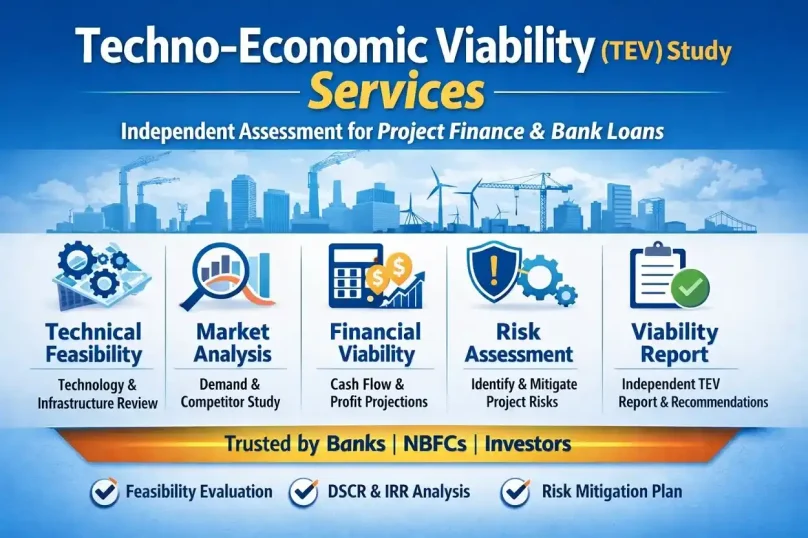
If you’ve ever tried getting a term loan for a large project in India — a manufacturing plant, a hotel, a solar farm, anything above a few crores — chances are a bank officer told you: “Get a TEV study done first.”
And you probably wondered: what exactly is a TEV study, who does it, and why does the bank need it before they even look at your loan application?
This guide answers all of that. No jargon overload. No generic definitions. Just a clear, ground-level explanation of how TEV studies work, what goes inside them, who needs them, and how they connect to the LIE Report — which becomes equally important once your project actually gets funded.
What Is a TEV Study? The Real Meaning
TEV stands for Techno Economic Viability. A TEV study is essentially a formal, third-party examination of a project that tells a bank or investor two things: Can this project actually be built and run? And will it make enough money to repay the loan?
Think of it this way. A promoter walks into SBI or PNB with a ₹50 crore project. They have a business plan, some Excel sheets, and a lot of confidence. But the bank can’t just take their word for it. They need an independent expert — someone with no skin in the game — to evaluate the project from scratch.
That’s exactly what a TEV study is. It is a risk mitigation exercise adopted by banks and financial institutions while making a decision to lend money on a particular project.
It’s not just a formality. In India’s high-stakes funding environment, a TEV report is the difference between being seen as a viable investment or an avoidable risk.
Why Banks in India Mandate a Techno Economic Viability Report
Here’s something most borrowers don’t realize: banks don’t always have in-house technical expertise for every sector. A banker who’s excellent at credit appraisal may not understand the nuances of a cement plant, a solar EPC project, or a cold storage chain.
So banks outsource this specialized evaluation to empanelled consultants. Banks and financial institutions require TEV studies for project loans appraisal, project financing (term loans), and revitalizing distressed assets.
Public sector banks like SBI and PNB mandate TEV studies for large loan proposals. Even NBFCs and private equity funds are increasingly asking for them before committing capital.
Without a TEV report, your loan application is essentially incomplete. The bank has no independent way to validate your cost estimates, technology choices, or revenue projections. And that almost always results in delays — or outright rejection.
Who Conducts a TEV Study?
Not just anyone. Leading banks, including public sector banks, maintain a panel of empanelled consultants — technical and financial experts with proven experience in project evaluation. Only these accredited professionals are authorised to submit TEV reports accepted for funding consideration.
SBI, for instance, maintains a list of empanelled TEV consultants, and has specific guidelines for who can get empanelled. The individual or firm should possess specific professional qualifications in the subject of their proposed area of specialisation, and should not be delisted or de-panelled by any other bank or financial institution.
So when you’re choosing a TEV consultant, always verify that they’re empanelled with your target lending bank. A report from a non-empanelled firm might simply not be accepted.
What Does a TEV Report Cover? The 5 Core Components
A proper techno economic viability report is not a thin document. It’s a detailed, multi-dimensional analysis. Here’s what it typically covers:
1. Technical Feasibility Assessment
This section evaluates whether the project can actually be built and operated. It includes:
- Land availability and suitability
- Choice of technology and its relevance to Indian conditions
- Production capacity and operational efficiency
- Infrastructure availability — power, water, logistics
- Compliance with technical standards and statutory approvals
- Environmental and scalability considerations
The TEV study takes into account project description, historical background of the project, details of the management and operations, marketing policies, accounting statements, financial data, tax obligations, and legal requirements.
2. Market Potential Analysis
This goes beyond basic demand-supply data.
The TEV study analyzes the market demand for the product or service being offered. It includes a review of market trends, competition, pricing strategies, and the overall market environment.
A good market analysis in a TEV report will also assess the macro-economic outlook for the sector — both local and global trends, government policy support, and how the proposed project fits into the competitive landscape.
3. Financial Viability Assessment
This is the section that banks look at most closely.
Key financial metrics such as Return on Investment (ROI), Internal Rate of Return (IRR), Net Present Value (NPV), and Debt Service Coverage Ratio (DSCR) are calculated to evaluate the project’s financial health and sustainability.
The assessment also includes sensitivity analysis of the project and evaluation of the Cost of Project, Means of Finance, and Source of Promoter’s Contribution.
DSCR is particularly critical for banks. If the project can’t comfortably cover its debt repayments from operating cash flows, the loan proposal will face serious questions.
4. Management Capabilities Assessment
Banks don’t just fund projects — they fund promoters. The assessment of management capabilities and Corporate Governance covers key areas including the profile of sponsors, their background, and the project-specific experience of promoters in executing similar projects.
This section often determines whether a borderline project gets funded or not. Strong promoters with a credible track record can tip the scales.
5. Risk Analysis and SWOT
Every TEV study includes a structured risk assessment. It takes into account an analysis of technological risk, market risk, regulatory risk, and financial risk — a critical evaluation of these parameters is essential for a meaningful TEV study.
Alongside this, a SWOT analysis evaluates both internal strengths/weaknesses and external opportunities/threats. The report closes with clear recommendations — whether to proceed, modify, or reject the project.
TEV Study: Key Financial Metrics at a Glance
| Metric | What It Tells the Bank |
|---|---|
| IRR (Internal Rate of Return) | Expected rate of return on the project investment |
| DSCR (Debt Service Coverage Ratio) | Ability to repay loan from operating cash flows |
| NPV (Net Present Value) | Project’s net value in today’s money |
| ROI (Return on Investment) | Overall profitability relative to investment |
| MPBF (Maximum Permissible Bank Finance) | Maximum loan the bank can safely extend |
| TOL/ATNW (Total Outside Liabilities/Adjusted Tangible Net Worth) | Leverage and balance sheet health |
Which Sectors Require a TEV Feasibility Study?
Real estate and hospitality are the predominant sectors, along with manufacturing, renewable energy, infrastructure, and gems and jewellery.
More broadly, the sectors where TEV reports are most commonly commissioned include:
- Infrastructure — roads, bridges, airports, railways
- Renewable energy — solar, wind, biomass projects
- Manufacturing — chemicals, textiles, food processing
- Hospitality — hotels, resorts, convention centres
- Real estate — commercial developments, SEZs
- Telecom — network expansion projects
- Healthcare — hospitals, diagnostic centres
If your project requires a large term loan — typically above ₹1–2 crore for most public sector banks, and higher thresholds for larger institutions — a technical feasibility study is almost always mandatory.
How Long Does a TEV Study Take?
The process can take anywhere from 2 to 6 weeks, depending on the scale and complexity of the project.
Here’s a rough timeline for a standard project:
| Stage | Typical Duration |
|---|---|
| Document collection and initial review | 3–5 days |
| Site visit and field assessment | 2–4 days |
| Market research and industry analysis | 5–7 days |
| Financial modelling and projections | 5–7 days |
| Report drafting and internal review | 4–6 days |
| Final report submission | 1–2 days |
| Total | ~3 to 6 weeks |
Delays usually happen at the document collection stage. Getting all the inputs ready — project reports, quotes, management profiles, land documents — before the consultant even starts can cut the timeline significantly.
Documents You Need to Prepare
Before a TEV consultant begins their assessment, they’ll typically need:
- Detailed Project Report (DPR) or project concept note
- Promoter and management profiles
- Land documents and statutory approvals obtained so far
- Technology vendor quotes and specifications
- Historical financial statements (for existing businesses)
- Market research or demand studies (if available)
- Projected financial statements and assumptions
The more organized and complete your documentation, the faster and smoother the TEV process goes.
TEV Study vs. Feasibility Study — What’s the Difference?
People often use these terms interchangeably. They’re related, but not identical.
| Aspect | TEV Study | Feasibility Study |
|---|---|---|
| Conducted by | Empanelled independent consultant | Internal team or consultant |
| Required by | Banks, NBFCs, investors | Promoters, internal decision-making |
| Scope | Technical + financial + market + management | Varies — may be broader or narrower |
| Output used for | Loan approval, project sanction | Investment decision, project planning |
| Regulatory backing | Bank empanelment guidelines | No formal regulatory requirement |
| Stage | Pre-disbursement | Pre-investment / early planning |
Essentially, a feasibility study is something you do for yourself. A TEV study is something a bank asks you to get done.
What Is the LIE Report? (And How It Connects to the TEV Study)
Once a project is funded, the bank’s job isn’t over. Crores of rupees are being disbursed in stages — and the bank needs to know those funds are actually being used for the project.
This is where the LIE Report comes in.
LIE stands for Lenders Independent Engineer. The Lenders Independent Engineer (LIE) report is a detailed evaluation conducted by an independent engineer chosen by the lender. It assesses the technical aspects and potential risks associated with a project, and helps the lender understand the project’s feasibility, construction progress, adherence to technical standards, and overall performance.
LIE reports are required by banks and financial institutions to have an update on the project development and utilization of funds in the same project which is financed by the banks and financial institutions. The foremost priority of the independent engineer is to safeguard the interest of the lenders and ensure that the risk of lenders is minimized.
What Does an LIE Report Cover?
The LIE Report includes technical evaluation (a thorough review of the project’s design, construction, and operational plans), financial assessment (cost estimates, budget adherence, and financial projections), progress monitoring (tracking the project’s progress against the original timeline), risk analysis (identifying technical, financial, environmental, and legal risks), and compliance checks against relevant regulations and contractual obligations.
When Is an LIE Report Required?
A request for a Lenders Independent Engineer Report is raised for any M&A transaction, construction loan, commissioning, or long-term loan.
The LIE doesn’t just show up once. It runs through the entire project lifecycle — from pre-sanction appraisal all the way through commissioning.
For projects with phased disbursements, the bank will require an LIE clearance before releasing each new tranche of funds. This keeps the promoter accountable and protects the lender at every stage.
TEV Study vs. LIE Report — A Simple Comparison
| Aspect | TEV Study | LIE Report |
|---|---|---|
| When conducted | Before loan sanction | After sanction, during execution |
| Purpose | Assess viability before funding | Monitor progress after funding |
| Focus | Technical + financial feasibility | Construction progress + fund utilization |
| Output | Viability recommendation | Periodic progress reports |
| Triggered by | Loan application | Disbursement request / project milestone |
They work as a pair: the TEV study gets the money sanctioned, and the LIE report ensures it’s used correctly.
TEV Study Services in India — What to Look For
When selecting a consultant for TEV study services in India, go beyond just checking for bank empanelment. Here’s what actually matters:
- Sector experience — A consultant who’s done 20 manufacturing TEV reports will serve you better than a generalist
- Bank relationships — Some consultants have stronger credibility with specific banks
- Report quality — Ask for a sample report. Thin, templated reports don’t serve you well
- Turnaround time — Realistic timelines matter when loan processing is time-sensitive
- Support during bank queries — A good consultant will also answer follow-up questions from the credit team
Top banks and financial institutions like SBI, SIDBI, and IREDA acknowledge TEV studies that merge engineering expertise with robust financial modelling to provide an unambiguous, data-driven framework for sound decision-making.
Common Mistakes Borrowers Make Around TEV Studies
Having worked around project finance, here are the mistakes that cause the most trouble:
- Choosing a non-empanelled consultant — The report simply won’t be accepted
- Providing incomplete documentation — Forces consultants to make assumptions, weakening the report
- Inflating projections — Independent consultants will flag unrealistic numbers; it undermines credibility
- Getting the TEV done too late — Rushing a TEV report near the loan deadline often results in poor quality
- Not reading the report yourself — You’ll be asked questions based on it during the credit committee meeting
- Ignoring the risk mitigation section — Banks love to ask: “How will you manage this risk?”
Who Needs a TEV Study — Quick Checklist
You likely need a techno economic viability study if:
- ✅ You’re applying for a term loan above your bank’s TEV threshold (varies by bank)
- ✅ Your project involves new technology or a new sector
- ✅ You’re applying for infrastructure or renewable energy project financing
- ✅ Your business is undergoing restructuring or debt resolution
- ✅ You’re seeking funding from an ARC (Asset Reconstruction Company) for distressed assets
- ✅ A private equity or venture debt fund has asked for it as part of due diligence
FAQs About TEV Study
1. Is a TEV study mandatory for all loans?
Ans: Not for all loans. Banks generally mandate it for project loans and term loans above a certain threshold, which varies by bank and project type. Smaller working capital loans typically don’t require one.
2. Who pays for the TEV study?
Ans: The borrower/promoter pays for it, even though the consultant is chosen from the bank’s empanelled list.
3. Can I use the same TEV report for multiple banks?
Ans: Sometimes yes, but many banks prefer their own empanelled consultants to prepare a fresh report. Always check with the specific bank first.
4. What happens if the TEV report is negative?
Ans: A negative report doesn’t automatically kill the loan. It tells the bank where the risks are. Some projects get modified based on TEV findings before resubmission.
5. How much does a TEV study cost in India?
Ans: Costs vary widely depending on project size and sector — typically ranging from ₹50,000 to several lakhs for large infrastructure projects. There’s no standard fee.
6. What’s the difference between a DPR and a TEV report?
Ans: A Detailed Project Report (DPR) is prepared by the promoter and describes the project. A TEV study is an independent assessment of that DPR by a third-party expert.
7. Can a CA firm prepare a TEV report?
Ans: Yes, if they are empanelled with the relevant bank and have the required technical expertise. Pure financial firms without technical capability often partner with engineering consultants for this.
8. Is a TEV study required for MSME loans?
Ans: For smaller MSME loans, banks often rely on their own credit appraisal. But for larger MSME project loans — especially above ₹5–10 crore — many banks do require a TEV report.
9. How is the LIE different from a TEV consultant?
Ans: The TEV consultant assesses viability before the project starts. The LIE monitors actual construction and fund utilization after the loan is sanctioned.
10. What financial ratios does a bank focus on in the TEV report?
Ans: DSCR (Debt Service Coverage Ratio) is the most important for repayment assurance. IRR, NPV, and sensitivity analysis are also closely scrutinized.
Key Takeaways
- A TEV study is a mandatory third-party evaluation of a project’s technical feasibility and economic viability, primarily required by banks before sanctioning large loans
- It covers five core areas: technical feasibility, market analysis, financial viability, management assessment, and risk analysis
- Key metrics include IRR, DSCR, NPV, MPBF, and sensitivity analysis
- Only bank-empanelled consultants can prepare reports that are formally accepted
- The LIE report is a companion document — it monitors fund utilization and construction progress after the loan is sanctioned
- TEV studies typically take 2–6 weeks; preparation quality directly impacts loan approval chances
- Choosing the right consultant — one with sector experience and bank empanelment — is often the most underrated step in the entire process