
Lenders’ Independent Engineer: Role, Report and Process
 By
Written by the Sapient Services Chartered Engineering team | Reviewed by Devender Kumar Malhotra, Registered Valuer under Section 247 of the Companies Act, 2013, who has served as a project engineer on thermal power projects | Sapient Services Pvt. Ltd. | Last Updated: October 2026
A lender that funds a construction project in stages cannot see the site, so it appoints a Lenders’ Independent Engineer (LIE) to look. The schedule says one thing, the invoices say another, and the borrower would rather show the better version.
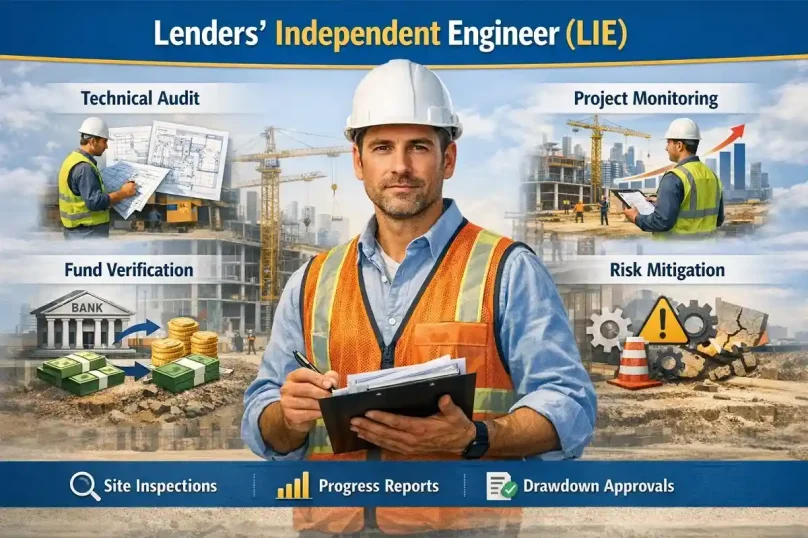
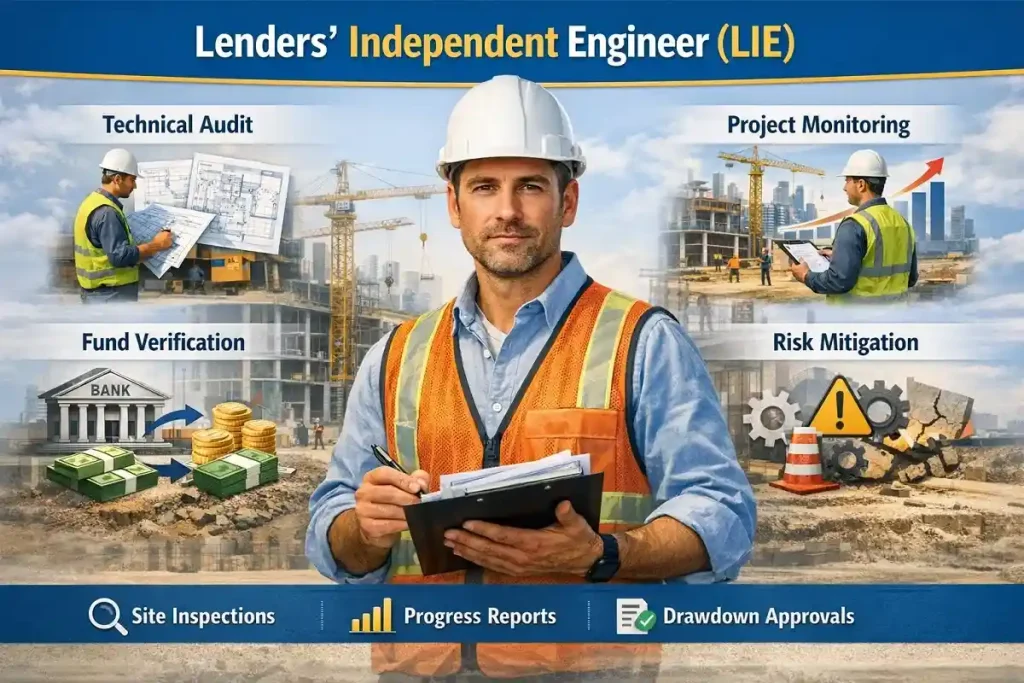
The LIE is a technical professional chosen by the lender. The work covers a review before approval, inspections during construction and written findings that the lender uses to decide each release of funds.
This guide follows that work from start to finish, shows what a report contains and marks where the engineer’s responsibility ends, so you know what to expect from one.
Learn more about our LIE services
|
Quick Answer: A Lenders’ Independent Engineer is a technical expert appointed by a lender to review a project, monitor its construction and report on whether the work and the spending match what was agreed. The lender chooses the engineer and the borrower normally pays. The engineer reports findings, and the lender decides what to release. |
What a Lenders’ Independent Engineer Is
An LIE, also called a lender’s engineer or lender’s technical advisor, is the technical expert a lender hires to get an unbiased view of a project’s engineering, cost and progress. The appointment usually comes from the loan agreement and the lender’s own credit policy.
Some regulators also require independent confirmation of construction progress on certain loans, so read the rules that apply to your facility.
Terminology varies. In a concession agreement, “Independent Engineer” can mean an engineer who supervises the concession, which is a different job. Check who appoints the engineer and who receives the reports.
Independence comes from structure. The lender picks the engineer, the borrower pays the fee and the report goes to the lender. That holds only while the lender controls the scope, because an engineer steered by the developer produces a certificate nobody should rely on.
Who Needs a Lenders’ Independent Engineer
Any project finance lender that releases funds in stages needs independent proof of progress. Banks, development institutions, funds and members of a lending group all work from the same report. The developer has a stake as well.
- Construction finance for residential and commercial real estate
- Solar, wind and battery storage plants
- Manufacturing plants and other large capital spending
- Roads, ports, logistics parks and similar infrastructure
- Hospitals and other institutional buildings financed in tranches
For lenders, the LIE gives early warning on slippage and an evidence trail for each release. For developers, records the engineer can verify make drawdown queries easier to answer, and overruns surface while there is still time to fund or fix them.
Without an LIE, the lender relies on the borrower’s own progress claims, and problems tend to surface late. Not every loan carries one. Smaller and simpler loans often go without, and the lender makes that call.
What the LIE Does at Each Project Stage
The scope depends on the engagement. Some LIEs join before approval, while others start at financial close.
Before Financial Close: Technical Due Diligence
Where a pre-close review is in scope, the LIE carries out what lenders call technical due diligence. It tests whether the project can be built as planned, for the money and in the time proposed. The review covers:
- The feasibility study and engineering design
- The technology chosen and the operating parameters it assumes
- Cost estimate, contingency and the implementation schedule
- Major contracts: EPC, O&M, long-term service, power purchase and off-take agreements
- Permits, environmental clearances and title to the land
- The technical assumptions behind the lender’s financial model, such as output, efficiency and operating cost
During Construction: Site Monitoring and Drawdown Checks
Site visits compare physical work with the approved schedule and budget. The LIE plots S-curves of planned against actual progress, which show whether the project is ahead or behind before slippage reaches the accounts.
Capital spending is verified, the use of released funds is checked, quality and variation orders are reviewed, and drawdown certificates are issued as the engagement requires.
At Completion and After: Commissioning Review
The LIE reviews test reports and inspection certificates, confirms completion and comments on readiness for commercial operation. Some lenders extend the engagement into operations, with periodic review of O&M arrangements and performance against approval projections.
What an LIE Report Contains
Lenders set the format, so reports differ. Common types include a pre-approval review, periodic progress reports, drawdown certificates and a completion report, and the engagement terms fix the schedule.
Depending on the lender’s requirements, a report may cover:
- Whether the design, technology and engineering standards suit the project
- Spend against budget, cost to complete and use of funds
- Site progress against the schedule, with S-curves and photographs
- Status of permits and compliance with contract terms
- Risks from construction, technology and contractors, with recommended action
- Quality of materials and workmanship, and test results
- A view on whether verified work supports the drawdown requested
To reach those findings, the engineer works from the feasibility study, approved designs, major contracts, permits, the cost and schedule, contractor bills and test certificates.
How a Drawdown Certificate is Issued
- The borrower submits a drawdown request with progress claims and supporting bills.
- Documents are checked against the approved budget and schedule.
- The LIE visits the site and measures physical progress against the claim.
- Verified work is compared with funds already released and the amount requested.
- A certificate follows, which may carry conditions such as pending test reports.
The certificate states what the engineer verified. It does not release money. The lender applies its own conditions and credit judgment before any funds move.
Red Flags an LIE Watches For
The engineer looks for signs that cost, time or quality are slipping before the lender’s money is exposed. Typical flags:
- Progress claimed ahead of the work visible on site
- Actual progress falling behind the S-curve with no recovery plan
- Payments running ahead of work done, or spending that departs from the approved budget
- Funds drawn for the project but used elsewhere
- Variation orders that add cost without a funding plan
- Failed tests or quality gaps in materials and workmanship
- Permits or land issues still open while construction continues
One flag rarely settles anything. A pattern does. The LIE reports it, and the lender decides whether to hold, part-release or release the tranche.
LIE vs Owner’s Engineer, Feasibility Consultant and Valuer
These roles overlap on paper, yet each answers a different question.
| Role | Works for | Question it answers | Typical stage |
|---|---|---|---|
| Lenders’ Independent Engineer | The lender | Is the project being built as planned and within budget, and does the work support the next drawdown? | Approval to completion, as engaged |
| Owner’s engineer or project management consultant | The developer | Is the project built to specification and managed well? | Design to handover |
| Feasibility or TEV consultant | Lender or borrower, depending on the process | Is the project technically and economically viable? | Before approval |
| Registered Valuer | Whoever engages the valuation | What is an asset or business worth for a stated purpose? | At the valuation date |
A feasibility study asks whether a project should be financed. The LIE asks whether the financed project is being delivered as agreed. Some markets call the first a TEV study, and our guide to the TEV study report covers it.
An LIE report is not a valuation. Valuation is a separate assignment with its own scope and report, such as plant and machinery valuation, even when it draws on similar project information.
How the LIE’s Focus Changes by Sector
The reporting objective is similar everywhere, but the engineering checks vary by sector.
- Real estate: stage-wise construction progress, approvals and quality against each tranche.
- Solar and wind: commissioning tests and performance against the minimum requirements in the offtake agreement.
- Battery storage: capacity degradation over the loan life and thermal safety.
- Roads and ports: design review, quantities and construction method.
- Manufacturing: equipment specification, plant capacity and commissioning trials.
Who Appoints the Lenders’ Independent Engineer, and Who Pays
The lender appoints the engineer and the borrower normally pays, usually as a project cost. The engagement letter sets the fee, which follows project size, sector, the number of site visits and the length of construction.
Many lenders choose from a panel of firms they have approved in advance, using criteria such as sector experience and the size of projects handled.
They also want an engineer with no commercial tie to the developer, the contractor or the equipment supplier. And they want a reviewer who can turn technical findings into numbers a credit committee can use, such as cost to complete and schedule slippage.
Independence outranks everything else on that list. A strong engineer with a link to the contractor is the wrong appointment.
Common Mistakes Borrowers Make with the LIE
- Treating the LIE as the owner’s engineer. One common misconception is that the LIE sits on the developer’s side because the developer pays. It reports to the lender and records what an owner’s engineer might smooth over, so keep specification records and progress evidence as separate files.
- Submitting drawdown papers late or incomplete. A stalled review stalls the release and the cash that depends on it. Send documents ahead of the review window.
- Expecting the LIE to approve cost increases. The LIE reports on a variation and only the lender decides to fund it, so the developer carries any overrun the lender will not fund. Raise overruns early.
- Ignoring conditions on a certificate. Open test reports and non-conformances roll into the next review and hold up later releases. Clear them before the next request goes in.
Pro Tips for Working with the LIE
- Read your definition first. Confirm who appoints the engineer, who pays and who receives the reports.
- Agree the report format at kick-off. Fix the milestone definitions and the document list so your progress claims match what the LIE measures.
- Define milestones by evidence. Tie each one to a quantity, test or certificate, not a percentage complete.
- Name one person to run the engagement. One contact for requests, bills and site access keeps the review moving.
- Brief the engineer before design changes. An early conversation on cost and schedule impact beats explaining a variation after it is built.
- Keep an open-items log. List every condition and pending test with the date raised and the date closed.
Lenders’ Independent Engineer FAQs
Q1. What is a Lenders’ Independent Engineer in project finance?
A technical expert a lender appoints to review a project, monitor construction and report on progress, cost and quality. The lender uses those findings to decide each release of funds.
Q2. Is an LIE report mandatory?
Not for every loan. The loan agreement and the lender’s policy decide whether one is needed, and some regulators also require independent confirmation of construction progress on certain loans.
Q3. Who appoints the LIE, and who pays the fee?
The lender selects and appoints the engineer. The borrower normally pays, usually as a project cost, which is why the lender has to control the scope.
Q4. What does an LIE report include?
Depending on the lender’s requirements, it covers technical review, cost against budget, progress against schedule, permits, risks, quality and a view on the drawdown request. Reports are issued at several points, not once.
Q5. How does an LIE drawdown certificate work?
The borrower submits a request with supporting bills, the engineer checks the documents and the site, and a certificate states what was verified. The lender then applies its own conditions before releasing funds.
Q6. How is an LIE different from an owner’s engineer?
The owner’s engineer works for the developer and manages the project to specification. The LIE works for the lender and verifies progress, cost and quality for the lender’s decisions.
Q7. How is an LIE different from a feasibility or TEV study?
A feasibility or TEV study tests whether a project should be financed. The LIE checks whether the financed project is being delivered as agreed.
Q8. Can an LIE stop a disbursement?
Not directly. The engineer reports and flags problems, and the lender decides whether to release, hold or part-release a tranche.
Q9. How often does an LIE visit the site?
The engagement terms set the frequency, and it varies by lender and project. Each visit leads to a written report for the lender.
Q10. Does an LIE value the project’s assets?
No. Valuation is a separate assignment with its own report, although it may draw on similar project information.
Q11. Who can act as an LIE?
Each lender decides, often through a panel of approved firms. Sector experience, a team that covers the relevant engineering disciplines and independence from the developer count most.
Q12. What affects the cost of LIE services?
Scope, project size and complexity, sector, the number of site visits and the length of construction. The engagement letter fixes the fee, and the borrower normally budgets it as a project cost.
For questions about your own project, contact our team directly.
Using LIE findings before the next drawdown
A certificate records what was verified at one point in time. It does not forecast completion.
What it hands a developer is a list: outstanding conditions, pending tests and corrective actions that the next review will look at again. Clear them before the next request goes in.
If you are arranging or financing a loan that needs an LIE, or want your project ready for an LIE review, contact Sapient Services Pvt. Ltd. at +91 9540162888, email valuation@sapientservices.com or visit sapientservices.com.
This guide is general information and not legal, financial or lending advice. The requirements for your facility sit in your loan agreement and in the rules that apply to your lender.