
What Is a Lenders’ Independent Engineer and Why Is It Important?
 By
By 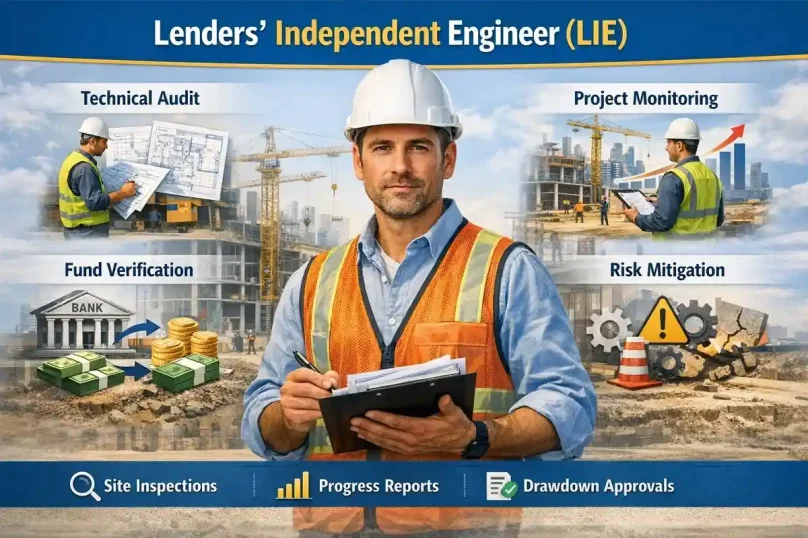
When a bank or financial institution agrees to fund a large infrastructure project, a real estate development, or an industrial facility — they aren’t just writing a cheque and hoping for the best. Before the first rupee is disbursed, and throughout the entire construction lifecycle, they need someone on the ground watching closely. That someone is the Lenders’ Independent Engineer.
What Is a Lenders’ Independent Engineer?
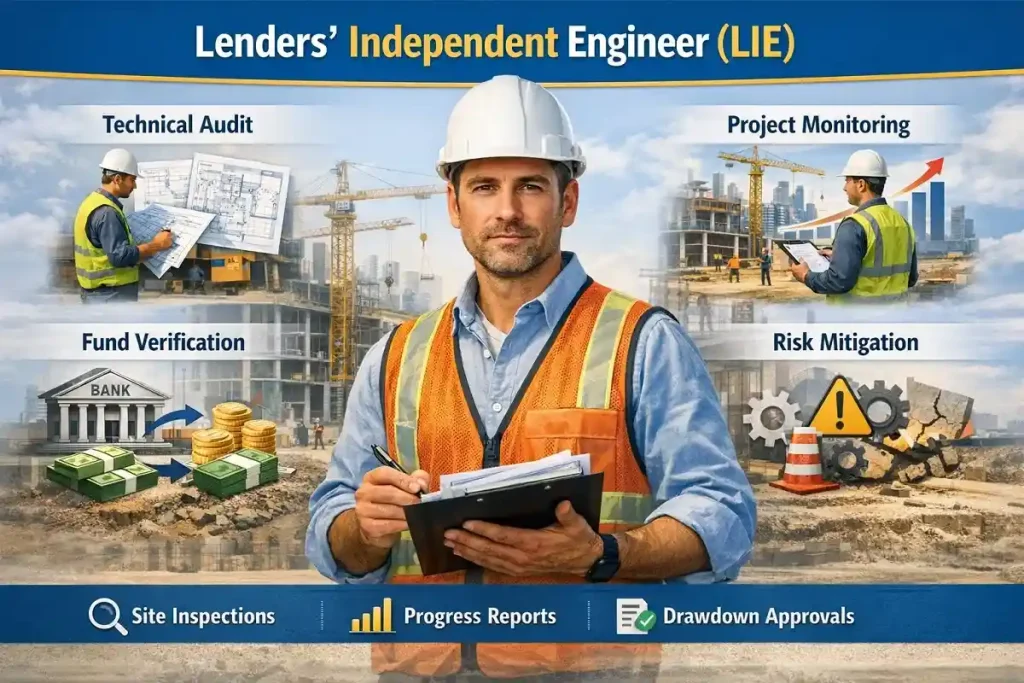
A Lenders’ Independent Engineer (LE) is an agent of lending institutions like banks or non-banking financial companies (NBFCs) that helps audit various projects — commercial or non-commercial — from the technical point of view whenever a developer seeks funding from a financial institution.
The key word here is independent. To maintain independence, the independent engineer is typically selected by the lender but paid by the developer or owner. The role is to conduct an independent technical assessment of a project or technical due diligence — and the opinions on technical aspects must not be biased either in favor of the lenders or the developer.
Think of it this way. The developer wants the project to look as strong as possible to get funding. The bank wants to protect its money. The LIE sits in the middle — serving neither agenda, just reporting what’s actually happening on the ground.
Medium and large-size industrial, infrastructure, and construction projects with high levels of capital expenditure pose a major risk to lenders given higher financial exposure. The LIE forms a crucial role in assessing the premises on which the project concept is built and monitoring physical and financial progress in defined periodicity, thereby mitigating risks for lenders and investors.
LIE vs Owner’s Engineer — Not the Same Thing
A common source of confusion. Many developers assume their own project engineer or owner’s engineer serves the same function. It doesn’t.
While the role of an independent engineer is similar to an owner’s engineer, they are distinctly different. An independent engineer deals with lenders and legal counsel on a regular basis to evaluate the financial health of the project as well as the technical aspects. Conversely, an owner’s engineer more often deals directly with the engineer of record, the constructor, and equipment suppliers — with a focus on ensuring that technical details meet specifications.
The owner’s engineer works for the developer. The LIE works for the truth — as seen from the lender’s perspective. Both are necessary on a large project. Neither replaces the other.
When Is a Lenders’ Independent Engineer Required?
A request for a Lenders’ Independent Engineer Report is raised for any M&A transaction, construction loan, commissioning, or a long-term loan. These reports are majorly required for real estate projects, SEZs, and other infrastructure projects.
In practical terms, you’ll encounter LIE requirements in:
- Large real estate developments seeking construction finance from banks or HFCs
- Renewable energy projects — solar, wind, battery storage — financed through project finance structures
- Industrial and manufacturing facilities with high capital expenditure
- Infrastructure projects like highways, ports, and logistics parks
- Any project where disbursements are staged and the lender needs verification at each stage
For projects in regions like Delhi NCR that involve multi-crore financing — especially in infrastructure and real estate — lenders cannot rely solely on the borrower’s word or internal appraisals. Independent Engineer Reports validate technical claims and ensure the project’s viability, thereby protecting lenders from default risks.
Core Responsibilities of a Lenders’ Independent Engineer
The LIE’s work doesn’t happen once and end. It runs through the entire project lifecycle — from pre-sanction appraisal all the way through commissioning.
Pre-Financial Closure Stage
This is where the LIE evaluates whether the project makes sense before the lender commits.
LIEs evaluate the project’s technical feasibility — including design, construction plan, technology selection, process parameters, implementation methodology, implementation timeline, and capital expenditure — to provide an independent opinion on these considerations.
At this stage, the LIE also reviews all major project contracts. This includes assessment of the technical aspects of major contracts such as EPC contracts, power purchase agreements, off-take agreements, long-term service agreements, and O&M agreements.
The LIE also verifies statutory clearances, environmental approvals, land ownership records, and licensing compliance. Anything that could derail the project legally or technically gets flagged here — before money moves.
Construction Stage Monitoring
Once the project gets funded and construction begins, the LIE’s role shifts to active monitoring.
The LIE needs to visit the project site at regular intervals and provide a complete assessment to give lending institutions estimates on: the physical status of work implemented on the site, the quantum of finance contributed and used for the project, estimated expenditure over observed progress, review of statutory approvals and clearances, and whether physical progress is in line with project implementation schedules.
One specific and critical tool used here is the S-curve. LIEs prepare S-curves to identify lead or lag factors in project implementation. This helps lenders track instances of time and cost overrun before they become unmanageable problems.
The LIE also issues drawdown certificates — arguably the most financially significant part of the job.
The scope of the LIE often includes validation of capex incurred on a project, utilization of funds released by the bank or financial institution, and comment on the drawdown requirement for a stipulated future period.
No drawdown certificate, no disbursement. The LIE’s signature literally controls the flow of funds.
Post-Commissioning and Operations
The role of the LIE may also be extended to verification of the completed project and commissioning of any industry. The LIE verifies the physical status of work implemented on the site and judges and reports on the quantum of finance actually being contributed and used on the project.
Upon project completion, the LIE conducts a final assessment to verify that the project meets all technical and financial criteria. This includes checking the project’s operational readiness and ensuring it is ready for commissioning. The LIE’s final report comprehensively evaluates the project’s success and any remaining issues that must be addressed.
What Does a Lenders’ Independent Engineer Report Actually Cover?
An LIE Report includes a technical evaluation of the project, financial assessments, progress monitoring, risk analysis, and compliance checks. The report provides a comprehensive overview of the project’s status and potential risks.
More specifically, a well-prepared LIE report covers:
- Technical feasibility review — design adequacy, technology choice, engineering standards
- Financial model inputs — verification of cost estimates, budget vs. actual, cash flow projections
- Progress monitoring — physical vs. planned progress with photographic documentation
- Risk identification — construction risks, technology risks, contractor capability assessment
- Compliance verification — environmental clearances, building permits, statutory approvals
- Quality assurance — materials used, construction standards, structural integrity
- Drawdown validation — confirmation that funds released match actual work done on site
An Independent Engineer Report is intended to provide the client with a review of the proposed project’s contractual documents and an evaluation of the technical design to verify compliance and ability to meet contractual obligations. Essentially, it is a due diligence report to help project financiers identify and mitigate possible risks.
Why Is the LIE So Critical for Lenders — Especially Banks and NBFCs?
This is the practical heart of the matter.
Prior to investing in any project, financial institutions, bankers, and investors intend to conduct thorough assessments of various aspects of their investments to safeguard their interests and ensure that the risk of the lender is minimized. The role of a Lender’s Engineer is to verify the physical status of work being implemented on site and to judge and report the quantum of finance actually being contributed and used on the project. These services assure the lender against misuse of funds.
Misuse of funds is not a hypothetical problem in India’s lending landscape. Construction loan fraud — where developers draw down funds for work that hasn’t happened — has contributed to significant NPA stress across banking and NBFC sectors. The LIE is the primary safeguard against this.
Banks and NBFCs must align their due diligence with RBI guidelines and other statutory frameworks. A Chartered Engineer’s Report provides documented assurance that the project complies with environmental laws, safety codes, and industry norms.
Lenders often take fixed assets — like plant, machinery, or real estate — as security. The LIE report ensures that these assets are genuine, functional, and valued correctly, reducing the chance of over-financing.
For staged disbursement projects specifically: For projects where loan disbursements are made in phases, lenders require periodic progress reviews before releasing the next tranche. The LIE report is what makes that review credible and independent.
The LIE’s Role in Renewable Energy Projects
This deserves special mention given how rapidly India’s renewable energy sector is growing.
Much of the lenders’ diligence on technology risks in energy projects is covered by a report from an independent engineer. The independent engineer examines the project’s ability to satisfy commissioning testing requirements and minimum performance requirements under applicable offtake agreements.
For battery storage projects specifically, the risks are more nuanced. For energy storage projects using lithium-ion batteries, lenders expect a robust review from the independent engineer on capacity degradation and safety issues tied to overheating. Fires resulting from battery thermal runaway have become one of the biggest challenges for energy storage project developers and lenders.
This is a genuinely emerging area. The LIE in renewable projects isn’t just reviewing civil construction — they’re assessing technology performance guarantees, equipment warranties, and long-term degradation models.
What Skills Does a Good LIE Actually Need?
This is where a lot of firms fall short. An LIE needs to be more than a civil engineer with a site inspection checklist.
The qualifications of an independent engineer are unusual in that, in addition to understanding the engineering aspects of a project, the independent engineer must also be well versed in the business aspects of project financing.
The appointed LIE should be capable of using technological equipment to ensure sound risk management and progress mapping. The LIE should also be able to translate technical information into inputs relevant to the financial participants involved in the project — especially the payback period and factors that impact returns.
In short — the best LIEs are bilingual. They speak engineering and they speak finance. That combination is rarer than it sounds.
Benefits Beyond Lender Protection
Here’s something developers often miss: the LIE isn’t just useful for the bank. A good LIE adds value to the project itself.
The benefits of an LE are not just limited to providing security to lenders but also offer risk management and value addition. Bringing in an LE can help achieve better planning and value for the business — and can subsequently save up to 10% on project costs.
When a developer knows an independent engineer is conducting site visits every month, contractors perform better. Materials get documented properly. Schedules get taken seriously. The discipline that the LIE’s presence imposes on the project often pays for itself.
LIE reports assist lenders in reducing risks and ensuring timely completion through regular site visits, document reviews, and technical validation — promoting informed lending decisions throughout the project lifecycle.
Frequently Asked Questions
1. What does LIE stand for in project finance?
Ans: LIE stands for Lenders’ Independent Engineer. It refers to a technically qualified professional or firm appointed by the lender to independently assess and monitor a project’s technical and financial progress throughout its lifecycle.
2. Who appoints the Lenders’ Independent Engineer — the bank or the developer?
Ans: The LIE is typically selected by the lender (bank, NBFC, or financial institution) but the cost of the LIE’s services is paid by the developer or project borrower. This structure is specifically designed to ensure independence.
3. Is a Lenders’ Independent Engineer report mandatory?
Ans: For large-scale infrastructure, real estate, and industrial project finance, an LIE report is almost always required by the lending institution. It is standard practice for construction loans, long-term project loans, and M&A transactions involving capital-heavy assets.
4. What is the difference between an LIE and a project engineer?
Ans: A project engineer works for the developer and focuses on technical execution. The LIE works for the lender and focuses on verifying that what the developer claims is actually happening on the ground — and that loan funds are being used as intended.
5. How often does the LIE visit the project site?
Ans: Typically once a month during active construction, though the frequency can be higher for complex projects or if risk indicators are elevated. Each visit results in a formal progress report submitted to the lender.
6. What is a drawdown certificate issued by an LIE?
Ans: A drawdown certificate is a formal document issued by the LIE confirming that the work completed on site justifies the next tranche of loan disbursement. Without this certificate, lenders do not release funds — making it one of the most consequential documents in project finance.
7. What sectors commonly require LIE services?
Ans: Real estate, infrastructure (roads, ports, airports), manufacturing facilities, renewable energy (solar, wind, BESS), SEZs, and industrial parks — essentially any capital-intensive project financed by institutional debt.
8. Can a developer benefit from the LIE process?
Ans: Yes. Beyond satisfying the lender’s requirements, the LIE’s independent monitoring imposes discipline on contractors, improves documentation standards, and can help identify cost overruns early — potentially saving significant money over the project timeline.
9. What happens if the LIE flags serious problems in a report?
Ans: The lender may withhold the next disbursement tranche, require corrective action before releasing funds, impose stricter monitoring, or in serious cases, initiate default proceedings. The LIE’s report directly influences the lender’s financial decisions.
10. How is an LIE different from a valuer or appraiser?
Ans: A valuer estimates the monetary worth of an asset. The LIE assesses technical feasibility, construction quality, regulatory compliance, and fund utilization over time. Both are used in project finance, but they serve distinct purposes and are usually different professionals.
In a lending environment where infrastructure projects run into hundreds of crores and construction timelines stretch over years, the Lenders’ Independent Engineer is not a luxury — it’s a structural necessity. For banks and NBFCs, it’s the closest thing to eyes on the ground. For developers, it’s the credibility layer that makes large-scale funding possible. And for the project itself, it’s often the single accountability mechanism that keeps everything on track.