IPO Investment in India — What Nobody Tells You First
 By
By 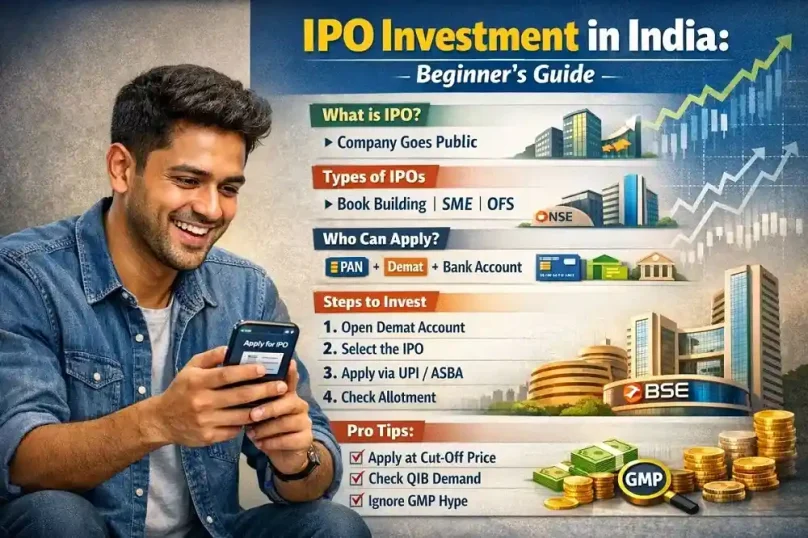
Written by the Sapient Services editorial team. Reviewed by Devendra Kumar Malhotra, Registered Valuer, Sapient Services Pvt. Ltd., New Delhi. Last updated: October 2026. Regulatory baseline: SEBI ICDR Regulations, 2018, and income-tax provisions, reviewed October 2026.
IPO investment in India had its biggest year in 2025, when 103 mainboard IPOs raised about ₹1.76 lakh crore. Seventy delivered gains on listing day. Thirty-two listed below their issue price, according to PRIME Database figures reported by The Economic Times.
That split is the case for doing the homework. In a busy issue, allotment is a lottery. The price band comes from the company and its bankers, and a listing can go either way on the first morning.
This guide covers how to apply, how allotment runs, how to read an offer document and how listing gains are taxed, with the rules as they stand in October 2026.
If your company is the one planning to list, see our IPO advisory and consulting services.
Quick Answer: To apply for a mainboard IPO in India you need a PAN, a demat account, completed KYC and a bank account that supports ASBA or UPI. Retail bids go up to ₹2 lakh, one application per PAN. UPI can be used up to ₹5 lakh, but a bid above ₹2 lakh is no longer a retail bid. Listing is scheduled for T+3, three working days after the issue closes, subject to exchange approvals. Qualifying gains are taxed at 20% within 12 months and at 12.5% above ₹1.25 lakh after that.
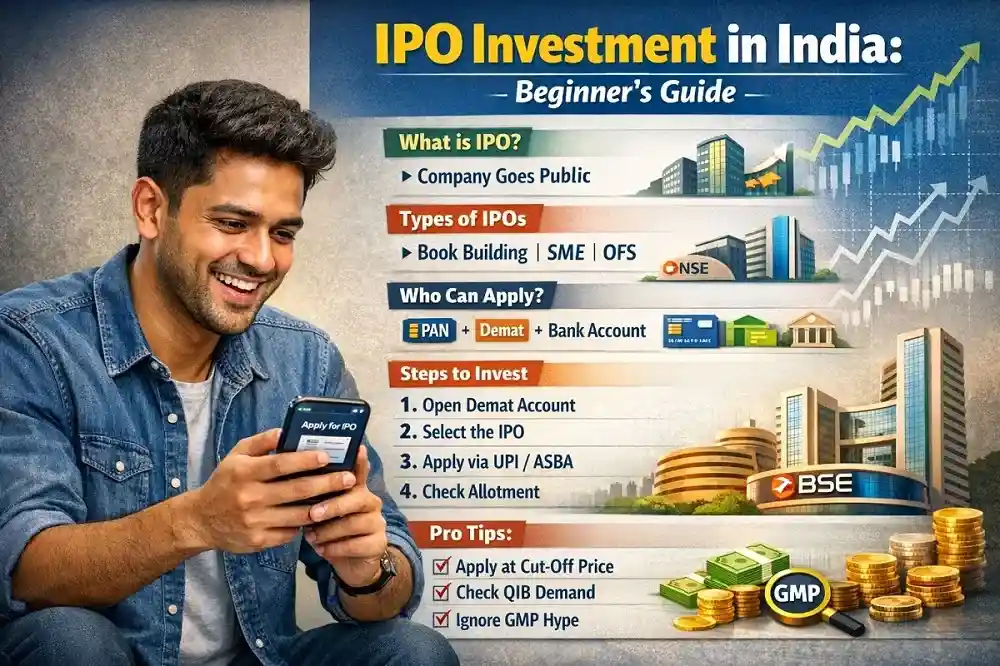
What IPO investment in India means
An initial public offering (IPO) is a public issue through which an unlisted company offers its shares to investors and seeks a listing on the NSE or BSE. To list, the company must be a public company under the Companies Act, 2013 and meet the SEBI ICDR Regulations, 2018 and the exchange’s eligibility norms.
For an investor, the offer is a one-time chance to buy at the offer price before the shares trade. The company’s side of the process, from DRHP filing to roadshow, is covered in our guide to what an IPO is and how it works. This page deals with the investor’s side: applying, allotment, valuation and tax.
What goes wrong when investors skip the checks
The same problems repeat from issue to issue. Investors bid on grey market chatter instead of the offer document, miss the UPI mandate window, pay full price for a company whose proceeds mostly go to selling shareholders, or plan the sale without counting tax.
Allotment adds another. In an oversubscribed retail quota most applicants get nothing, and some get one lot. After listing, anchor lock-ins end at 30 and 90 days, which adds tradable supply.
None of this is a reason to avoid IPOs. It is a reason to know the price you are paying and the amount you can afford to lose.
Who can apply for an IPO in India
Any adult with a PAN, a demat account, completed KYC and a bank account that supports ASBA or UPI can apply. There is no income test and no minimum portfolio. A trading account matters only when you sell.
One PAN, one application. RHPs state that multiple applications on the same PAN may be rejected, so family members should each apply with their own PAN, demat account and bank account.
RHPs generally count HUFs applying through their Karta and eligible NRIs in the retail category when the bid is up to ₹2 lakh. NRIs must also follow FEMA and RBI rules, and the account route and any repatriation treatment are set out in each RHP.
Investor categories, quotas and the allotment lottery
SEBI splits a book-built IPO into categories, each with its own quota and allotment method.
| Category | Who and how much | Quota (Reg 6(1)) | Allotment |
|---|---|---|---|
| Retail (RII) | Individuals bidding up to ₹2 lakh | At least 35% | Lottery if oversubscribed |
| Non-institutional (NII) | Individuals, HUFs and corporates bidding above ₹2 lakh | At least 15% | Proportionate |
| QIB | Mutual funds, banks, insurers, FPIs; no bid cap | Up to 50% | Proportionate |
| Anchor (inside QIB) | QIBs applying in the anchor portion a day before the issue opens | Up to 60% of the QIB portion | Discretionary; 50% locked 30 days, the rest 90 days |
These percentages describe the standard book-built mainboard structure under Regulation 6(1). Issuers listing under Regulation 6(2) must give QIBs at least 75% and retail no more than 10%. The RHP gives the actual numbers.
SEBI changed the anchor rules on 31 October 2025. Forty per cent of the anchor portion is now reserved: 33.33% for domestic mutual funds and 6.67% for life insurers and pension funds. Before that, one-third was reserved, for mutual funds alone (Business Standard).
In an oversubscribed retail category, the registrar runs a computerised lottery that tries to give one lot to as many applicants as possible. Bidding for extra lots does not improve your chance of getting the first one.
How to apply for an IPO in India, step by step
Step 1: Open a demat account
Use a SEBI-registered broker or bank, with video KYC. A demat account is enough to apply.
Step 2: Find the issue and read the price band
Check your broker app, your bank’s net banking or the NSE and BSE websites. Note the dates, price band, lot size and subscription status.
Step 3: Read the RHP
The Draft Red Herring Prospectus (DRHP) goes to SEBI for review. The Red Herring Prospectus (RHP) is the final version, issued before the issue opens. Read the RHP before you bid. Our guide to DRHP preparation explains how issuers build it.
Step 4: Choose lots and bid price
You bid in lots. Groww’s price band was ₹95 to ₹100 and the lot was 150 shares, so one lot cost ₹14,250 to ₹15,000. At ₹100 a share, the ₹2 lakh retail cap allowed 13 lots, or ₹1,95,000.
Most retail bidders choose the cut-off price, which accepts whatever final price is set inside the band. The amount blocked is calculated at the top of the band.
Step 5: Pay by UPI or ASBA
Block the money through a UPI mandate in your broker app or an ASBA request in net banking. It stays in your account and is debited only if you are allotted shares.
UPI can be used for individual applications up to ₹5 lakh, per SEBI’s application-form rules. That does not make a ₹5 lakh bid a retail bid: above ₹2 lakh you fall into the non-institutional category. The mandate must normally be approved by 5 PM on the closing day, so confirm the exact cut-off in the issue’s schedule.
Step 6: Check allotment
Allotment is finalised on T+1 and the stock lists on T+3. Use your PAN or application number to check status.
IPO allotment and listing timeline (T+3)
SEBI’s T+3 circular moved listing from six working days after closing to three. T is the closing day. Groww’s 2025 issue shows how the days fell. Real dates depend on allotment, fund unblocking and exchange approval.
| Day | What happens | Groww, November 2025 |
|---|---|---|
| T | Issue closes; UPI mandate deadline 5 PM | Friday 7 November |
| T+1 | Basis of allotment finalised | Monday 10 November |
| T+2 | Funds unblocked for non-allottees; shares credited | Tuesday 11 November |
| T+3 | Listing | Wednesday 12 November |
Check status on the registrar’s site (MUFG Intime India, formerly Link Intime, or KFin Technologies) or on the BSE and NSE portals, using your PAN, application number or DP ID. If you are not allotted shares, the blocked amount is released and nothing is debited.
How to evaluate an IPO before you apply
Evaluating an IPO means testing the offer price against the company’s profit, cash flow, debt and listed peers before you bid. A workable rule: apply only if you can explain in two sentences why the price is fair. If you cannot, skip the issue. Passing on one IPO is cheap. A bad one is not.
| RHP section | The question to ask |
|---|---|
| Risk Factors | What could do the most damage to this business? |
| Objects of the Offer | Where exactly does the fresh-issue money go? |
| Basis for Offer Price | Are the peers really comparable? |
| Financial information | Is revenue growth turning into profit and cash? |
| Related-party transactions | How much business is done with promoter or group entities? |
| Outstanding litigation | Could any case hurt the company materially? |
| Promoters and promoter group | Who controls the company, and are they selling? |
| OFS details | Who is exiting, and what do they hold afterwards? |
Profit, cash flow and debt
Put reported profit next to operating cash flow across several years. Profit that keeps climbing while operating cash flow stays weak, especially when receivables grow faster than sales, needs an explanation before you go further. Then check debt against equity, interest coverage and the working-capital cycle, meaning receivable days and inventory days.
Valuation against peers
Compare price to earnings or EV/EBITDA with the peers in the Basis for Offer Price section, and ask whether they match the company in size, growth and margins. A discount to peers can be fair.
For a company without meaningful earnings, P/E says little. Revenue multiples and sector-specific operating metrics matter more there, along with how believable the route to profit is.
Where the money goes
A fresh issue puts money into the company. An offer for sale (OFS) pays the selling shareholders and the company gets nothing. Groww’s November 2025 issue mixed the two, with roughly ₹1,060 crore fresh and ₹5,572 crore OFS, while IRCTC’s 2019 issue was entirely OFS by the Government of India.
A large OFS is not a warning sign by itself. Judge it in context: who sells, what they keep, and whether the business needs fresh capital at all. For the fresh portion, a named use such as capacity, specific debt repayment or an identified acquisition tells you more than a broad general corporate purposes line.
Red flags worth a second look
- A sudden jump in revenue just before the IPO
- Weak cash conversion, or receivables rising faster than sales
- A few customers accounting for most revenue
- Heavy related-party dealings
- A peer set that looks chosen to flatter the price
- Contingent liabilities or pending cases that are large against net worth
None of these rules out an issue by itself. Each is a reason to keep reading.
Subscription data and GMP
High QIB subscription shows demand during the issue. It does not show that the price is fair. The anchor list shows who committed a day before opening, but a familiar name on it is no substitute for your own read of valuation.
The grey market premium (GMP) is unofficial and unregulated, and SEBI does not recognise it as a measure of anything. It can swing within hours and has no reliable link to listing-day or long-term returns. Skip it.
SME IPO vs mainboard IPO
An SME IPO is a public offer by a small company on NSE Emerge or BSE SME. The minimum bid is larger and trading is thinner.
| Feature | Mainboard IPO | SME IPO |
|---|---|---|
| Minimum application | One lot; the value varies by issue | Two lots, with a minimum application above ₹2 lakh under the revised framework; check the RHP |
| Liquidity | Deeper trading | Thinner trading, wider swings |
| Company test | Profit record under ICDR Regulation 6 | Operating profit from operations (EBITDA) of at least ₹1 crore in at least two of the three preceding financial years |
| Offer for sale | Allowed under mainboard rules | Capped at 20% of the issue; sellers can offload at most 50% of their holding |
SEBI’s board approved the revised SME framework in December 2024, and the ICDR amendment was notified in March 2025. Our view: SME issues suit investors who can lose the whole application amount and live with thin trading. For a first IPO, stay with the mainboard.
Tax on IPO gains in India
For listed equity sold on a recognised exchange with securities transaction tax (STT) paid, short-term gains on shares held 12 months or less are generally taxed at 20% under Section 111A. Qualifying long-term gains under Section 112A are taxed at 12.5% on the amount above ₹1.25 lakh in a financial year.
Cess applies to both, and surcharge may apply at higher incomes. The Income-tax Act, 2025 carries the long-term provision as Section 198. The Income Tax Department’s page on sale of shares sets out the current position.
As an illustration only, 40 IRCTC shares bought at ₹320 and sold at ₹626 give a gain of ₹12,240. Twenty per cent of that is ₹2,448 before cess, surcharge, STT and brokerage. Your own liability depends on your return.
Tax is one input to a hold-or-sell decision, not the reason for one.
What changed in 2025 and 2026
According to PRIME Database figures, 78 mainboard IPOs raised a record ₹94,205 crore in April to September 2026, with NSE’s ₹22,563 crore issue among the largest (The Economic Times). In January to August 2026, 126 SME IPOs raised ₹5,739 crore (Business Today).
Two rule changes matter to an applicant. The SME framework, with its operating-profit test, OFS cap and two-lot minimum, was notified in March 2025. The anchor reservation for mutual funds, life insurers and pension funds was notified on 31 October 2025.
IPO case studies: IRCTC and Paytm
IRCTC listed on the NSE on 14 October 2019 at ₹626 against an issue price of ₹320, after being subscribed about 112 times. A lot of 40 shares cost ₹12,800 and was worth ₹25,040 at the listing price.
Paytm’s ₹18,300 crore issue was the largest in India at the time. It was priced at ₹2,150 and subscribed 1.89 times. Grey market quotes during the issue showed a discount of roughly ₹10 to ₹20.
It listed at ₹1,950 on 18 November 2021, about ₹200 below the issue price, and closed the day near ₹1,560. The grey market had missed the size of the fall by a wide margin.
Where our IPO view comes from
Sapient Services Pvt. Ltd. is an IBBI-registered valuation and advisory firm in Okhla Phase II, New Delhi. We support issuers with valuation, due diligence and DRHP documentation, and our DRHP guide names IKIO Lighting, Greaves Electric Mobility and SAEL among the companies we have worked with. Our clients page lists others.
That issuer-side work shapes how we read an offer document: peer set first, then objects of the issue, related-party dealings and cash flow.
We can help with similar listing questions. Contact our experts on +91 9540162888.
Common IPO investing mistakes
- Treating GMP as a signal. Paytm’s grey market quote showed a discount of ₹10 to ₹20 while the stock listed about ₹200 below issue price.
- Missing the UPI mandate. If the request is not approved before the cut-off, the bid is not valid, even if you entered it earlier.
- Reusing one PAN for several bids. Each family member should apply with their own.
- Skipping the OFS split. In a mostly OFS issue the company gets little of your money. Know that before you bid.
- Having no plan for hold or sell. Decide in advance what would make you hold or sell, such as valuation, results or your time horizon. Tax matters, but it should not be the main reason.
Pro tips for applying to an IPO
Start with Basis for Offer Price. It is the company’s own peer table. If the peers are much larger or in a different business, question the comparison.
Read the anchor book for mix, not names. The list is disclosed a day before the issue opens. Check how much sits with mutual funds, and keep your own valuation read ahead of it.
Set a rupee ceiling before the issue opens. Allotment is a lottery and the listing can disappoint. Decide the amount you can lose and stay inside it.
Price IPO financing honestly. If you borrow through your broker, compare the interest cost with a realistic gain. A small listing pop can disappear after interest.
Test your UPI mandate early. Confirm your UPI ID and bank limit before the bid window, and approve the request well before the closing-day cut-off.
Frequently Asked Questions
What is the maximum a retail investor can bid in an IPO?
₹2 lakh per IPO. UPI can be used for individual applications up to ₹5 lakh, but a bid above ₹2 lakh falls into the non-institutional category, which has a different quota and allotment method.
Can I apply for an IPO without a trading account?
Yes, through your bank’s ASBA facility. You need a demat account and a bank account. A trading account or broker is needed only to sell.
Does applying for more lots improve my allotment chances?
Not in an oversubscribed retail quota. The lottery aims to give one lot to as many applicants as possible, so extra lots add cost without adding odds of that first lot.
Can family members and HUFs apply for the same IPO?
Yes, if each applicant has a separate PAN, demat account and bank account. A HUF applies through its Karta with the HUF’s own PAN. Multiple applications on one PAN may be rejected.
Can I sell IPO shares on the listing day?
Yes. Allotted shares are credited to your demat account on T+2 and become tradable when the stock lists on T+3. A sale within 12 months is taxed as a short-term gain at 20%, and brokerage and STT apply.
Is GMP a reliable indicator of listing gains?
No. It is an unofficial grey market quote that SEBI does not recognise. Use the RHP and the valuation instead.
How can I tell whether an IPO is overpriced?
Compare the issue’s price to earnings or EV/EBITDA with comparable listed peers, then check whether operating cash flow supports reported profit. If you cannot explain any premium in two sentences, treat the price as a reason to wait.
Which RHP sections should I read first?
Risk Factors, Objects of the Offer, Basis for Offer Price, the restated financials, related-party transactions and outstanding litigation. Then check who the promoters are and whether they are selling in the OFS.
How are IPO listing gains taxed?
Qualifying short-term gains on listed equity are taxed at 20%, and qualifying long-term gains at 12.5% above ₹1.25 lakh a year. STT must have been paid, cess applies and surcharge can apply at higher incomes.
Is an IPO better than a mutual fund SIP?
They do different jobs. An IPO is a one-time bid on a single stock with lottery allotment. A SIP spreads regular money across many stocks. Choosing between them depends on your risk tolerance, time horizon and goals, and a SEBI-registered investment adviser can help with that.
Have more questions about listing your own company? Contact our team directly at valuation@sapientservices.com.
Conclusion
The 2025 count of 70 gains and 32 discounts says one thing plainly: a record year did not make every issue a good one. The investor’s edge is the habit of reading the RHP before the bid window closes, while the price is still a choice.
Before the next issue opens, download its RHP and answer four questions for that company: where the fresh money goes, who is selling, whether cash flow supports profit and how the peers were chosen. If you cannot answer the cash-flow and OFS questions, pass on it.
If your company is preparing to list, call Sapient Services at +91 9540162888, write to valuation@sapientservices.com or visit sapientservices.com.
You may also find helpful: Pre-IPO valuation.