
Top Post-Merger Integration Challenges in India
 By
By 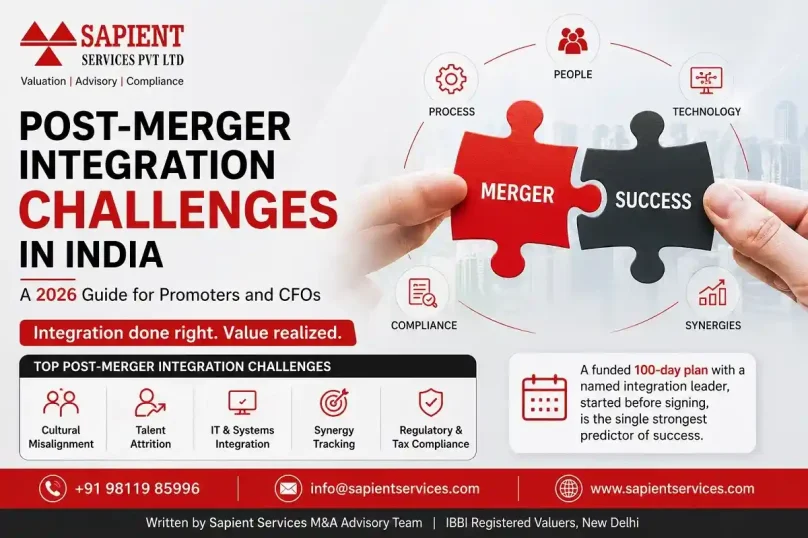
Most acquisitions fail after the deal closes, not before it. A widely-cited KPMG study found that 83% of acquisitions fail to boost shareholder returns, and Harvard Business Review’s long-running research puts the broader M&A failure rate at 70–90%. Post-merger integration, not deal structuring, is usually where that value gets destroyed.
In India, deal value rose 18% year-on-year to USD 123.8 billion in 2025, according to EY’s latest M&A Transactions Report. The pattern here is the same one seen globally: the valuation was sound, the due diligence was thorough, the NCLT scheme was sanctioned on schedule — and then the combined entity spent months bleeding customers, key employees and synergy targets.
This guide covers the post-merger integration challenges that actually derail Indian deals, the regulatory landmines specific to Sections 230–232 of the Companies Act 2013, CCI standstill obligations, and Income Tax Act 2025 loss carry-forward rules, and the practical framework promoters and CFOs use to protect the value they paid for.
Quick Overview
The five biggest post-merger integration challenges are cultural misalignment, IT and systems integration, talent attrition, synergy tracking failure, and regulatory or tax compliance gaps. Globally, 70–90% of M&A deals underperform because of integration breakdowns rather than a flawed deal thesis. Industry surveys consistently link structured, playbook-driven integration, rather than an improvised approach, to meaningfully higher success rates, with some programs reporting Day-1 synergy tracking success as high as 92%.
What Is Post-Merger Integration?
Post-merger integration is the structured process of combining two organisations’ operations, systems, people and finances after a merger or acquisition closes. In India, it begins the day the NCLT sanctions a scheme under Sections 230–232 of the Companies Act, 2013, or the day share transfer completes under a definitive agreement.
The process is governed by more than one law at once. The Companies Act sets the corporate mechanics. The Competition Act, 2002 imposes a standstill obligation until the Competition Commission of India clears the combination. The Income Tax Act, 2025, effective April 2026, governs how losses, depreciation and slump sale consideration carry over into the merged entity.
Integration matters commercially because the acquisition price already assumes the synergies exist. A bank financing the deal, a private equity investor with a board seat, or a promoter who has personally guaranteed acquisition debt all need the projected cost savings and revenue uplift to show up in the numbers within 24 months, not just in the investment memorandum.
Who Faces These Challenges
Post-merger integration risk touches every party connected to the deal, not just the two merging companies.
- Promoters and boards who approved the acquisition and are accountable to shareholders for the synergy case
- Private equity and venture-backed acquirers running roll-up strategies across multiple targets
- Banks and NBFCs that financed the acquisition and monitor covenant compliance tied to post-merger EBITDA
- CFOs responsible for consolidating two sets of books, two ERP systems and two statutory audit trails
- HR and leadership teams managing headcount overlap, retention of key talent, and cultural integration
What most finance teams don’t realise until it’s too late: the integration budget is usually set at 1–2% of deal value when the realistic range, based on 2025-26 data, is 6–10%. Underfunding integration is itself one of the biggest post-merger integration challenges.
Suggested Services
- Mergers & Acquisitions Services in Mumbai
- Merger & Acquisition Services in Ahmedabad
- Mergers & Acquisitions Advisory Services in Bengaluru
- Merger & Acquisition Advisory in Hyderabad
- Merger & Acquisition Services in Chennai
Sapient’s 5-Pillar View of Post-Merger Integration Challenges
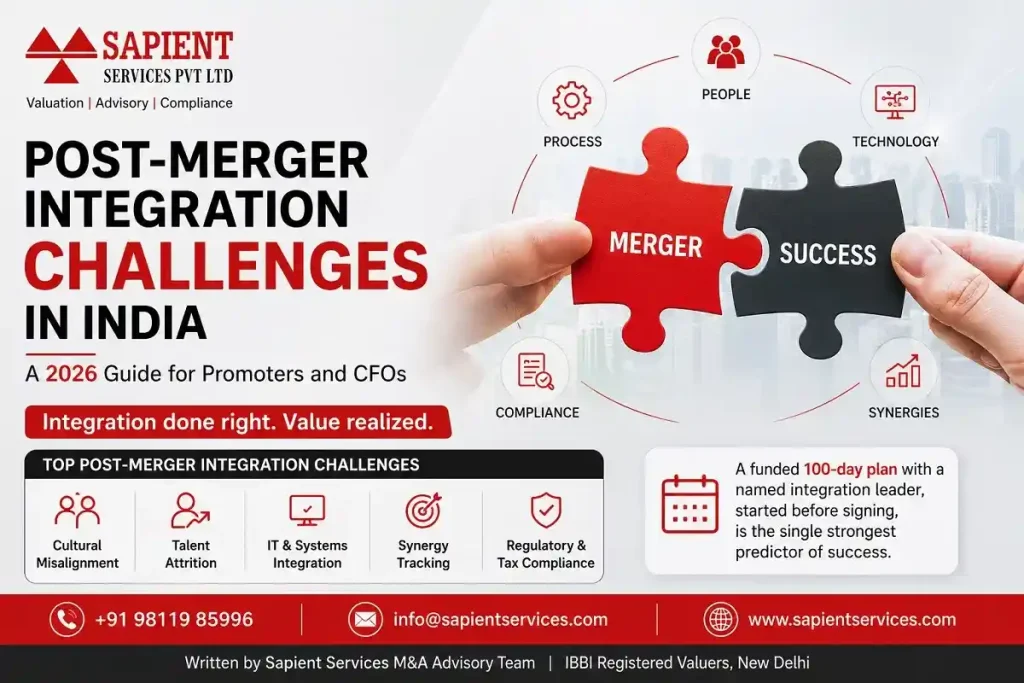
Every failed integration traces back to one or more of five recurring failure points. None of them are about the deal thesis being wrong — they are about execution after signing.
| Challenge | Why It Happens | Typical Impact |
|---|---|---|
| Cultural misalignment | Decision-making styles, risk appetite and communication norms differ and are rarely assessed during diligence | Cited as the top cause in roughly 25–30% of failed integrations (industry surveys) |
| Talent attrition | Uncertainty motivates the most employable people to leave first | Average turnover near 47% in Year 1 across studied deals |
| IT and systems integration | Two ERPs, two data structures, two vendor contracts collide | Bain & Company estimates 70% of systems integrations fail at the start, not the end |
| Synergy tracking failure | Targets are set at deal-model level, not broken down to function owners | 57.2% of acquirers destroyed shareholder value post-close (KPMG, 2025) |
| Regulatory and tax gaps | Post-close compliance is treated as a formality instead of a workstream | Delayed CCI clearance, lapsed loss carry-forward, RoC and RBI filing penalties |
Industry surveys indicate acquirers who assign a dedicated integration leader before close are considerably more likely to meet their strategic goals, with some studies citing figures as high as 75%. Most Indian mid-market acquirers still don’t create that role.
Key Takeaway
None of the five biggest post-merger integration challenges are about picking the wrong target. They are about what happens — or doesn’t happen — in the first 100 days after signing.
IT, Data and Systems Integration Challenges
IT is where integration budgets and timelines break most often. Merging two ERP systems (SAP, Oracle or Tally in the Indian mid-market) means reconciling different chart-of-accounts structures, master data, and access controls before a single consolidated report can be trusted.
Cybersecurity due diligence is now part of this workstream, not separate from it. Acquirers need visibility into the target’s identity and access management, data retention practices, and any legacy systems still running unsupported software before granting network access to combined teams.
A practical rule: prioritise customer-facing systems first to protect service continuity, then migrate back-office finance and HR systems on a slower, tested timeline. Rushing a full cutover in one weekend is the most common cause of post-close IT outages.
HR, Customer and Vendor Integration
People and HR Integration
Payroll harmonisation, designation mapping, ESOP treatment, and HRIS migration all need to be resolved before Day 1 communication goes out. Ambiguity about compensation and reporting lines is what pushes critical employees to start job-hunting in week one.
Customer and Vendor Continuity
Customers and key accounts need a single point of contact from Day 1, even before pricing and contracts are harmonised. On the vendor side, rationalising overlapping supplier contracts too early can disrupt supply continuity — most acquirers sequence this after the first 100 days, once volumes and terms are fully mapped.
Regulatory and Compliance Challenges Unique to Indian Deals
Indian post-merger integration carries a compliance layer that acquirers from other markets often underestimate.
The CCI Standstill Obligation
Once a combination is notified to the Competition Commission of India under Section 5 of the Competition Act, 2002, the parties cannot integrate operations, share competitively sensitive data, or take joint pricing decisions until clearance is obtained.
Since September 2024, this standstill also applies to deals crossing the Deal Value Threshold of INR 2,000 crore, provided the target has “substantial business operations in India” — a test that can be met by user base or market reach even where the target’s revenue is low. This closed a gap that previously let some high-value digital and technology acquisitions escape scrutiny purely on turnover numbers.
The CCI issued five gun-jumping decisions in 2025, against one in 2024 — a clear signal that early integration steps are under closer scrutiny.
Loss Carry-Forward Under the Income Tax Act, 2025
A common modelling error: assuming the merged entity gets a fresh eight-year window to carry forward the target’s accumulated losses. Under Section 116 of the Income Tax Act, 2025, the successor company only inherits the remaining balance of the original carry-forward period. Any synergy case built on a full fresh eight-year shield overstates the tax benefit.
Cross-Border and RBI Approvals
Where the transaction involves an inbound or outbound merger under Section 234 of the Companies Act, 2013, prior RBI approval through the authorised dealer bank is mandatory before the NCLT sanctions the scheme. Integration teams that assume RBI sign-off is a formality on cross-border restructurings routinely find it adds three to six months to the Day 1 timeline.
Listed Companies and Statutory Audit Alignment
Where either party is listed, SEBI’s disclosure and open-offer rules add another layer of Day-1 communication obligations. Separately, the target’s statutory auditors and the acquirer’s ICAI-registered audit team need a joint plan for the first post-merger audit cycle, so consolidated numbers don’t get delayed at year-end.
Key Takeaway
Indian post-merger integration challenges are not limited to operations. CCI standstill rules, RBI cross-border approval, SEBI disclosure norms and Income Tax Act, 2025 loss carry-forward limits all need their own workstream owner.
Financial Integration and Synergy Tracking
The financial workstream is where synergy promises either get captured or quietly disappear. Three areas need attention in the first 100 days.
Purchase Price Allocation and Fixed Asset Verification
Ind AS 103 requires the acquirer to allocate the purchase consideration across identifiable assets, liabilities and goodwill at fair value. This is not a paper exercise — it needs a physical fixed asset verification of the target’s plant, machinery and property to confirm what actually exists, its condition, and its useful life, before the opening balance sheet is finalised.
Stock and Inventory Reconciliation
Where the target holds inventory financed by a bank cash credit facility, a stock audit at the time of takeover protects both the acquirer and the lender. Discrepancies between book stock and physical stock discovered six months post-close are far harder to resolve, and far more expensive, than discrepancies caught on Day 1.
Function-Level Synergy Ownership
Acquirers who disaggregate synergy targets down to named function owners, with monthly tracking against the original deal model, achieve success rates of up to 92%. Acquirers who track synergy only as a single number on a board slide rarely hit it.
Building a 100-Day Integration Plan
A structured first-100-days plan is the single strongest predictor of integration success. It should start during due diligence, not after signing.
| Phase | Timeline | Key Actions |
|---|---|---|
| Pre-close | Diligence to signing | Cultural assessment, integration budget approval, CCI and RBI filing strategy, dedicated integration leader named |
| Day 1 | Closing date | Communication to all employees, leadership structure announced, standstill compliance confirmed, retention offers activated |
| First 30 days | Weeks 1–4 | Fixed asset verification, stock audit, ERP data mapping, function-level synergy targets assigned |
| First 100 days | Months 1–3 | Ind AS purchase price allocation finalised, key system migrations begun, culture bridge programme launched |
| 6–24 months | Ongoing | Full ERP consolidation, synergy tracking against original deal model, statutory filings closed (RoC, CCI, RBI) |
Need help building your integration plan? Sapient Services’ team can review your deal structure and flag the fixed asset, stock, and compliance risks specific to your acquisition. Call +91 9540162888 to schedule a consultation.
An Illustrative Example
The following is a composite, illustrative scenario based on common patterns seen in Indian mid-market manufacturing deals, not a specific client engagement.
Picture a Delhi NCR-based auto-component manufacturer acquiring a smaller competitor to add capacity ahead of an export order. The deal model assumes a smooth transfer of the target’s machinery and inventory.
A frequent complication in such deals: the target’s fixed asset register hasn’t been updated in years, and a meaningful share of listed machinery turns out to be scrapped or relocated without record. This becomes a problem the moment a lender asks for a clean opening balance sheet before releasing the next tranche of acquisition finance.
The fix in these situations is consistent: an independent physical fixed asset verification and reconciliation, cross-checked against Ind AS 103 fair value requirements, run alongside a stock audit of raw material and work-in-progress inventory.
The result acquirers are looking for: a defensible opening balance sheet delivered inside the lender’s timeline, and a fixed asset baseline that can be reused for the annual Ind AS componentization review.
Common Mistakes in Post-Merger Integration
Treating integration planning as a post-close task. Waiting until after signing to build the integration plan costs momentum that is nearly impossible to recover. Start planning during due diligence.
Underfunding the integration budget. Allocating 1–2% of deal value when the realistic range is 6–10% typically leaves the integration office understaffed from Day 1.
Assuming CCI and RBI approvals are formalities. Beginning operational integration before clearance risks a gun-jumping finding and penalties under Section 43A of the Competition Act.
Skipping physical verification of assets and stock. Relying on the target’s own registers without independent fixed asset verification or a stock audit leaves the acquirer exposed to a materially wrong opening balance sheet.
No named integration leader. Handing integration to whoever closed the deal, without dedicated authority and budget, creates an accountability gap exactly when decisions need to move fast.
Pro Tips for a Smoother Integration
Start the 100-day plan during diligence. The roadmap should exist before the ink is dry, not after.
Fund retention before Day 1. Identify the 20–30 people whose departure would break the synergy case, and have retention offers ready at signing.
Run fixed asset verification and stock audit in parallel with legal integration. Both should be complete within the first 30 days, not deferred to year-end audit.
Assign synergy targets to named owners, not departments. A number without an owner rarely gets captured.
Bring the CIO into deal discussions before the term sheet. Only a minority of acquirers currently do this, and it shows in the IT integration failure rate.
Track loss carry-forward under the correct Income Tax Act, 2025 sections. Section 116 caps the carry-forward at the target’s remaining original period — build the tax model on that basis, not a fresh eight years.
Report integration progress monthly to the board. The same discipline applied to deal sourcing should apply to deal execution.
Frequently Asked Questions
Q: What is post-merger integration?
A: Post-merger integration is the process of combining two companies’ operations, systems, finances and people after a deal closes, so the combined entity captures the synergies it was priced on.
Q: What are the biggest post-merger integration challenges?
A: Cultural misalignment, talent attrition, IT and systems integration, synergy tracking failure, and regulatory or tax compliance gaps are the five most common post-merger integration challenges.
Q: Why do most post-merger integrations fail?
A: KPMG and Harvard Business Review research puts the M&A failure rate at 70–90%, driven mainly by execution breakdowns after close rather than a flawed original deal thesis.
Q: How long does post-merger integration take in India?
A: Core integration typically runs 6 to 24 months. A full ERP consolidation for a mid-sized acquisition usually takes 12 to 18 months.
Q: What is Day 1 readiness in post-merger integration?
A: Day 1 readiness means the leadership structure, employee communication, payroll continuity and standstill compliance are all confirmed before the deal legally closes.
Q: What is Day Zero versus Day One?
A: Day Zero is the internal planning stage before announcement; Day One is the first day of operating as a combined entity, when Day-1 readiness items go live.
Q: What is an Integration Management Office (IMO)?
A: An IMO is the dedicated team, led by the named integration leader, that coordinates every workstream — finance, HR, IT, legal — against the 100-day plan.
Q: Is CCI approval required before integration can begin?
A: Yes. Once notified under Section 5 of the Competition Act, 2002, a standstill obligation applies until the CCI grants clearance; early integration risks a gun-jumping finding.
Q: What is the ideal integration budget as a percentage of deal value?
A: Industry data suggests successful acquirers spend 6–10% of deal value on integration, well above the 1–2% many mid-market acquirers typically budget.
Q: How much does post-merger integration cost in India?
A: Cost varies by deal size and complexity, but budgeting 6–10% of deal value for integration, covering advisory, IT migration and verification work, is a reasonable starting benchmark.
Q: Why does fixed asset verification matter in post-merger integration?
A: Ind AS 103 requires fair-value allocation of the purchase price. Physical fixed asset verification confirms what assets actually exist before the opening balance sheet is finalised.
Q: Does a stock audit matter if the target already has audited financials?
A: Yes. Audited financials reflect book stock, not physical stock. A stock audit at takeover protects the acquirer and any lender against inventory discrepancies found later.
Q: What happens to the target’s accumulated tax losses after a merger?
A: Under Section 116 of the Income Tax Act, 2025, the successor company can carry forward the target’s losses only for the remaining balance of the original eight-year period.
Q: Who should lead post-merger integration?
A: A dedicated integration leader, separate from the deal team, named before Day 1 with direct authority and budget. This is linked to meaningfully higher success rates.
Q: When should integration planning start?
A: During due diligence, before the deal signs — not after. Early planning is consistently linked to better integration outcomes.
Q: How is synergy measured after a merger?
A: Synergy is measured by tracking specific cost and revenue targets, assigned to named function owners, against the original deal model on a monthly basis.
Q: What role does culture play in integration failure?
A: Cultural incompatibility is cited as the top cause in roughly 25–30% of failed integrations, yet it is typically the least rigorously assessed factor during due diligence.
Q: How does Sapient Services support post-merger integration?
A: Sapient Services provides IBBI-registered valuation, fixed asset verification, stock audit, and financial and tax due diligence support through the integration phase.
Conclusion
The deal itself is often the easier part. Post-merger integration is where value is typically created or destroyed, and the data across 2025-26 points the same way: acquirers who plan integration before close, fund it properly, and verify what they actually acquired tend to outperform those who treat integration as a cleanup task.
If your business has recently closed an acquisition, or is preparing for one, an independent fixed asset verification and stock audit at takeover is one of the highest-value, lowest-cost steps you can take to protect the opening balance sheet and the synergy case your board approved.
Sapient Services works with promoters, CFOs and lenders across Delhi NCR and India on M&A advisory, valuation and post-merger financial verification. Contact us at +91 9540162888 or visit sapientservices.com to discuss your integration timeline.