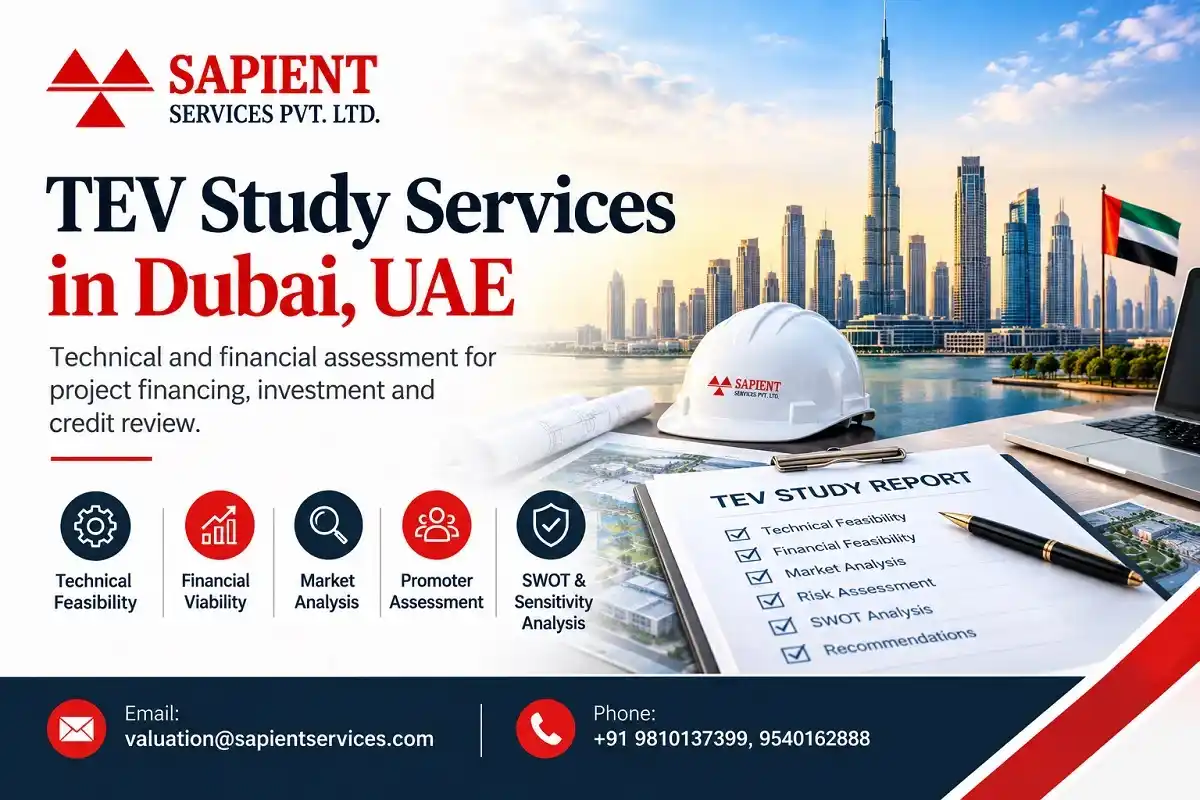
A lender asking for a TEV study before releasing project financing isn’t unusual. When a bank, DFI, or investor requests a technical and financial feasibility review, it’s generally part of how they assess project and credit risk — the exact scope depends on the lender, the financing programme, and the project itself.
This page focuses on Dubai, though TEV and feasibility requirements can differ elsewhere in the UAE depending on the free zone, sector, and financing route. Sapient Services Pvt. Ltd. prepares TEV reports covering technical soundness, market position, and financial viability. Here’s what typically goes into one, and where projects usually lose time getting through the process.
Quick Answer
A TEV study checks whether a project is technically workable and financially sound enough to support the financing or investment decision behind it. It covers technical, market, and financial feasibility, along with a look at the promoter’s execution capability, then brings the findings together in a SWOT and sensitivity analysis.
How long it takes and what it costs depend on project size, sector, and how complete the documentation is going in — there’s no single fixed range that applies across every project. Reports are prepared for submission to lenders, DFIs, or private investors as part of project and credit appraisal.
Editorial note: Earlier drafts of this page stated specific turnaround ranges and day-by-stage estimates that weren’t based on Sapient’s actual historical data — I built them as reasonable placeholders while drafting, which isn’t something that belongs on a live page. They’re removed throughout. If you have real turnaround figures, send them and I’ll add them back properly.
What Is a TEV Study?
A TEV study is an independent check on whether a project is technically sound and financially able to support what it’s borrowing, or the capital being invested in it. It combines an engineering review with a financial one, which is why a standard credit check doesn’t cover the same ground. Construction risk, technology risk, and market-demand risk all sit outside a normal financial statement review.
That gap matters in the UAE’s current industrial financing environment. Emirates Development Bank announced on 14 September 2026 that it had approved more than AED 30 billion in cumulative financing since 2021, completing its five-year mandate across manufacturing, renewables, advanced technology, healthcare, and food security. That financing has fed roughly AED 14 billion into industrial GDP and supported more than 1,000 companies. The UAE’s wider industrial strategy, Operation 300bn, still targets AED 300 billion in industrial GDP contribution by 2031. At that scale of lending, a bank or DFI needs a consistent way to separate a genuinely viable project from an optimistic pitch.
One detail worth knowing, and not something most Dubai-focused consultancy pages will tell you: the UAE doesn’t run a single nationwide rule tying a mandatory TEV report to loan size. India does. The RBI (Project Finance) Directions, 2025, effective 1 October 2025, require a fresh study specifically when an infrastructure PPP project’s Appointed Date changes and lender exposure hits ₹100 crore or more.
In the UAE, requirements sit at the level of the individual lender or financing programme. Emirates Development Bank’s Foreign Direct Investment route, for example, lists a project feasibility study covering technical and financial aspects as a stated requirement for that specific route — it isn’t framed as a blanket “TEV report” requirement across all EDB financing. Confirm the exact scope with your relationship manager rather than assuming one rule applies everywhere.
Who Needs a TEV Study in Dubai?
If a lender has asked you for one before releasing funds, you’re not being singled out. This applies to projects with a real technical, construction, or production component — not general trading or services financing:
- Manufacturers and industrial sponsors seeking term financing for a new plant or capacity expansion in Dubai Industrial City, Jebel Ali Free Zone, KEZAD (Abu Dhabi), or elsewhere in the UAE
- Healthcare, food security, and renewable energy promoters applying to Emirates Development Bank or a commercial bank under project finance
- Companies undergoing credit or financing restructuring where the lender requests an updated technical and financial view
- Private equity firms and family offices running pre-investment technical and financial diligence before committing capital
- SMEs applying for larger term loans where the lender’s internal risk assessment requires more than a standard business plan
Skip this when your project genuinely needs it, and the likely outcome isn’t a quick rejection — it’s an application that stalls while the lender asks for what should have been in the file from the start.
Our TEV Study Process
Sapient’s TEV engagements for UAE projects generally move through these stages:
- Scoping call and document checklist
- Technical feasibility assessment — site, technology, capacity, and manpower review
- Market feasibility and demand analysis
- Financial modelling and sensitivity analysis
- Risk synthesis and draft report
- Client review and report finalisation
Actual timing depends on project size, sector, and how quickly documentation comes through. Share your project details on the scoping call and you’ll get a realistic timeline for that project, not a generic one.
Before You Start: What to Have Ready
Projects that move fastest through a TEV study usually walk in with these already in hand:
- Site or land documentation
- Technology and equipment specifications or vendor quotations
- Promoter and group company financials
- Project cost estimates
- Sector-specific market data, if you have any already
- Utility connection status or timeline from the relevant free zone authority
Missing one or two of these won’t stop the process, but it will add time to it — usually spent waiting on a document instead of moving the analysis forward.
Types of TEV & Feasibility Assessments We Prepare
Greenfield Manufacturing Projects
No operating history to lean on, so technical feasibility, market entry, and financial projections get built from design specifications and vendor quotations rather than past performance.
Brownfield & Expansion Projects
Reviews the existing facility’s real operating and financial history alongside the expansion plan — lenders want proof the current operation works before they fund its growth.
Reports for Term Financing
Structured for submission to UAE commercial banks and DFIs such as Emirates Development Bank, aligned with the documentation each institution asks for.
Pre-Investment Studies for PE & Family Offices
Commissioned by the investor rather than the borrower, before capital moves — the question shifts from “will the lender get repaid” to “is this worth investing in.”
Credit Facility Restructuring Reviews
An updated technical and financial view on an existing facility when a lender wants fresh eyes before changing the terms.
What a TEV Study Should Cover
Sapient Services Pvt. Ltd. builds each report around the specific project rather than a generic template. A properly scoped TEV report should include:
- Technical feasibility — technology, capacity, site, and infrastructure considerations
- Market and demand assessment
- Project cost basis and key assumptions
- Financial projections and cash-flow analysis
- DSCR, IRR, and other relevant financial metrics
- Sensitivity and scenario analysis
- Key project risks and how they’re addressed
- Regulatory and licensing considerations relevant to the project and location
- Promoter and management execution capability, where relevant to the project
A report missing several of these usually means the assessment wasn’t built around the specific project it’s meant to cover.
TEV Study Cost in Dubai
Fees scale with project complexity, sector, and how much technical documentation is already in place. Rather than publish a generic rate card that wouldn’t reflect your actual project, Sapient provides a project-specific estimate after an initial scoping call.
| Project Type | What Mainly Drives Cost |
|---|
| Small/medium manufacturing unit | Site count, technology complexity |
| Large industrial or infrastructure project | Multi-site assessment, sector-specific engineering review |
| Restructuring / existing facility review | Volume of historical financial data to verify |
| Healthcare or specialised facility | Regulatory and licensing complexity |
Exact fees follow the scoping call, once we understand what’s already in place and what still needs to be built.
Common Mistakes & Risks to Avoid
The most costly mistake is approaching the consultant after the loan application is already submitted — everything below becomes harder to fix once the clock is running.
- Submitting financial projections that don’t reconcile with the technical assumptions — for example, revenue built on a plant capacity the technical section doesn’t support
- Treating the report as a formality instead of a genuine stress test — one that only confirms what the promoter already believes is less useful to a lender than one that flags real risk
- Not disclosing group company or related-party financial history, which can raise additional questions once the lender’s own due diligence begins
- Assuming a report formatted for a different country’s lenders will satisfy a UAE bank or DFI without adaptation
A rushed first draft is usually where rework starts, and rework costs more time than doing it right from the beginning.
Frequently Asked Questions
Q: What is a TEV study in Dubai?
A: An independent assessment of whether a project is technically feasible and financially viable enough to support financing or investment — covering technical, market, and financial factors, prepared for the lender’s or investor’s review.
Q: Who typically asks for a TEV report — the bank or the borrower?
A: Usually the lender, as part of credit appraisal for a term loan. Some promoters commission one proactively before approaching a bank, to strengthen their application.
Q: How long does a TEV study take in the UAE?
A: It depends on project size, sector, and how complete your documentation is at the start. Share your project details on a scoping call for a realistic timeline rather than a generic range.
Q: Does Emirates Development Bank require a technical or feasibility study?
A: Requirements vary by EDB’s financing programme. For its Foreign Direct Investment route specifically, EDB’s published eligibility criteria list a project feasibility study covering technical and financial aspects as a requirement. For other financing routes, confirm the documentation EDB expects directly with your relationship manager.
Q: What’s the difference between a TEV study and a feasibility study?
A: They overlap substantially. A feasibility study generally evaluates whether a project is technically, commercially, and financially feasible, while a TEV study is often used in a project-appraisal or financing context to assess technical and economic viability specifically. The exact scope depends on the project and the institution commissioning it.
Q: Can a TEV report be prepared before construction starts?
A: Yes. Greenfield projects are assessed before construction begins, based on approved designs, technology specifications, and financial projections rather than operating history.
Q: What documents do I need to provide for a TEV study?
A: See the checklist above — site documentation, technology and equipment specs, promoter financials, project cost estimates, and sector-specific market data are the core five.
Q: Is a TEV study different for a brownfield project versus a greenfield one?
A: Yes. Brownfield reports also review the existing facility’s operating and financial history, not just the expansion plan, since lenders want current performance alongside future projections.
Q: What happens if the TEV report flags concerns?
A: It doesn’t automatically end the financing. Lenders can respond to flagged risks by asking for clarification, revised assumptions, additional security or equity, or adjusted financing terms — the specific response depends on the lender and the nature of the risk.
Q: Do free zone companies need a different TEV approach than mainland companies?
A: The core feasibility areas are similar, but supporting documentation can differ between mainland and free-zone projects — licensing, land tenure, and utility access chief among them.
Q: How much does a TEV study cost in Dubai?
A: It depends on project size, sector, and documentation readiness. Sapient Services provides a written quote after a scoping call rather than a flat fee upfront.
Q: Can Sapient prepare a TEV report for a project outside Dubai, elsewhere in the UAE?
A: Yes. The same methodology applies across the UAE, with sector and free zone-specific adjustments made for each emirate.
What to Do Next
If a lender has already asked you for this, the most useful next step is pulling together your site documentation, technology specs, and project financials before the scoping call. That’s what actually moves the process forward, more than anything else on this page.
Sapient Services Pvt. Ltd., New Delhi, India prepares TEV and project appraisal reports for manufacturing, healthcare, renewable energy, and infrastructure projects financed across Dubai and the wider UAE.
Call +91 9540162888 | Email valuation@sapientservices.com