If a bank, a customs officer, or a DGFT authority has asked you for a Chartered Engineer certificate, you already know it can’t come from just anyone.
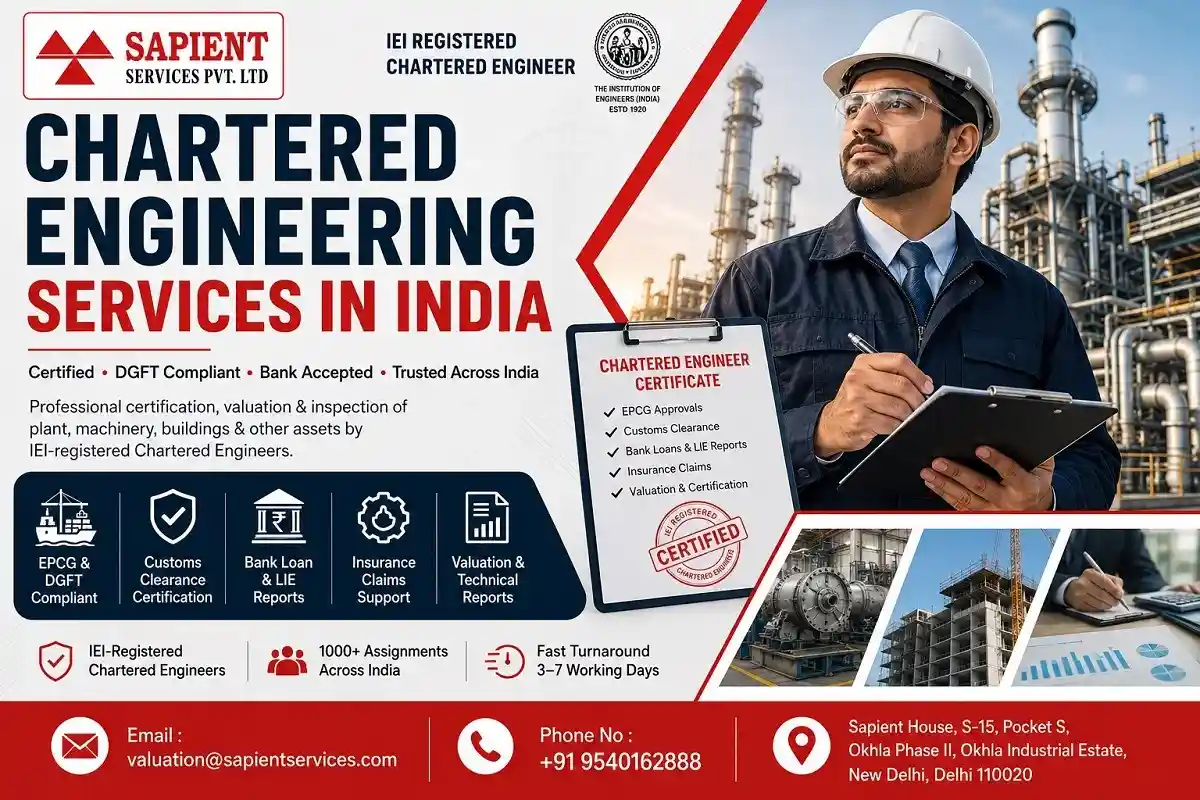
Chartered engineering services in India cover the technical certification, valuation, and inspection of plant, machinery, and property, carried out by an engineer registered with the Institution of Engineers (India).
This certification sits behind EPCG import approvals, loan disbursements, and insurance claims across the country.
Sapient Services Pvt. Ltd., an IBBI-registered valuation and advisory firm in New Delhi, issues Chartered Engineer certificates that hold up with customs, DGFT, banks, and courts. Here’s what this technical engineering certification actually involves.
Quick Answer: - Chartered engineering services cover certification, valuation, and inspection of plant, machinery, buildings, and other assets by an IEI-registered Chartered Engineer.
- You need this CE certification for EPCG authorizations, customs clearance, bank loan approvals, insurance claims, and fixed asset verification.
- Sapient Services has completed 1000+ assignments across India, with most Chartered Engineer certificates delivered in 3–7 working days.
|
What Is a Chartered Engineer Certificate?
A Chartered Engineer certificate is a formal technical document confirming the value, condition, or specifications of an asset — typically plant and machinery, industrial equipment, or immovable property.
In most cases, it must come from an engineer recognized as a Chartered Engineer by the Institution of Engineers (India), under its Royal Charter of 1935, or another authority-approved engineering professional depending on the applicable regulation.
This isn’t optional paperwork. Customs authorities may reject or seek clarification on reports that don’t meet prescribed certification requirements, and DGFT typically accepts EPCG installation certificates only from a recognized Chartered Engineer.
Many banks, NBFCs, and insurers require certification from qualified — and where applicable, empanelled — engineering professionals. This professional engineering certification is what turns a technical opinion into a document regulators and lenders can rely on.
Is a Chartered Engineer Certificate Always Mandatory?
It’s mandatory in specific, regulation-linked situations — EPCG installation, customs clearance of used machinery, and most bank/NBFC-financed capital equipment purchases.
It’s usually not required for routine internal asset transfers or low-value equipment where no regulator, lender, or insurer has asked for technical certification.
When in doubt, check with the requesting authority or bank first — using the wrong certification (or none at all) is a common cause of delay.
Who Needs Chartered Engineering Services in India?
- Importers and exporters bringing in used or second-hand machinery through Indian ports — Chennai, Mumbai, JNCH, Mundra, Kandla
- Manufacturers applying for EPCG authorization for duty-free capital goods import
- Banks and NBFCs financing large capital projects, requiring a Lender’s Independent Engineer
- Companies undergoing stock audits, fixed asset verification, or asset componentization
- Businesses filing insurance claims on damaged plant, machinery, or property
- Promoters and developers needing stability certificates for buildings and structures
- Corporates in NCLT or IBC proceedings requiring technical valuation of physical assets
If your bank has withheld a disbursement pending a Chartered Engineer’s report, or your consignment is stuck at customs, this isn’t a service you can wait on.
Certificates from uncertified providers get rejected outright, restarting the clock from zero.
Documents Required for Chartered Engineer Certification
Having the right paperwork ready speeds up inspection and certificate issuance considerably.
- Purchase invoice or import/export bill of entry for the asset
- Prior valuation or inspection reports, if any exist
- Company PAN, GST registration, and constitution documents
- Insurance policy copy, for claim-related certification
- Site access and a point of contact for physical inspection
- EPCG authorization copy, for DGFT-linked installation certificates
Our Process: Step-by-Step
- Initial Consultation & Scope Confirmation — We confirm asset type, purpose, and format. 1 business day.
- Document Collection — Invoices, import papers, and prior reports are reviewed. 1–2 business days.
- Site Inspection — A Chartered Engineer inspects the asset and records condition and specifications. 1–3 business days.
- Technical Assessment — We apply the correct valuation and depreciation methodology for the purpose.
- Report Drafting & Review — The certificate is drafted in the exact format the authority requires.
- Certificate Issuance — Signed and sealed by an IEI-registered Chartered Engineer.
Types of Chartered Engineering Services We Offer
EPCG Chartered Engineer Certificate
Under the EPCG scheme, DGFT requires a chartered engineer certificate for EPCG license confirming imported capital goods are installed and operational.
We prepare and file these in the exact DGFT format, keeping export obligation timelines on track.
Customs Certification for Used Machinery
Every import or export of used machinery requires a chartered engineer certificate for used machinery import, confirming fair depreciated value.
This prevents disputes over under-invoicing or over-valuation at customs.
Lender’s Independent Engineer Services
For large capital projects, banks and NBFCs appoint a Lender’s Independent Engineer to track fund utilization and verify construction milestones before releasing finance in tranches.
Under the RBI Project Finance Directions, 2025, lenders now place greater emphasis on independent technical due diligence and ongoing project monitoring before each disbursement.
Chartered Engineer Certificate for Bank Finance
Banks and NBFCs financing plant and machinery purchases often ask for a Chartered Engineer certificate for bank loan approval, confirming machinery valuation and residual life.
This engineering valuation supports credit appraisal alongside your project report, and covers equipment certification for both new and used capital goods.
Insurance Loss Assessment & Claims Certification
When plant, machinery, or property is damaged, insurers require an independent Chartered Engineer’s assessment before settling a claim.
We provide certified reports covering cause, extent, and replacement cost.
Fixed Asset Verification & Componentization
Statutory audits under the Companies Act require physical verification of fixed assets, and increasingly, componentization into separately depreciable parts.
Stability Certificates for Buildings & Structures
For older buildings, post-incident assessments, or bank collateral, we issue structural stability certificates confirming load-bearing capacity and safety.
Chartered Engineer vs Registered Valuer — What’s the Difference?
A Chartered Engineer certifies the technical condition, specifications, and value of physical assets like plant and machinery.
A Registered Valuer, empanelled under Section 247 of the Companies Act 2013, is authorized specifically for statutory valuations such as fair value reporting.
Sapient Services’ team holds both credentials, so the correct professional signs off depending on what your bank, customs officer, or auditor asks for.
Regulatory Authorities & Bodies We Work With
Chartered Engineer certificates and technical due diligence reports from Sapient Services are structured to meet the format each authority expects.
- DGFT — EPCG installation certificates
- Customs — used machinery import/export valuation
- Institution of Engineers (India) — Chartered Engineer registration
- RBI-regulated banks and NBFCs — project finance and loan appraisal
- Insurance companies — loss assessment and claims
- NCLT and IBBI — asset valuation in insolvency proceedings
Why Choose Sapient Services?
Sapient Services has completed over 1000 valuation and chartered engineering certification assignments for banks, corporates, and government bodies across India, and in the UAE.
| Parameter | Generic Local Provider | Other Delhi Firms | Sapient Services |
|---|
| Credentials | Unverifiable | Partial | IEI-registered Chartered Engineers, IBBI-linked valuers |
| Turnaround | Unpredictable | 7–10 days | 3–7 working days |
| Methodology | Ad hoc | Standard | DGFT/Customs-prescribed matrix, Ind AS-aligned |
| Bank/Customs Acceptance | Frequently rejected | Usually accepted | Accepted by leading banks, customs, DGFT, NCLT |
| Client Base | Local, small ticket | Regional | 1000+ assignments — banks, NBFCs, PSUs, MNCs, MSMEs |
| Compliance | Not always current | Generally current | Updated to current DGFT/Customs/Companies Act standards |
| Support | Limited | Standard | Dedicated point of contact through certificate delivery |
For a manufacturer’s EPCG installation certificate queried at the DGFT regional office, our team resubmitted a corrected report within 48 hours, keeping the export obligation deadline intact.
Pan-India Chartered Engineering Services
Sapient Services is headquartered in New Delhi and serves clients across Delhi, New Delhi, and Delhi NCR, along with pan-India coverage in Mumbai, Chennai, Ahmedabad, Bengaluru, Hyderabad, Pune, and Kolkata.
We also support Chartered Engineer certificate requirements for clients in the UAE through our Dubai advisory desk.
Pricing & Cost Guidance
The chartered engineer certificate cost in India varies by asset type, location, and purpose — a single-machine EPCG certificate costs less than a multi-site fixed asset verification.
| Service Type | Factors That Affect Cost | Indicative Range |
|---|
| EPCG / Customs CE Certificate | Number of machines, port location, inspection complexity | Project-specific quote |
| Lender’s Independent Engineer | Project size, disbursement tranches, site visits required | Project-specific quote |
| Insurance Loss Assessment | Extent of damage, asset value, documentation available | Project-specific quote |
| Fixed Asset Verification | Number of locations, asset count, componentization scope | Project-specific quote |
Sapient Services offers transparent, project-specific pricing with no hidden charges.
Get a Project Estimate in 24 Hours →
Common Mistakes & Risks to Avoid
- Using an uncertified “engineer” for customs or DGFT work — reports without proper IEI registration are commonly rejected or queried, restarting your timeline.
- Applying the wrong valuation methodology — a replacement-cost approach for insurance won’t satisfy DGFT’s depreciation matrix for EPCG.
- Missing regulatory timelines — EPCG obligation periods and insurance claim windows are strict; delayed certification can mean penalties.
- Relying on document review alone — reports without an actual site inspection are often challenged by banks and customs.
Frequently Asked Questions
Q: What is a Chartered Engineer certificate used for in India?
A: It’s used for EPCG approvals, customs clearance, bank loans, insurance claims, and fixed asset verification.
Q: Who is authorized to issue a Chartered Engineer certificate in India?
A: Typically, an engineer recognized by the Institution of Engineers (India) or another authority-approved professional, depending on the regulation.
Q: Is a Chartered Engineer certificate always mandatory?
A: It’s mandatory for EPCG, customs machinery clearance, and most lender-financed purchases — not for routine internal transfers.
Q: How long does it take to get a Chartered Engineer certificate?
A: Most certificates are issued within 3–7 working days of site inspection.
Q: Is a Chartered Engineer certificate mandatory for EPCG licenses?
A: Yes. DGFT typically requires it to confirm installation of capital goods imported under EPCG.
Q: How to get a chartered engineer certificate in India?
A: Share your asset details and purpose with Sapient Services; we schedule inspection and issue the certificate within days.
Q: What is a Chartered Engineer certificate for customs clearance?
A: It confirms the fair depreciated value of used or second-hand machinery for import or export at Indian ports.
Q: What documents are needed for a Chartered Engineer certificate?
A: Purchase invoices, import documents, prior valuation reports, and site access for inspection.
Q: What is the chartered engineer certificate cost in India?
A: Cost depends on asset type and inspection scope; we provide a written quote within 24 hours.
Q: Is a Chartered Engineer certificate required for a bank loan?
A: Often, yes — for machinery-backed loans, banks commonly ask for a certificate confirming valuation and residual life.
Q: Does Sapient Services offer chartered engineering services in Delhi NCR and pan-India?
A: Yes, we’re based in New Delhi and serve clients across Delhi NCR and pan-India, plus the UAE.
Q: Why do banks sometimes reject Chartered Engineer reports?
A: Reports lacking proper registration, correct methodology, or a physical site inspection are commonly queried or rejected.
Q: What’s the difference between a Chartered Engineer and a Registered Valuer?
A: A Chartered Engineer certifies technical condition and value; a Registered Valuer under Section 247 handles statutory valuations.
Q: Is a Chartered Engineer valuation report required for insurance claims?
A: Usually yes — insurers typically require an independent loss assessment before settling claims on damaged assets.
Q: How do I contact Sapient Services for a Chartered Engineer certificate?
A: Call +91 9540162888 or email valuation@sapientservices.com with your requirement.
Get Chartered Engineering Services in India — Without the Delays
Whether it’s an EPCG certificate stuck at a DGFT desk, a customs consignment waiting on valuation, or a bank holding back disbursement, a Chartered Engineer certificate is what unlocks the next step.
Sapient Services Pvt. Ltd., New Delhi, has delivered chartered engineering services across 1000+ assignments for banks, corporates, and government bodies pan-India.
Our engineers are IEI-registered, and every report is built to the exact format each authority expects. Regulatory deadlines don’t wait — reach out before yours becomes urgent.
Call us today: +91 9540162888 | Email: valuation@sapientservices.com