
What is Asset Componentization? Meaning, Process & Benefits
 By
By 
If a large chunk of your company’s fixed asset register is a building, a plant, or heavy machinery, chances are a single depreciation rate for the whole asset is quietly overstating or understating your numbers. Fixed assets componentization solves exactly this problem.
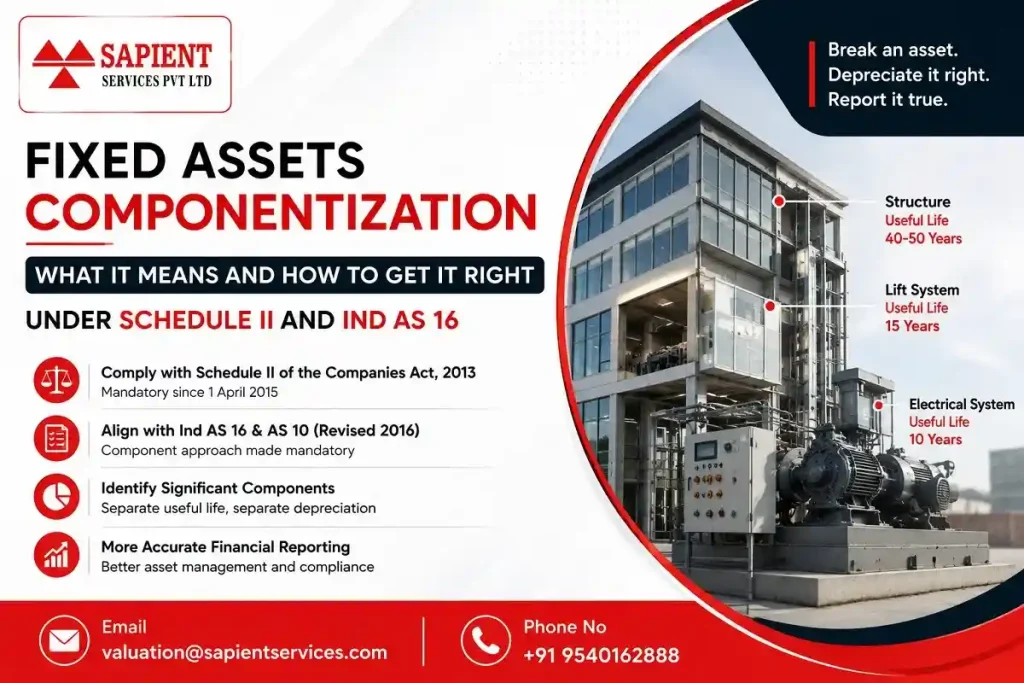
In simple terms, it means splitting a single asset into its significant parts — say, a building’s structure versus its lift, or a plant’s main frame versus its control panel — and depreciating each part over its own useful life instead of one blanket rate for the entire asset.
This isn’t an optional accounting nicety anymore. For most Indian companies, componentization has been a legal requirement under Schedule II of the Companies Act, 2013 since financial year 2015-16, and it sits at the heart of Ind AS 16 for companies that follow Indian Accounting Standards.
Quick Answer: What Is Fixed Asset Componentization?
Fixed asset componentization is the practice of identifying parts of a tangible fixed asset whose cost is significant relative to the total cost, and whose useful life differs from the asset as a whole, then depreciating that part separately. Under Schedule II of the Companies Act, 2013, this has been mandatory since 1 April 2015. Under Ind AS 16 (Paragraphs 43-47), it applies to any Ind AS-compliant entity regardless of company size.
Why Componentization Exists in the First Place
Think of a manufacturing plant (figures below are illustrative, not statutory). The civil structure might reasonably last 40-50 years. The roofing sheets might need replacement in 15 years. The electrical wiring and control systems could be due for an overhaul in 10. If you depreciate the whole plant at one rate, you’re either writing off the building too fast or the wiring too slow — and both distort your books.
Componentization fixes this by matching depreciation to how the asset actually wears out, part by part. It’s a more honest picture of asset consumption, and it’s also why regulators made it compulsory rather than optional.
The Legal Framework: Schedule II, Ind AS 16, and AS 10
Schedule II of the Companies Act, 2013
Schedule II replaced the old rate-based depreciation system under Schedule XIV of the Companies Act, 1956 with a useful-life-based approach, effective from FY 2014-15. Note 4 of Part C states that where the cost of a part of an asset is significant to the total cost, and its useful life differs from the rest of the asset, that part’s useful life must be determined separately.
The requirement was voluntary for FY 2014-15 and became mandatory for financial years commencing on or after 1 April 2015, following an MCA amendment. In practice, this means every company preparing accounts under the Companies Act should already be applying componentization — this isn’t a new or emerging rule.
Ind AS 16 — Property, Plant and Equipment
For companies that follow Indian Accounting Standards, Paragraphs 43 to 47 of Ind AS 16 lay down the component approach directly. Each significant part of an asset with a cost significant to the total is depreciated separately. Parts with the same useful life and depreciation method can be grouped together for convenience.
AS 10 (Revised 2016) — For Companies Not on Ind AS
The original AS 10 allowed the component approach as an option. That version is superseded. AS 10 (Revised 2016), notified by the MCA on 30 March 2016 and mandatory for accounting periods from FY 2017-18, replaced both the old AS 10 and AS 6 (Depreciation Accounting). Under the revised standard, separately depreciating a significant, differently-lived part of an asset is a recognition requirement, not a choice — bringing non-Ind AS companies in line with Ind AS 16 and Schedule II on this point.
In effect, by 2026 nearly every company preparing accounts under the Companies Act — whether on Ind AS or on the older Accounting Standards — is expected to apply component accounting wherever a part’s cost is significant and its useful life genuinely differs. The one caveat that still needs individual judgment is materiality: if no part of an asset meets both conditions, there’s simply nothing to separate out.
How to Identify a Significant Component
This is usually where companies get stuck, because neither the Act nor Ind AS gives a hard percentage. That said, there is useful guidance to lean on:
- The ICAI’s Guidance Note and Application Guide on Schedule II point to 10% of the original cost of the asset as an indicative threshold for judging whether a component is material — not a rigid legal cut-off, but a benchmark widely used in practice as a starting point.
- A part only needs separate treatment if both conditions are met: its cost is significant, and its useful life genuinely differs from the main asset.
- Identifying components correctly often needs technical input — a structural engineer’s view on a building’s shell versus a plant engineer’s view on rotating machinery carries real weight here, not just an accountant’s estimate.
- If a component’s assessed useful life is shorter than the useful life prescribed in Part C of Schedule II for the whole asset class, the shorter life applies to that component — and equally, a longer useful life can be adopted where technical evidence genuinely supports it, as long as the deviation and its basis are disclosed.
- Materiality is ultimately a judgment call based on the facts of each case — the 10% figure is a guide, not a formula to apply blindly.
Step-by-Step Componentization Process
- Compile the fixed asset register with original cost, acquisition date, and existing useful life for every asset class above a chosen materiality threshold.
- Engage technical experts (structural, mechanical, or electrical, depending on the asset) to physically identify distinct components and estimate each one’s remaining useful life.
- Apply the materiality test — typically around 10% of original cost — to filter out components that don’t warrant separate tracking.
- Allocate the asset’s original cost across identified components using engineering estimates, replacement cost data, or purchase invoices where available.
- Assign each significant component its own useful life and depreciation method, keeping the residual value at or below 5% of original cost unless a higher figure is technically justified and disclosed.
- Recompute the carrying value and adjust opening retained earnings for any transitional impact, then document the entire exercise for audit purposes.
- Build a process to update component records whenever a part is replaced or a major addition is capitalized.
What Happens When a Component Is Replaced
This is one of the more practical benefits of componentization. When a significant part — say a transformer, a roof, or an engine — is physically replaced, the remaining book value of the old part is derecognized and written off, and the cost of the new part is capitalized and depreciated afresh over its own useful life.
Without componentization, companies often end up either double-counting the replaced part’s cost or continuing to depreciate an asset that no longer physically exists in that form. Getting this step right also directly affects repair-versus-capitalization decisions during major overhauls.
Common Mistakes Companies Make
- Applying componentization only to new assets acquired after the effective date and ignoring the existing asset base — the requirement applies to the entire block of assets, not just new additions.
- Treating the 10% materiality threshold as a strict legal rule rather than an indicative benchmark that still requires judgment.
- Skipping technical/engineering input and letting the accounts team estimate component lives on assumption alone.
- Setting residual value above 5% of original cost without documented technical justification.
- Failing to update component records when a part is replaced, leading to overlapping depreciation on the same physical asset.
- Not maintaining a clear audit trail showing how original cost was allocated across components — this is usually the first thing statutory auditors ask for.
Why Proper Componentization Is Worth the Effort
Beyond compliance, componentization gives management a far more accurate read on asset health and future capex needs. It flags upcoming replacement costs component by component, rather than leaving the whole asset’s remaining life as a single, blurred number.
It also holds up better under statutory audit and tax scrutiny, since the depreciation charge is backed by documented technical assessments rather than a blanket assumption applied across dissimilar parts.
Why Work With Sapient Services on Componentization
Sapient Services is an IBBI-registered valuation and advisory firm that carries out fixed asset verification, component identification, and useful-life assessments for companies bringing their asset registers into line with Schedule II and Ind AS 16. The team combines technical asset inspection with accounting expertise, so the component split holds up to both engineering scrutiny and audit review.
- IBBI-registered valuers on the team
- On-ground technical asset verification, not desk-based estimates
- Documentation built to withstand statutory and tax audit queries
- Support across the full cycle — identification, cost allocation, and ongoing component tracking
Frequently Asked Questions
Is fixed asset componentization mandatory in India?
Yes. Under Schedule II of the Companies Act, 2013, componentization became mandatory for financial years commencing on or after 1 April 2015. Ind AS-compliant companies apply it under Ind AS 16, Paragraphs 43-47.
What is the materiality threshold for identifying a component?
There’s no fixed legal percentage, but the ICAI’s Guidance Note suggests around 10% of the asset’s original cost as an indicative benchmark. It’s a guide, not a rigid rule — judgment still applies.
Does componentization apply to old assets or only new purchases?
It applies to the entire existing block of assets, not just assets acquired after the effective date. Companies cannot restrict it to new additions alone.
What’s the maximum residual value allowed under Schedule II?
Residual value generally should not exceed 5% of the asset’s original cost, unless a higher value is technically justified and properly disclosed in the financial statements.
Who decides which components are significant?
Materiality is a judgment call based on facts, usually made jointly by the accounts team and technical or engineering experts who can assess each part’s condition and remaining life.
What happens to depreciation when a component is replaced?
The remaining book value of the old component is derecognized, and the cost of the new component is capitalized and depreciated over its own separately assessed useful life.
Is componentization the same under AS 10 and Ind AS 16?
Close to it. The original AS 10 made it optional, but AS 10 (Revised 2016) — the version in force today for non-Ind AS companies — made it mandatory, matching the position under Ind AS 16.
Can useful life of a component differ from Schedule II’s Part C rates?
Yes. Part C gives useful life for the whole asset. If a component’s genuine useful life is shorter, that shorter life is used for that specific component.
Does componentization require an external technical expert?
It’s strongly advisable. Identifying significant parts and estimating their useful lives often needs structural, mechanical, or electrical expertise beyond what an accounts team typically has.
What documentation should be kept for componentization?
Keep the technical assessment report, the basis for cost allocation across components, useful-life justifications, and any residual value workings — auditors will ask for these.
Does componentization affect tax depreciation as well?
No. Componentization is a Companies Act and Ind AS accounting requirement. Tax depreciation is computed separately under the Income Tax Act, 2025 (Section 33, effective from FY 2026-27, replacing the earlier Section 32), which still uses the block-of-assets / written-down-value method — so book depreciation and tax depreciation can diverge and need separate tracking.
How often should component useful lives be reviewed?
Useful life and residual value estimates should be reviewed at least annually; any revision is treated as a change in accounting estimate under Ind AS 8.
Is componentization only relevant for large companies?
No. It applies to any company where a part of an asset has both a significant cost and a differing useful life, regardless of company size, though the practical impact is larger for asset-heavy businesses.
What industries typically need componentization the most?
Manufacturing, real estate, hospitality, infrastructure, and power are the sectors where buildings, plant, and machinery routinely have components with very different wear patterns.
Can a company self-assess components without third-party help?
Technically yes, but given the technical judgment involved and audit scrutiny, most companies engage valuation or engineering specialists to support the assessment with defensible documentation.
The Bottom Line
Fixed asset componentization isn’t a box-ticking exercise — it’s a compliance requirement under Schedule II and Ind AS 16 that also gives management a sharper view of what its assets are actually worth and when replacement spending is coming. The companies that get tripped up are usually the ones that treat the 10% threshold as gospel, skip technical input, or never touch their existing asset base.
If your fixed asset register hasn’t been reviewed for componentization, or it was done years ago without technical backing, it’s worth having it properly assessed before the next audit cycle. Sapient Services can walk through your asset base, identify significant components, and build documentation that stands up to scrutiny.
Suggested Services