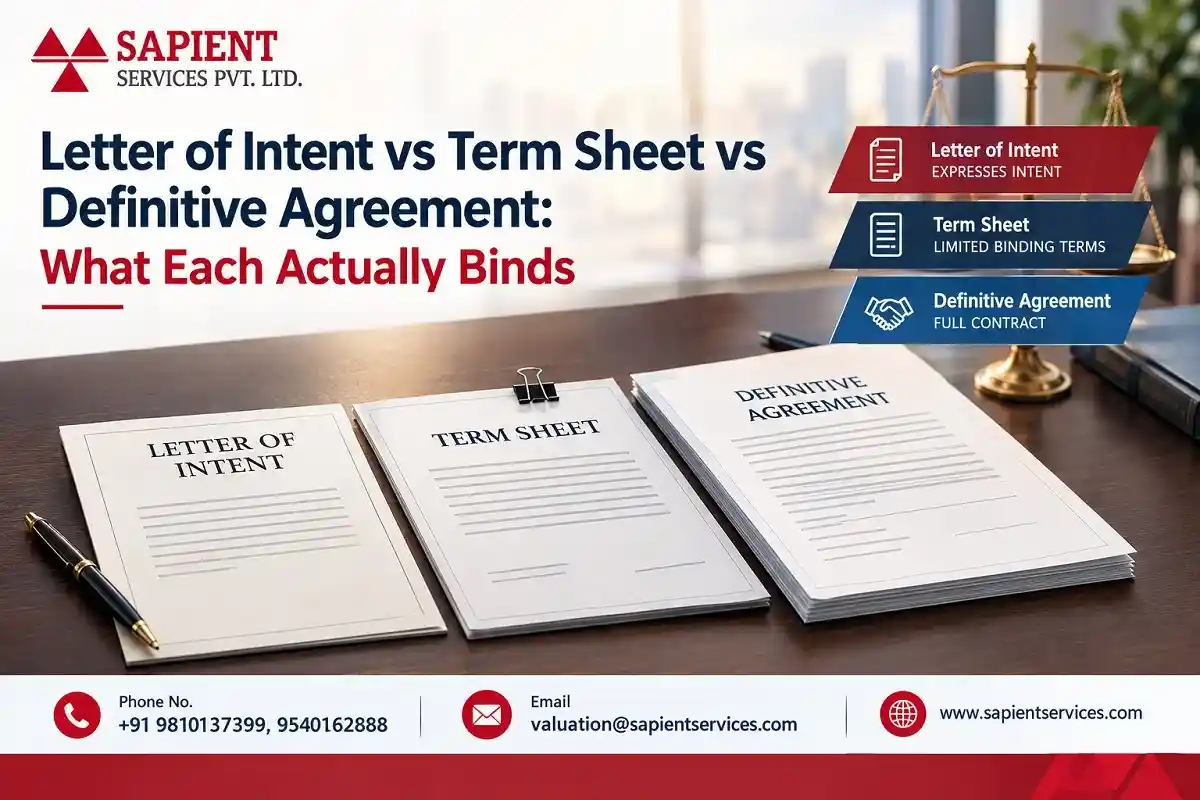
Letter of Intent vs Term Sheet vs Definitive Agreement: What Each Actually Binds
 By
By 
In 2015, OYO signed a term sheet to acquire Zostel’s hostel business. The document called itself non-binding, except for five named clauses: confidentiality, approvals, expenses, exclusivity, and governing law. Eleven years later, that case is still in court. An arbitral tribunal once held the whole thing had become binding anyway. The Delhi High Court disagreed in 2025. Zostel appealed. As of this writing, a Division Bench is still deciding it, and OYO has already agreed on the record to hand over 7% equity if Zostel wins.
That’s the real lesson behind the LOI-vs-term-sheet-vs-definitive-agreement question. It’s not about which label you put on a document. It’s about which specific sentences in it create an obligation, and how much room those sentences leave for a court to disagree about what you meant. Get it wrong and you either lose leverage you thought you had, or spend a decade finding out you were bound to something you assumed was still open.
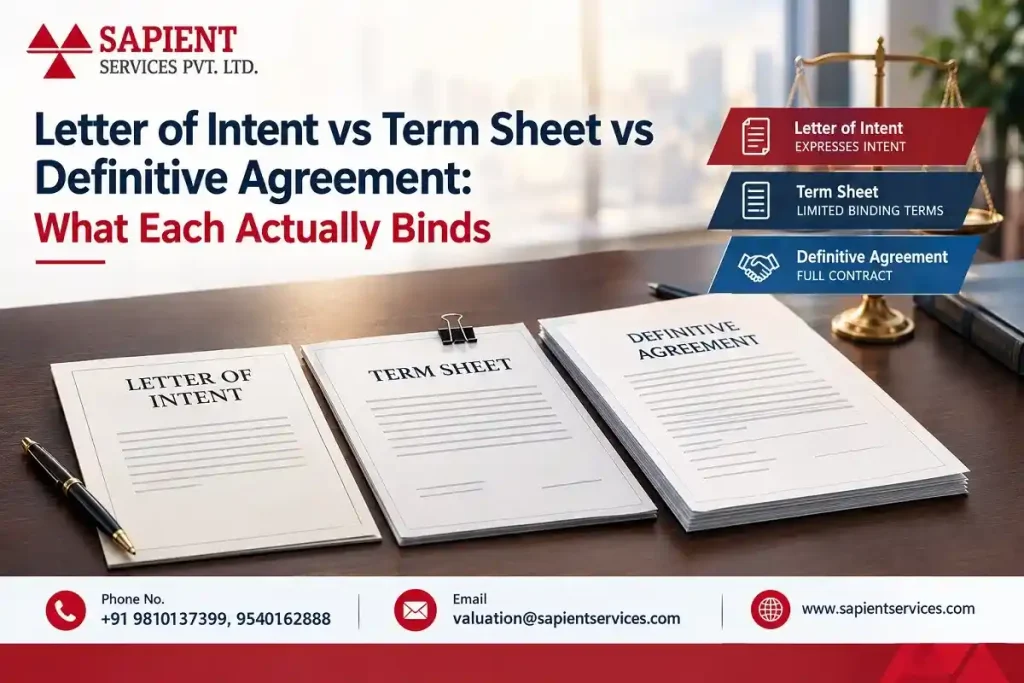
At a Glance
| Letter of Intent | Term Sheet | Definitive Agreement | |
| What it’s for | Signals intent to negotiate | Sets out commercial terms in detail | The actual contract |
| What usually binds | Little or nothing, unless the wording says otherwise | Only the clauses it names as binding | Everything the agreement sets out, subject to its own conditions and termination rights |
| Can you walk away | Generally, yes | From the commercial terms, yes — not from the carved-out clauses | Only via an agreed termination right or breach |
| Governs under | Sections 7 and 10, Indian Contract Act, 1872 | Same | Same |
Under Section 10 of the Indian Contract Act, 1872, an agreement becomes a contract when there’s free consent between parties competent to contract, for lawful consideration and a lawful object. Section 7, separately, requires that acceptance of the offer be absolute and unqualified. Between the two, that’s the whole test — and neither one asks what you titled the document.
Suggested Service:
The Cases That Actually Decide This
The Supreme Court has been consistent on Letters of Intent for decades. In Rajasthan Co-operative Dairy Federation v. Maha Laxmi Mingrate Marketing Service, it held that an LOI ordinarily signals intent to contract in future, nothing more. In Dresser Rand S.A. v. Bindal Agro Chem Ltd. (2006), the Court found the LOIs in question hadn’t even pulled in the arbitration clause from the parties’ general purchase conditions, so no arbitration agreement existed at all. In South Eastern Coalfields v. S. Kumar’s Associates AKM (JV) (2021), it laid out the test still used today: whether an LOI binds depends on the totality of the circumstances and the actual words used, not the heading.
Two of the freshest reaffirmations came out of government tender disputes rather than M&A, but courts apply the same reasoning to a commercial term sheet. In State of Himachal Pradesh v. OASYS Cybernatics (2025), a three-judge Bench called an LOI a “promise in embryo” that only matures into a contract once its preconditions are met or a formal Letter of Acceptance follows. In Maharashtra State Electricity Distribution Co. Ltd. v. R.Z. Malpani (9 April 2026), the Court held on its facts that an LOI which hadn’t ripened into a concluded contract couldn’t anchor an arbitration clause either — the same underlying question, just in a tender setting instead of a deal.
There’s a counterweight worth remembering before you get too comfortable calling something “just an LOI.” In Kollipara Sriramulu v. T. Aswatha Narayana (1968), the Supreme Court held that a preliminary document can become a fully enforceable contract if every essential term is already settled and the parties clearly intend to be bound then and there. The title never decides the outcome. The wording does.
Term Sheets Aren’t All-or-Nothing
Most term sheets carve out a handful of clauses that stay binding no matter what happens to the rest of the negotiation:
- Confidentiality — what either side learns during talks stays confidential even if the deal dies.
- Exclusivity (no-shop) — the seller can’t negotiate with other buyers for a set period.
- Cost allocation — who pays advisory and diligence expenses if the deal falls apart. This is different from a break fee, which is a specific payment triggered by a defined event, not just a cost-sharing rule.
- Governing law and dispute resolution — which law and forum apply to disputes over the term sheet itself.
- Non-solicitation — neither side poaches the other’s employees mid-negotiation.
Each of these can stand on its own as an enforceable obligation, separate from whatever happens to the main deal, because each one on its own can satisfy Section 10 — an offer, an acceptance of that specific term, consideration, a lawful object. Whatever the term sheet doesn’t name as binding stays open to renegotiation. But that only holds if the drafting actually says so. Silence isn’t a carve-out.
The OYO-Zostel dispute is the clearest illustration of how much this drafting matters, and also of how messy it gets when the wording still leaves room to argue. The 2015 term sheet named exactly five clauses as binding. When the deal fell apart, an arbitral tribunal held in 2021 that the entire term sheet had become binding through the parties’ later conduct, entitling Zostel to roughly 7% of OYO. The Delhi High Court set that award aside in May 2025 — not on the carve-out wording alone, but partly because it found the tribunal hadn’t properly worked through whether the parties had actually reached consensus on the deal’s material terms. Zostel then took the wrong appeal route to the Supreme Court, got told to go to a Division Bench instead, and did. That appeal was heard on 12 August 2026. OYO has already conceded that if Zostel wins, the 7% (or its value) changes hands. Nobody should read this case as fully closed — it’s the best real-world argument for writing your binding clauses precisely enough that a court doesn’t have to guess.
This is also where the Specific Relief (Amendment) Act, 2018 raises the stakes. Before 2018, specific performance — a court order forcing a party to actually go through with a deal — was discretionary, used mainly when damages wouldn’t cut it. The amendment made it the default remedy instead. Courts can still refuse it under the Act’s own exceptions, including for contracts that are inherently determinable. But a term sheet with every commercial term already settled and no real conditionality now carries more of that risk than it did before 2018.
Definitive Agreement: Where Signing Isn’t the Same as Closing
The definitive agreement — Share Purchase Agreement, Business Transfer Agreement, Shareholders’ Agreement, merger agreement, whatever form it takes — is where the real risk allocation happens. Representations and warranties about the target, indemnities if those turn out false, covenants on how the business runs between signing and closing, conditions precedent that have to clear before anything completes.
Signing binds the parties, subject to whatever conditions precedent the agreement sets. Closing is when money and shares, or assets, actually move. The stretch between the two — the “interim period” — is governed by covenants on how the target must be run while conditions clear, and it’s often where deals quietly unravel.
For a listed target, the date of the definitive agreement carries weight beyond the two signatories. Under the SEBI (Substantial Acquisition of Shares and Takeovers) Regulations, 2011, crossing 25% of voting rights or acquiring control triggers a mandatory open offer. The public announcement is usually dated to whichever agreement actually fixes the acquisition of shares or control — in most private M&A, that’s the definitive SPA, not the earlier LOI or term sheet.
The Regulatory Triggers Worth Planning Around
Two regulators care about when you sign, not just when you close, though the exact trigger depends on your deal’s structure.
Competition Commission of India. A notifiable combination has to be reported to the CCI before consummation. In practice, that means after the definitive agreement is executed, or a merger gets board approval, since that’s usually the document that actually fixes the deal’s terms. The 2023 amendment scrapped the old rigid 30-day filing window and trimmed the CCI’s overall review clock from 210 to 150 calendar days. Since September 2024, deals over ₹2,000 crore can fall within the deal-value threshold even where the usual asset or turnover thresholds aren’t met, provided the target has substantial business operations in India. Consummating a notifiable combination before clearance — gun-jumping — can draw a penalty of up to 1% of combined turnover or assets.
SEBI’s Takeover Code. Cross 25% of voting rights, or take control of a listed company, and you’re obliged to launch an open offer for at least 26% of the target’s shares. A December 2025 amendment tightened the pricing side of this: open offer pricing for indirect acquisitions or non-cash consideration now has to be certified by an Independent Registered Valuer under Section 247 of the Companies Act, 2013, not set by merchant bankers or chartered accountants on their own. Effective January 2026, that puts a registered valuer’s sign-off directly on the deal’s pricing, not just its accounting.
Both obligations sit with the definitive agreement in the overwhelming majority of deals. You can’t sidestep them by keeping the real commitment inside a term sheet and treating the SPA as paperwork — regulators read substance the same way courts do.
A Pattern Worth Watching For
One thing that comes up often enough to be worth naming: a buyer treats a signed term sheet as though it were already the final SPA, and refuses to revisit a term even after diligence turns up something that clearly should change it. Usually the seller’s side has left the exclusivity and price-adjustment language loose, assuming the whole document stays non-binding until a formal agreement is signed. The fix is almost always the same — go through the term sheet clause by clause, separate what’s actually binding from what’s still open, and put that position in writing before the next round of talks. It’s a cheaper conversation to have before signing than after.
Where Deals Go Wrong — and the Fix
Mistake: treating “non-binding” as “nothing counts.” Fix: name the specific clauses that survive, the way the OYO-Zostel term sheet did. Everything not named stays open — but only if the drafting says so.
Mistake: leaving exclusivity and break-fee terms vague. Fix: put a number on it. A start date, an end date, an actual rupee figure — not “reasonable” or “market standard.”
Mistake: assuming the regulatory clock starts at closing. Fix: for CCI and SEBI purposes, it usually starts at signing. Build your long-stop date around the CCI’s 150-day review window and, for listed targets, the SEBI valuer requirement.
Mistake: skipping legal review because “it’s just a term sheet.” Fix: route it through counsel before signing, not after a dispute has already started. The commercial terms and the legal exposure are decided in the same document.
FAQ
Q: Is a Letter of Intent legally binding in India?
A: Generally, no — unless its own wording shows a clear intention to be bound. The Supreme Court reaffirmed the general rule as recently as April 2026, in MSEDCL v. R.Z. Malpani, though that case arose from a tender dispute, not an M&A deal.
Q: Can a non-binding term sheet still be enforced?
A: Specific clauses can be, even when the rest isn’t. Confidentiality, exclusivity, cost allocation, and governing-law clauses are commonly drafted as binding carve-outs that survive even if the broader deal collapses.
Q: What does Section 10 of the Indian Contract Act, 1872 require?
A: Free consent between competent parties, lawful consideration, a lawful object — and, under the separate Section 7, an offer accepted absolutely and unconditionally.
Q: Does signing an LOI trigger a CCI filing?
A: Not usually. The Section 6(2) notification obligation is tied to the definitive acquisition agreement or a board-approved merger, not a preliminary LOI.
Q: When does an open offer become mandatory under SEBI’s Takeover Code?
A: When an acquirer, alone or acting in concert with others, crosses 25% of voting rights or takes control of a listed target.
Q: What’s the difference between signing and closing?
A: Signing is when the parties execute the definitive agreement and become bound to it, subject to conditions precedent. Closing is when consideration is actually paid and shares or assets transfer.
Q: How are representations and warranties different from indemnities?
A: Reps and warranties are statements of fact about the target that, if false, support a breach claim. Indemnities are a separate promise to cover specific losses once the contract’s own trigger is met — usually a lower bar than proving breach of a representation.
Q: Is the OYO-Zostel case actually over?
A: No. The Supreme Court sent Zostel back to file the right kind of appeal at the Delhi High Court, which it did. That appeal was heard on 12 August 2026, and as of this writing it hasn’t been finally decided. OYO has already agreed on record to transfer the disputed 7% equity if Zostel wins.
Q: Has it become easier to force a party to complete a deal in India?
A: Yes, generally. The Specific Relief (Amendment) Act, 2018 made specific performance the default remedy rather than a discretionary exception, though courts can still refuse it under the Act’s own statutory exceptions.
Before You Sign Anything
Check three things on whatever you’re about to sign: which clauses are actually labelled binding, whether your commercial terms are genuinely still open or complete enough that a court could enforce them as-is, and whether your timeline accounts for CCI or SEBI clearance running from the day you sign, not the day you hope to close.
If any of those three answers is unclear, get it reviewed before you sign, not after the other side starts relying on it. Sapient Services can walk through the specific clauses in your term sheet or draft definitive agreement and flag where your actual exposure sits — reach out at +91 9540162888 or valuation@sapientservices.com.
Suggested to Read: