Complete Guide to Mergers & Acquisitions
 By
By 
Every merger or acquisition starts with a structure, and the structure quietly settles most of what follows. It decides who has to approve the deal, which liabilities the buyer inherits, how the transaction is taxed and how long closing takes. Settle it before you settle price. A number agreed before the structure is a number you may have to reopen. This guide explains what mergers and acquisitions are, how the main deal types differ, how a transaction runs from first contact to integration, what valuation and due diligence are for, and where deals go wrong. Rules differ from one country to the next, so the guide sticks to principles that hold wherever a deal is done.
| If you are planning a merger, acquisition or sale, Sapient Services offers a free consultation on structure, valuation and due diligence. Call +91 9540162888 or write to valuation@sapientservices.com. |
M&A at a Glance
- A merger joins two companies into one. An acquisition transfers control, and the target usually survives.
- Structure comes first because it drives approvals, tax and liability.
- Valuation gives a range. Negotiation, structure and diligence findings decide the price.
- Diligence exists to price risk, not to tick boxes.
- Integration is part of the deal, so plan it before signing.

What Mergers and Acquisitions Mean
Mergers and acquisitions, usually shortened to M&A, covers every way a business combines with another or changes hands. Buyers use it to grow faster than building would allow, to enter a new market or to buy a capability they lack. Sellers use it to exit.
In a merger, two companies become one. Sometimes one is absorbed and disappears, and sometimes both fold into a new entity. In an acquisition, a buyer takes control by purchasing shares or assets, and the target may carry on as a separate company under new ownership.
The labels are looser than they sound. A merger of equals is usually an acquisition described kindly, because one management team ends up running the combined business. A takeover means buying a listed company, and it turns hostile when the buyer bypasses the board and goes to shareholders directly. A demerger, or spin-off, runs the other way: a division is separated from its parent.
Merger vs Acquisition
| Point | Merger | Acquisition |
|---|---|---|
| The target | One company is absorbed, or both fold into a new one | Continues under new ownership, or sells a business or specific assets |
| What sellers receive | Shares in the combined company, sometimes with cash | Cash, shares of the buyer, or a mix |
| Typical route | A merger agreement or plan, often with a shareholder vote and sometimes a court or registry step | A share purchase, an asset purchase or an offer made to shareholders |
| Approvals | Shareholders of the companies involved, plus regulators where the combined business is large | The seller and its shareholders where required, plus regulators depending on size, sector and listing status |
Types of Mergers and Acquisitions
By Commercial Relationship
A horizontal merger joins competitors. It buys scale and market share, and it draws the closest look from competition regulators because a rival disappears. A vertical merger joins companies at different stages of one supply chain: buying a supplier is backward integration, and buying a distributor is forward integration. A conglomerate merger joins unrelated businesses, usually to spread risk or enter a new sector. Market extension and product extension deals sit in between, selling the same product in a new region or a new product to the same customers.
Not every investment is a takeover. A strategic investor wants control and a voice in management. A financial investor wants a return and takes limited rights, such as a board seat and vetoes over defined decisions. A joint venture splits control between two parties under a shared agreement. The type decides what you investigate and what you document.
Private equity adds two more forms: the roll-up, in which several small companies are combined into one platform, and the leveraged buyout, in which borrowed money funds most of the price. A management buyout, led by the target’s own executives, is a close relative.
By Deal Structure
| Structure | What happens | Why it gets chosen |
|---|---|---|
| Share purchase | The buyer acquires shares, and the company comes with all its liabilities | Simple to execute; contracts and permits generally stay with the company, though change-of-control terms can still apply |
| Asset purchase | The buyer picks specific assets and liabilities | Leaves unwanted liabilities behind; contracts, permits and staff may need to be moved one by one |
| Statutory merger | Companies combine under merger law into one legal entity | Clean combination; usually needs a shareholder vote and sometimes court or registry approval |
| Demerger or spin-off | A division is separated into its own company | Lets a business be sold or listed on its own |
| Tender offer | The buyer offers to buy shares directly from a listed target’s shareholders | The usual route for a takeover, friendly or hostile |
| Reverse merger | A private company merges into a listed one to become public | A route to a listing without a conventional public offering |
| Joint venture | Two parties share ownership of a new or existing business | Shares risk while each party stays independent |
| Leveraged buyout | Acquisition funded mainly with debt secured on the target | Lets a buyer control a business with a small equity cheque |
Benefits and Risks of Mergers and Acquisitions
Buyers pay a premium because they expect the combined business to be worth more than the two parts. The reasons are usually concrete: customers, distribution, a technology or team that would take years to build, lower unit costs, control of supply, or keeping an asset away from a competitor.
Sellers have reasons too. A founder may be ready to leave, or a business may need capital or scale it cannot fund alone. Those motives shape how hard a seller pushes on price and on staying involved after closing.
The extra value a buyer expects is called synergy, and it comes in two kinds that deserve different levels of trust. Cost synergies come from removing duplicate functions, combining purchasing and closing overlapping sites. They are easier to estimate because the costs already exist. Revenue synergies, such as cross-selling, depend on customers behaving the way the model assumes. A buyer who pays for revenue synergies is paying the seller for work the buyer will have to do.
Deals disappoint for ordinary reasons. The buyer overpays, integration is planned late, two cultures clash, a liability surfaces after closing, or the people the business depends on leave. Each of these can be tested before signing, which is what valuation, diligence and an integration plan are for.
The M&A Process, Stage by Stage
Negotiated deals follow a similar order, though the sequence shifts when the target is listed or distressed.
- Strategy and target search. The buyer decides what it wants to own and why, then builds a shortlist. Sellers prepare their information and often appoint an adviser.
- First contact and confidentiality. A non-disclosure agreement comes before any sensitive data is shared.
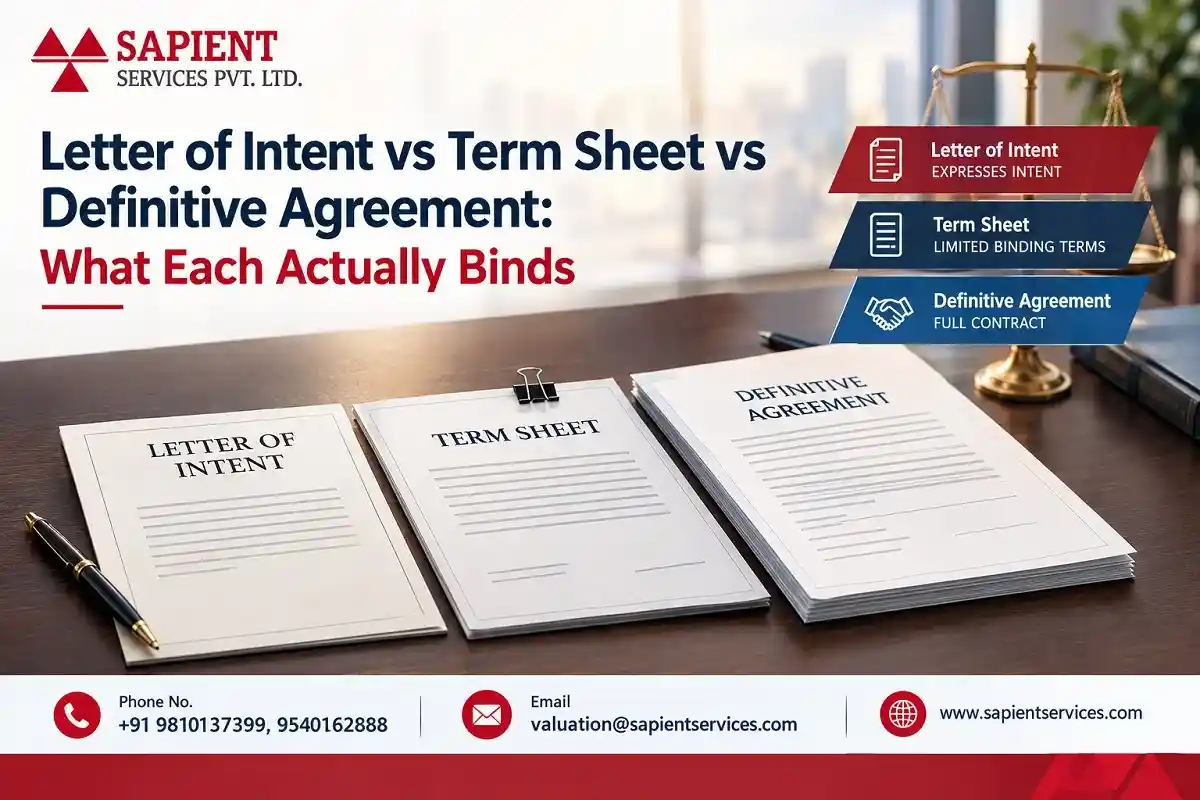
- Term sheet or letter of intent. Structure, price range, exclusivity and timetable are recorded. Most of it is non-binding, though confidentiality and exclusivity usually bind. Letter of intent vs term sheet vs definitive agreement shows what each document commits you to.
- Due diligence. The buyer tests what the seller has claimed.
- Valuation and negotiation. A valuation sets a range, and negotiation settles where in that range the price lands.
- Definitive agreements. The purchase or merger agreement fixes price mechanics, warranties, indemnities, conditions to closing and termination rights.
- Approvals and closing. Conditions are met, consents are obtained, the price is paid and ownership transfers.
- Integration. This is the work that should have started before signing.
A private share purchase between two willing parties moves fastest. Anything that needs regulatory clearance, a shareholder vote or a court approval sets its own clock, and that clock rarely answers to the deal team.
How Valuation Shapes the Price
Valuation produces a range, not a price. The price comes from negotiation, from the structure and from what diligence turns up. The method matters less than its inputs: the same model gives a different answer when the forecast, the discount rate or the earnings base changes.
The approaches in common use are discounted cash flow, trading multiples of comparable companies, multiples from comparable past deals and asset-based methods. Our article on valuation techniques in M&A explains when each one works and where it breaks.
Two terms cause confusion. Enterprise value is the value of the operating business. Equity value is what belongs to shareholders once net debt and similar claims are deducted. Mixing them up is an easy way to misread an offer.
Price does not have to be paid as one cheque on closing day. Three tools adjust it.
- An earn-out pays part of the price later, if the business meets agreed targets.
- An escrow or holdback keeps part of the price aside to cover claims after closing.
- A working capital adjustment trues the price up for the cash tied up in operations on the closing date.
Use an earn-out to bridge a genuine difference in forecasts. Do not use it to postpone an argument about what the business is worth.
A buyer should also check what the price does to its own numbers. A listed buyer will look at whether the deal raises or lowers earnings per share, and every buyer should compare the offer with the target’s standalone value to see how much it is paying for control. In a share-for-share deal, settle whether the exchange ratio is fixed at signing or moves with the buyer’s share price, because that decides who carries the market risk.
A simple illustration, not a real transaction. A buyer prices a manufacturer at a multiple of its reported EBITDA. Diligence then shows that part of that EBITDA came from a one-off gain and that the plant needs more investment than the seller’s plan allowed for. The buyer restates earnings, deducts the extra spending, adjusts for debt and working capital, and the offer drops. The method did not change. The inputs did.
For a valuation prepared for a live transaction, see our business valuation services.
Due Diligence: What it Should Find
Treat diligence as a way to price risk, not as a pass-or-fail test. What it finds should change the price, the protections in the agreement, or both. Several workstreams run side by side.
- Financial diligence tests earnings quality, working capital and the full debt picture.
- Legal diligence covers title to property and assets, the validity of licences, litigation and, above all, change-of-control clauses in material contracts.
- Tax diligence reviews open assessments, past positions and exposure that would stay with the company.
- Commercial diligence tests customer concentration, suppliers and the market assumptions behind the forecast.
- Operational and technical diligence looks at the condition of facilities and systems and what they will cost to maintain or replace.
- People diligence reviews key staff, incentive schemes and employment obligations.
- Data and cyber diligence matters wherever the target holds personal data or depends on its systems.
- Capitalisation diligence checks who owns what: share records, option grants and shareholder agreements. Gaps here can stall closing.
For more, read our explainers on due diligence and financial due diligence. Sellers can shorten the process by keeping ownership records, contracts, licences, tax filings and financial statements in one organised data room before a buyer asks for them.
Approvals and Legal Checks
Which approvals apply depends on where the parties operate, their size, whether any of them is listed and which sector they are in. The categories repeat across most legal systems.
- Board and shareholder approval, which a merger usually needs and a sale of most of a company’s business often needs.
- Competition or antitrust review where the combined business is large or the market is concentrated.
- Takeover and securities rules where a listed company is involved, including disclosure duties and, in many systems, an obligation to offer to buy the remaining shareholders out once a control threshold is crossed.
- Foreign investment screening where a buyer from another country acquires a business in a sensitive sector.
- Sector regulators for banks, insurers, telecoms, utilities and similar businesses, who commonly approve a change of control.
- Court or registry steps where the merger law requires them.
- Consents from lenders, landlords, key customers and licensing bodies where contracts contain change-of-control terms.
Map these at term-sheet stage. Closing before a required clearance can bring penalties, and the deal itself can be put at risk.
Tax and Accounting
Tax should shape the structure, not follow it. A share sale and an asset sale can produce very different bills for buyer and seller, and the two sides often prefer opposite structures. Sellers tend to favour selling shares. Buyers often favour buying assets, partly to choose which liabilities to take and partly because the price paid can sometimes be reflected in the tax value of those assets.
Many systems let qualifying mergers and demergers proceed without immediate tax on the transfer, provided set conditions are met. Transfer or stamp taxes, indirect taxes and the treatment of accumulated tax losses vary widely. Never assume losses survive a deal.
On the accounting side, the buyer generally records the acquired assets and liabilities at fair value and books any excess of price over those net assets as goodwill. Combinations between companies under common control can be treated differently.
Post-Merger Integration
Closing is where integration starts, and the plan should exist before signing. The work usually splits into six areas.
- Leadership and reporting lines come first.
- Finance and systems follow: charts of accounts, reporting calendars, tax registrations and the main IT platforms.
- Customer and supplier contracts need review for assignment and change-of-control terms.
- People work covers retention of key staff, alignment of pay and policies, and compliance with employment law.
- Culture needs deliberate attention, since two teams with different habits will not merge by memo.
- Regulatory filings and the transfer of licences, bank accounts and permits come last.
Employment law decides what happens to staff when a business changes hands, and the answer differs between a merger, a share purchase and an asset purchase. Tell employees early what changes and what stays. Name an integration lead before signing, and give that person authority.
Common M&A Mistakes
- Agreeing a price before the structure.
- Letting diligence turn into box-ticking once the team is committed to the deal.
- Paying for revenue synergies in the price.
- Missing change-of-control clauses in key contracts, licences and loan agreements, which can let the other side terminate or demand consent.
- Leaving approvals until after signing.
- Using an earn-out to postpone a disagreement about value.
- Planning integration after closing.
Who Does What in an M&A Transaction
A lawyer drafts the agreements and manages approvals. A tax adviser shapes the structure, and an accountant runs financial diligence. A valuer produces the valuation. A banker or broker finds counterparties and runs the sale process. Specialists review technical, data and environmental risk where the target depends on them. Sapient Services works on the valuation and diligence side; read about our M&A advisory support.
M&A Glossary
| Term | Meaning |
|---|---|
| Synergy | Extra value expected from combining two businesses, through lower costs or higher revenue |
| Enterprise value | The value of the operating business before deducting net debt |
| Equity value | The value that belongs to shareholders after net debt and similar claims |
| Exchange ratio | The number of acquirer shares given for each target share in a share-for-share deal |
| Earn-out | Part of the price paid later if the business meets agreed targets |
| Escrow | Part of the price held with a third party to cover claims after closing |
| Material adverse change clause | A clause that lets the buyer walk away if the target’s condition deteriorates badly before closing |
| Conditions to closing | Steps that must be completed before the deal can close, such as approvals and consents |
| Exclusivity (no-shop) | A promise by the seller not to solicit or negotiate with other bidders for an agreed period |
| Break fee | A sum payable if a party withdraws from an agreed deal in the circumstances the agreement lists |
Frequently Asked Questions
What is the difference between a merger and an acquisition?
In a merger, two companies become one legal entity. In an acquisition, a buyer takes control of a company or its assets and the target usually continues to exist. In practice the terms overlap, since many mergers are acquisitions in all but name.
What are the main types of mergers?
The common ones are horizontal (competitors), vertical (supplier and customer), conglomerate (unrelated businesses) and market or product extension. Deals are also classed by legal structure, such as share purchase, asset purchase, statutory merger and demerger.
What are the stages of an M&A deal?
Strategy and target search, confidentiality agreement, term sheet, due diligence, valuation and negotiation, definitive agreements, approvals and closing, and integration.
What is the difference between enterprise value and equity value?
Enterprise value is the value of the operating business. Equity value is what belongs to shareholders after net debt and similar claims are deducted. An offer quoted on one basis can look very different on the other.
What is the difference between a share purchase and an asset purchase?
In a share purchase the buyer takes the company with all its history and liabilities. In an asset purchase the buyer chooses what to take, which can leave liabilities behind but means moving contracts, permits and staff individually. Liabilities generally stay with the seller unless the buyer assumes them, subject to the agreement and applicable law.
What is a leveraged buyout?
It is an acquisition funded mainly with borrowed money secured on the target’s own assets and cash flows. The buyer puts in a smaller share of equity, so the business has to generate enough cash to service the debt.
Do all M&A deals need regulatory approval?
No. A small private share purchase may need none beyond the parties’ own approvals. Larger deals, listed targets, foreign buyers and regulated sectors usually add approvals, and contracts can add consents.
What is a hostile takeover?
It is an acquisition of a listed company that the target’s board opposes. The buyer goes to shareholders directly with an offer instead of negotiating with the board.
What is a reverse merger?
A private company merges into a listed one so that it becomes public without a conventional offering. It is a restructuring route, and any use of tax losses depends on the conditions that apply and should never be assumed.
What is an earn-out?
It is a part of the purchase price paid after closing if the business meets agreed targets. It helps when buyer and seller disagree about the forecast.
What happens to employees after a merger or acquisition?
It depends on the structure and on employment law. In a merger, staff usually move to the surviving company; in an asset purchase, employee transfers may need separate steps, and contracts or incentive schemes may contain change-of-control terms.
Why do M&A deals fail to deliver?
The common causes are overpaying, relying on revenue synergies, late integration planning, culture clashes and liabilities found after closing.
Before You Speak to Advisers
Four decisions shape almost every deal: structure, approvals, price and integration. Before you speak to anyone, write down answers to the five questions below, because a first meeting built on written answers is shorter and a good deal more useful.
- What exactly do you want to buy or sell: shares, a business or specific assets?
- Which structure fits that goal, and what does it do to tax and liability?
- Which approvals and consents will it trigger?
- What price range do you have in mind, and what is it based on?
- Who will lead integration, and what must be in place on day one?
| Once you have your answers, Sapient Services offers a free consultation to review them: +91 9540162888, valuation@sapientservices.com. |