Buy-Side vs Sell-Side M&A Advisory: What’s the Difference
 By
By 
Every M&A deal has two advisors sitting on opposite sides of the table, and they are not doing the same job. A buy-side M&A advisor works for the company writing the cheque. A sell-side M&A advisor works for the company being sold. Confuse the two roles, and a promoter can end up paying for advice that was never built to protect their interests.
If you are evaluating an acquisition, planning an exit, or simply trying to understand who does what in a transaction, this guide breaks down buy-side vs sell-side M&A advisory the way it actually plays out in Indian deal-making — the process, the valuation approach, the fee structure, and the regulatory checkpoints each side has to clear.
Quick Overview:
|

What Is Buy-Side vs Sell-Side M&A Advisory?
Buy-side and sell-side M&A advisory are two mirror-image services built around the same transaction but serving opposite clients. A buy-side advisor is retained by the acquirer to identify, evaluate, and close an acquisition that fits its strategy, its return expectations, and its risk appetite.
A sell-side advisor is retained by the company, promoter, or investor looking to sell. Their job is to maximise achievable value while protecting certainty of closing — not just chase the highest headline number.
In India, both roles sit within the same regulatory architecture. Sections 230 to 232 of the Companies Act, 2013 govern court or NCLT-approved schemes. Section 247 governs who can act as a Registered Valuer. The SEBI Takeover Code applies where the target is listed.
The advisor’s loyalty still points in opposite directions. The same underlying business can attract a different recommended price depending on which side of the deal the advisor represents — not through dishonesty, but through whose downside they are managing.
Why the Buy-Side vs Sell-Side Distinction Matters
- Promoters planning an exit or succession: need a sell-side advisor who runs a competitive process, not a single-buyer negotiation that leaves value on the table.
- Corporates pursuing bolt-on acquisitions: need a buy-side advisor who stress-tests the target’s numbers before the term sheet is signed, not after.
- Private equity funds at exit: typically need sell-side advisory with vendor due diligence prepared upfront to shorten the buyer’s diligence cycle.
- Banks and NBFCs financing an acquisition: may require an independent valuation report from the buy-side, separate from the deal advisor’s own recommendation, depending on the lender’s internal policy.
A seller who uses a generalist “deal advisor” without a defined sell-side mandate often accepts the first credible offer instead of testing the market.
A buyer who skips independent buy-side diligence frequently discovers integration problems only after the deal has closed.
- Must Reads on: What Is Business Valuation and Why Every Company Needs One
How Buy-Side M&A Advisory Works in India
A buy-side mandate typically runs through six stages, and each one exists to protect the acquirer from overpaying or inheriting hidden liabilities.
1. Target Screening and Deal Sourcing
The advisor builds a shortlist of acquisition targets against the buyer’s stated strategy — market entry, capability addition, or consolidation — and approaches promoters or investors on a confidential basis.
2. Preliminary Valuation and Strategic Fit
Before any offer is made, the advisor runs an indicative valuation using the discounted cash flow method, comparable company multiples, and precedent transaction data, and checks the target against the buyer’s return thresholds.
3. Due Diligence Coordination
The buy-side advisor coordinates financial, tax, legal, and operational due diligence — usually with separate specialist teams.
Findings are consolidated into a single risk register that feeds back into price negotiation, covering everything from GST and transfer-pricing exposure to pending litigation and contract risk.
4. Deal Structuring and Negotiation
This covers structuring the transaction as a slump sale, share purchase, or scheme of merger under Sections 230-232, deciding on cash versus stock consideration, and negotiating representations, warranties, and indemnities.
5. Regulatory Clearances
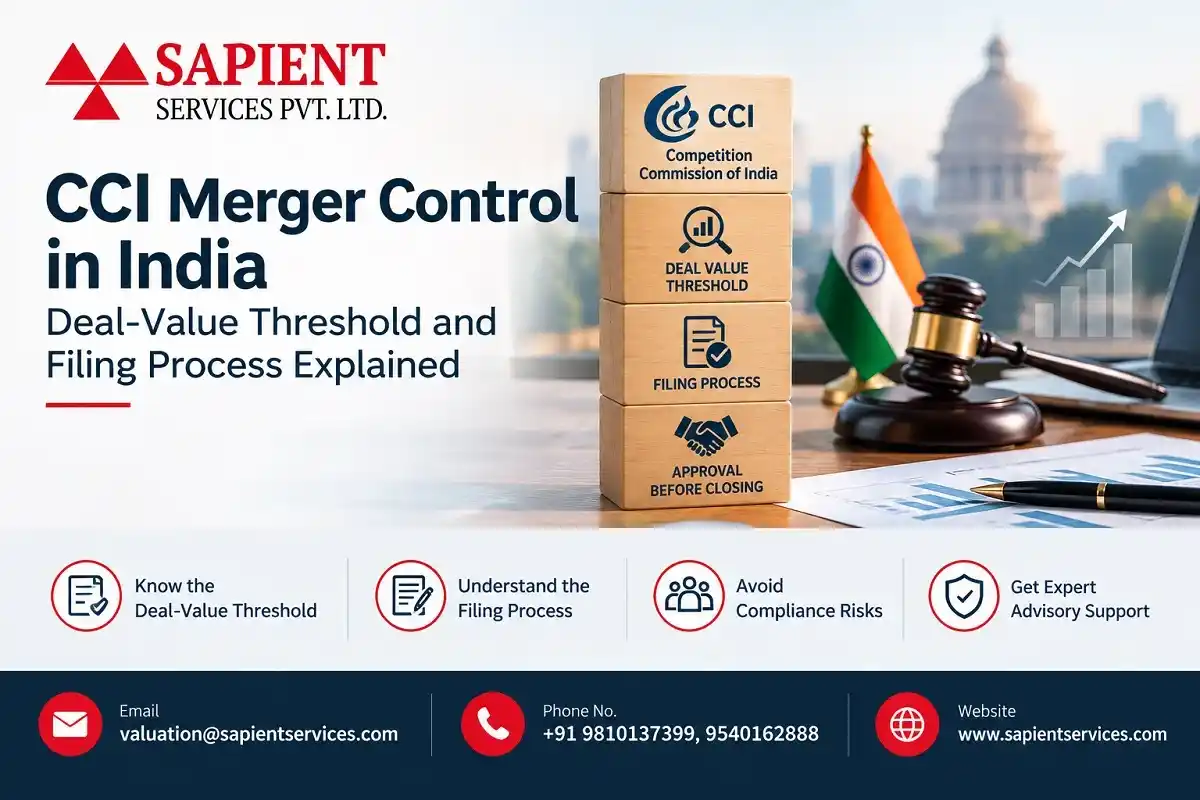
Depending on deal size, this includes Competition Commission of India approval. The CCI’s deal value threshold under Section 5(d) of the Competition Act — operative since 10 September 2024 — brings transactions above ₹2,000 crore into scrutiny even where asset or turnover thresholds are not met.
Cross-border buyers also need to factor in sectoral approvals such as RBI or FEMA clearance, which is covered in more detail later in this guide.
6. Closing and Post-Deal Support
The advisor manages conditions precedent, purchase price adjustments, and in many cases supports the first 100 days of integration planning.
How Sell-Side M&A Advisory Works in India
A sell-side mandate is built around one goal: creating genuine competitive tension so the seller is negotiating from strength, not necessity.
1. Sale Readiness and Vendor Due Diligence
The advisor reviews the company’s financials, contracts, and compliance record before it goes to market — fixing the issues a buyer would otherwise use to negotiate the price down.
2. Valuation and Positioning
A defensible valuation range is prepared using the same methodologies a buyer would apply, so the seller enters negotiations with a number they can justify, not just a number they hope for.
3. Information Memorandum Preparation
A confidential information memorandum is drafted covering the business, financial performance, market position, and growth drivers, released only after interested parties sign a non-disclosure agreement.
4. Market Outreach and Competitive Process
The advisor approaches a curated list of strategic and financial buyers simultaneously, structuring a staged bid process so offers can be compared on equal terms rather than negotiated one at a time.
5. Negotiation and Bid Management
Beyond headline price, the advisor negotiates deal certainty — financing contingencies, regulatory conditions, and the timeline to closing — since the highest bid is not always the safest one.
6. Closing Support
For listed targets, this includes coordinating with the acquirer’s obligations under the SEBI Takeover Code, which triggers a mandatory open offer once a buyer crosses the 25% shareholding or control threshold.
Buy-Side vs Sell-Side: Key Differences at a Glance
The table below sets out how the two mandates differ in practice, even when they sit on the same transaction.
| Factor | Buy-Side Advisory | Sell-Side Advisory |
|---|---|---|
| Advisor’s client | The acquiring company or investor | The company, promoter, or fund being sold |
| Primary objective | Acquire at a defensible price that fits strategy and return targets | Sell at the best achievable value with certainty of closing |
| Valuation posture | Conservative — stress-tests optimistic projections | Constructive — builds the strongest justifiable case for value |
| Process style | Targeted, often single-negotiation or limited shortlist | Competitive, multi-party bid process wherever possible |
| Due diligence role | Commissions and reviews diligence findings | Prepares vendor due diligence to pre-empt buyer concerns |
| Fee structure | Retainer plus success fee on completion | Retainer plus success fee, often scaled to price achieved |
| Typical timeline | 3-9 months depending on target complexity | 4-8 months for a structured competitive process |
Fee ranges and timelines above are indicative and vary by deal size, sector, and complexity — always confirm scope and fee structure in the engagement letter.
Regulatory and Valuation Considerations for Indian M&A
Both sides of an Indian M&A transaction operate inside the same compliance framework, and an advisor on either side who is unfamiliar with it can slow a deal down or expose a client to penalties.
- IBBI Registered Valuer requirement: Section 247 of the Companies Act, 2013 mandates that wherever a valuation is required under the Act — including the share swap ratio in a merger under Sections 230-232 or a preferential share issuance under Section 62(1)(c) — it must be conducted by a Registered Valuer regulated by the Insolvency and Bankruptcy Board of India.
- CCI approval for combinations: Transactions crossing the asset or turnover thresholds, or the ₹2,000 crore deal value threshold under Section 5(d) of the Competition Act, require Competition Commission of India clearance before closing — factor this into the deal timeline on both sides.
- SEBI Takeover Code for listed targets: An acquirer crossing prescribed shareholding thresholds in a listed company must make an open offer to public shareholders, which materially affects deal cost and structure.
- Fast-track mergers for eligible companies: Two separate 2025 reforms widened Section 233 eligibility. G.S.R. 603(E), effective 4 September 2025, extended the fast-track route to unlisted companies with debt up to ₹200 crore, holding-subsidiary and cross-subsidiary mergers, and inbound cross-border mergers.
Separately, G.S.R. 880(E), effective 1 December 2025, raised the “small company” definition to ₹10 crore paid-up capital and ₹100 crore turnover — pulling more companies into the original fast-track category.
- Income Tax Act, 2025 transition: For deals closing on or after 1 April 2026, capital gains and valuation certification provisions fall under the Income Tax Act, 2025 rather than the 1961 Act — advisors on both sides need to flag which framework applies to a given transaction date.
Cross-Border M&A: FEMA and RBI Considerations
Buy-side and sell-side advisory both change shape when a foreign party is involved, since pricing and reporting are no longer purely commercial decisions.
- Pricing guidelines: under FEMA, share transfers between resident and non-resident parties must be priced at fair value, certified by a Chartered Accountant or a SEBI-registered Merchant Banker.
- Reporting requirements: inbound investment requires Form FC-GPR or FC-TRS filing with the RBI within prescribed timelines, which a buy-side advisor should build into the closing checklist.
- Sectoral caps: certain sectors carry FDI limits or require government approval rather than the automatic route — this should be checked at the target-screening stage, not after a term sheet is signed.
- Outbound investment: Indian buyers acquiring overseas targets fall under the Overseas Investment Rules, which set separate reporting and structuring requirements from inbound deals.
Common Mistakes in Buy-Side and Sell-Side M&A
- Using one advisor for both sides without a clear mandate: A single “deal facilitator” acting informally for both parties creates a conflict of interest that surfaces during price negotiation — engage separate, clearly mandated advisors.
- Sellers skipping vendor due diligence: Skipping this step means the buyer finds the problems first, during their own diligence, which shifts negotiating leverage away from the seller at the worst possible moment.
- Buyers relying only on management projections: Projections prepared by the target’s own management are rarely independently stress-tested — a buy-side advisor should always build a separate base case.
- Underestimating regulatory timelines: CCI clearance, SEBI open offer procedures, or NCLT scheme approvals can each add several months — building this into the deal timeline from day one avoids last-minute renegotiation.
- Sell-side processes with only one buyer in the room: Negotiating with a single interested party, however credible, removes the competitive tension that typically drives a stronger final price.
Frequently Asked Questions
Q: What is the main difference between buy-side and sell-side M&A advisory?
A: Buy-side advisory represents the acquiring company and focuses on price discipline and risk. Sell-side advisory represents the company being sold and focuses on maximising value through a competitive process.
Q: Can one advisory firm handle both buy-side and sell-side work?
A: Yes, but not on the same transaction. A firm can run buy-side mandates for some clients and sell-side mandates for others — representing both parties in a single deal creates a direct conflict of interest.
Q: How long does a sell-side M&A process usually take in India?
A: A structured sell-side process typically takes four to eight months from vendor due diligence through to closing, depending on business complexity.
Q: What is vendor due diligence and why does it matter?
A: It’s a review the seller commissions on their own business before going to market, so issues surface early instead of being found by a buyer mid-negotiation.
Q: When is a Registered Valuer required in an Indian M&A deal?
A: Wherever the Companies Act specifically requires a valuation — such as the share-swap ratio in a merger under Sections 230-232 — it must be certified by a Registered Valuer under Section 247.
Q: What triggers CCI approval in an M&A transaction?
A: Crossing prescribed asset or turnover thresholds, or the ₹2,000 crore deal value threshold under Section 5(d) of the Competition Act, in force since 10 September 2024.
Q: What is the SEBI Takeover Code and when does it apply?
A: It requires an acquirer of a listed company to make an open offer to public shareholders once they cross the 25% shareholding or control threshold. It does not apply to unlisted companies.
Q: How are M&A advisory success fees calculated?
A: Most mandates combine a fixed retainer with a success fee on completion, often a percentage of transaction value — the exact structure is negotiated in the engagement letter.
Q: What happens if a seller skips a competitive sale process?
A: Negotiating with a single buyer removes competitive tension, which usually weakens the final price and terms compared with a structured multi-party process.
Q: Is FEMA approval needed for cross-border M&A deals?
A: Cross-border share transfers need FEMA-compliant pricing and RBI reporting, but not always prior approval — most transactions qualify for the automatic route unless the sector is restricted.
Q: Does buy-side or sell-side advisory cost more?
A: Fee structures are broadly similar on both sides — a retainer plus success fee — though the fee percentage can vary with deal size and process complexity rather than which side is represented.
Conclusion: Choosing the Right Side of the Table
Buy-side and sell-side M&A advisory — or acquisition and divestment advisory, as it’s sometimes called — solve different problems for different clients. A buyer needs an advisor who will say no to a bad target. A seller needs an advisor who will hold out for a better one.
Getting this right shows up directly in the final price and terms of a deal.
Whether you are evaluating an acquisition or preparing your business for sale, engage an advisor whose mandate is clearly aligned to your side of the table — and whose valuation work is backed by a Registered Valuer where the law requires it.
If you need a compliant valuation report, due diligence support, or end-to-end M&A advisory for a buy-side or sell-side transaction, Sapient Services’ team works directly with promoters, corporates, and financial investors across India.