Why Post-Merger Integration Fails: 10 Costly Mistakes
 By
By 
Studies on post-merger integration report a wide range of outcomes, but most converge on the same uncomfortable pattern: a majority of mergers and acquisitions fail to deliver the value promised at signing. KPMG’s 2025 report, The M&A Dance: Orchestrating Synergies and Value Creation in Public Company Acquisitions, analyzed more than 3,000 public-to-public deals worth over USD 100 million between 2012 and 2022, and found that 57.2% of acquirers ultimately destroyed shareholder value after close. The report traced this to two consistent causes: acquirers overpaying for synergies, and then failing to operationalize the gains they had projected.
In India, deal value crossed USD 123.8 billion in 2025 according to EY’s India M&A report, up 18% from the year before, and getting an NCLT sanction under Sections 230-232 of the Companies Act, 2013 is often the easier half of the job. Post-merger integration, or PMI, decides whether the deal actually pays for itself. This guide sets out the 10 pitfalls that repeatedly derail post-merger integration for Indian acquirers, and the framework that separates companies that capture the synergies they paid for from the ones that watch them disappear.
Quick Answer:
- Post-merger integration most often fails because companies start planning after the deal closes instead of during due diligence, underestimate cultural misalignment between the two organizations, and stop tracking synergies once the integration team disbands.
- KPMG’s research on more than 3,000 public-to-public acquisitions puts the value-destruction rate at 57.2% of acquirers, with overestimated synergies and underestimated integration complexity as the two consistent causes.
- Fixing the 10 pitfalls below, starting with Day 1 readiness and ending with synergy governance, is what turns a signed deal into a value-creating one.
What Is Post-Merger Integration?
Post-merger integration, or PMI, is the structured process of combining two companies’ operations, systems, people, and finances after a merger or acquisition closes legally. It is not the deal itself. It is everything that happens after.
In India, PMI formally begins the day the National Company Law Tribunal, or NCLT, sanctions a scheme of amalgamation under Sections 230-232 of the Companies Act, 2013 (the court-supervised process through which two companies legally merge), or the day a share purchase agreement completes and shares change hands. It runs through Day 1 readiness, the first 100 days, and typically continues for 12 to 24 months before the combined entity stabilizes.
For a bank financing the acquisition, a promoter who has personally guaranteed the debt, or a private equity investor with a board seat, PMI is where the valuation assumptions built into the deal price either hold up or fall apart. The purchase price already assumes the synergies exist. Integration is what makes them real.
Suggested Packages:
- Mergers & Acquisitions Services in India
- Mergers & Acquisitions Advisory Services in Delhi NCR
- Mergers & Acquisitions Services in Mumbai
- Merger & Acquisition Services in Chennai
Why Integration Failure Costs More Than a Bad Deal
Poor integration does not just erode a spreadsheet projection. It shows up as customer attrition, key employees resigning within the first year, and covenant breaches on acquisition debt.
Banks approving project finance or working capital loans for the merged entity rely on the projected cost synergies to assess repayment capacity. NCLT-appointed resolution professionals handling a distressed acquisition under the Insolvency and Bankruptcy Code, 2016 (IBC), which governs the resolution and restructuring of financially distressed companies in India, need the combined entity to actually perform, not just exist on paper. Boards that approved the deal on the strength of a synergy case get held to that number at the next shareholder meeting.
What most finance teams don’t realize until it’s too late is that a scheme sanctioned by the NCLT, cleared by the CCI, and structured for tax efficiency under the Income Tax Act, 2025 can still destroy value in the boardroom if nobody owns the 100 days that follow closing.
Post-Merger Integration: Verified Data Snapshot
- 57.2% of acquirers destroyed shareholder value post-close, across 3,000+ public deals studied. (KPMG, “The M&A Dance,” 2025)
- 67% of dealmakers experienced delayed synergy realization due to culture-related issues; 30% of deals never fully met financial targets for the same reason. (Mercer, M&A culture research, 1,400+ professionals, 54 countries)
- 81% of disciplined corporate acquirers now assign a named owner to each longer-term synergy realization milestone. (Transaction Advisors Institute with Mercer)
- India’s M&A deal value reached USD 123.8 billion in 2025, up 18% year-on-year. (EY India, M&A report, 2025)
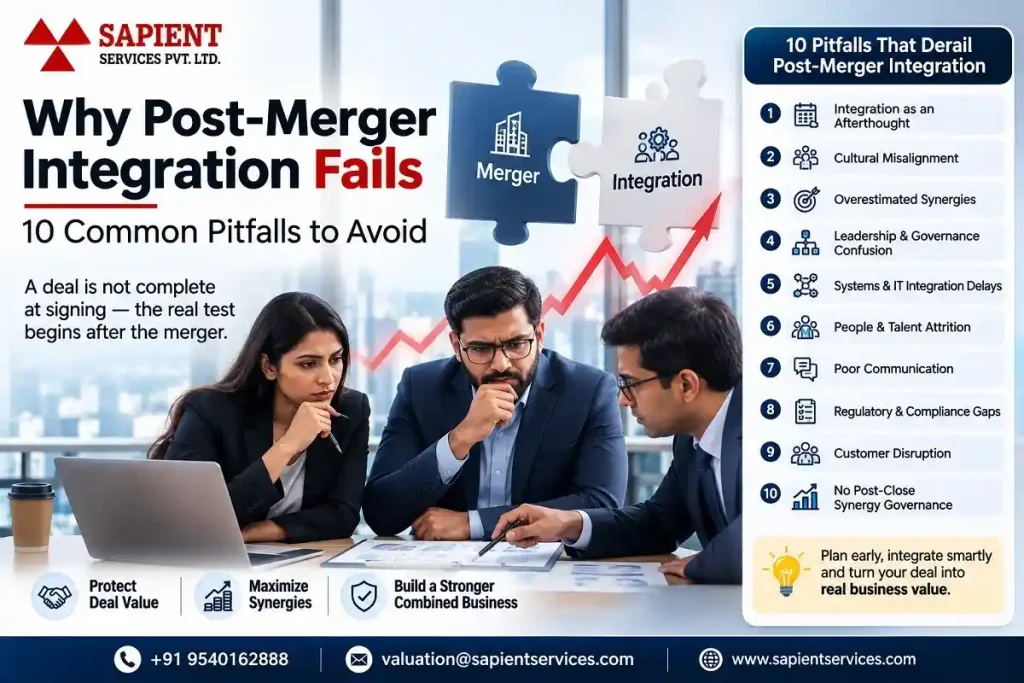
The 10 Most Common Post-Merger Integration Pitfalls
Each of the following pitfalls shows up repeatedly across Indian M&A, from mid-market manufacturing roll-ups to cross-border acquisitions structured under the FEMA Cross-Border Merger Regulations, 2018. Most are avoidable. Almost none are addressed once the deal is already in trouble.
1. Treating Integration as a Post-Close Afterthought
Many acquirers start detailed integration planning only after the NCLT sanctions the scheme or the share purchase agreement completes. That compresses the timeline and forces the integration team to react instead of plan. Integration planning should start during due diligence, not after Sections 230-232 approval. The companies that begin building the Day 1 operating plan before signing consistently outperform those that wait for legal close.
2. Underestimating Cultural Misalignment
Mercer’s global M&A culture research, based on more than 1,400 M&A professionals across 54 countries, found that 67% of dealmakers experienced delayed synergy realization because of culture issues, and 30% of deals never fully met their financial targets for the same reason. Two Indian companies with different decision-making styles, reporting cultures, or founder-led versus professionally managed structures rarely blend on their own. Assess culture during diligence, not after the handshake photo.
3. No Single Integration Owner With Real Authority
Corporate development closes the deal and hands off to operations. Operations often lacks the mandate, budget, or seniority to run a structured integration program. The result is an accountability vacuum where functional leaders assume someone else is driving the plan. Every Indian merger needs one named integration lead who reports to the board or CEO, not a committee.
4. Losing Key Talent in the First 100 Days
Industry HR benchmarking research indicates that without a structured retention plan, close to half of a target company’s identified key talent can leave within the first year of a deal closing. Uncertainty about roles, reporting lines, and compensation drives out exactly the people whose knowledge the acquirer paid a premium for. Retention agreements and clear role communication in the first two weeks after close matter more than any all-hands meeting held later.
5. IT and Systems Integration Left Unplanned
Industry surveys consistently flag IT and systems integration as one of the workstreams most likely to run into significant unplanned issues, especially when systems mapping starts after close instead of during diligence. Two ERPs, two GST registrations, and two chart-of-accounts structures do not merge cleanly on a deadline set by the closing date. A technical due diligence assessment of both companies’ core systems should happen before signing, not during Day 1 planning.
6. Synergy Targets Without Synergy Tracking
Boards approve a deal on a synergy number, then nobody tracks whether it is actually being captured. Research fielded by the Transaction Advisors Institute with Mercer among active corporate acquirers found that 81% of disciplined acquirers now assign a named owner to each longer-term synergy realization milestone, rather than leaving it to be revisited only at the next board meeting. A synergy is a plan, not a hope.
7. Ignoring Regulatory and Tax Sequencing
The Competition Act, 2002 imposes a standstill obligation, meaning the two companies cannot combine operations or exchange competitively sensitive information until the CCI formally clears the transaction. The CCI’s Deal Value Threshold under the 2024 Combinations Regulations brought more deals into mandatory notification. Integrating operations before clearance, or overlooking how loss carry-forward works under Section 116 of the Income Tax Act, 2025 (which governs how accumulated losses and unabsorbed depreciation transfer to the merged entity), can trigger penalties or erase the tax benefit the deal was structured around.
8. Communication Vacuum With Employees and Customers
When leadership goes quiet after the announcement, employees and customers fill the silence with their own assumptions, usually the worst-case ones. A structured communication cadence, starting on Day 1 and continuing through the first 100 days, is one of the cheapest interventions available and one of the most consistently skipped.
9. Overloading Functional Leaders With Dual Roles
Finance heads, HR leads, and plant managers are asked to run their day job and lead an integration workstream simultaneously, with no additional bandwidth or support. Something gives, and it is usually the integration work, because the day job has a deadline that cannot slip. Dedicated integration resources, even if temporary, pay for themselves.
10. No Defined End State or Success Metrics
Integration without a defined end state drifts indefinitely. Teams need to know what “done” looks like: which systems will be common, which processes will follow the acquirer’s playbook versus the target’s, and by what date. Deals with a documented 100-day plan and clear success metrics consistently outperform deals run on improvisation.
A Case From Our Experience
A Delhi NCR-based mid-market manufacturing group acquired a smaller competitor to consolidate capacity ahead of a planned Series C round. The valuation and NCLT scheme under Section 232 went through without incident.
Challenge: Within four months of closing, the acquired unit lost two plant supervisors and a sales lead, and the promised cost synergies from combined procurement had not been tracked or realized. The board had no visibility into whether the deal was on track.
Sapient’s approach: We built a 100-day integration tracker with named owners for each synergy line item, ran a rapid cultural and process gap assessment across both plants, and set up a monthly integration review cadence reporting directly to the board.
Outcome: Within two quarters, procurement synergies were being tracked against target for the first time, and the group entered its Series C diligence with a documented integration record instead of an unverifiable claim.
The 7-Pillar Post-Merger Integration Framework
A structured PMI framework gives every workstream owner a common reference point instead of ad hoc coordination. Sapient Services applies the following seven pillars when structuring an integration management office (IMO) for Indian acquirers:
- People: Retention of key talent, role clarity, reporting-line decisions, and leadership alignment across both organizations.
- Process: Mapping which company’s operating procedures, approval workflows, and reporting cadence the combined entity will follow.
- Technology: ERP, CRM, and core systems integration sequencing, including data migration and access-control cleanup.
- Governance: The integration management office structure, decision rights, and how the integration reports to the board.
- Culture: Deliberate cultural assessment and alignment work, not left to resolve itself over time.
- Finance: Synergy tracking, consolidated financial reporting, and covenant compliance on acquisition debt.
- Compliance: Sequencing CCI clearance, NCLT conditions, Income Tax Act 2025 provisions, and FEMA or DPDP requirements where applicable.
The Post-Merger Integration Timeline: What Happens When
A realistic post-merger integration timeline for an Indian deal typically looks like this:
- Announcement: Deal terms are announced; integration planning should already be underway internally, not starting now.
- Signing: Definitive agreements are signed; the CCI standstill obligation begins if the deal is notifiable.
- Closing (NCLT sanction or SPA completion): Legal ownership transfers; Day 1 readiness plan is executed.
- Day 1: New reporting lines, communication to employees and customers, and interim operating protocols go live.
- 30 Days: Quick wins are identified, retention agreements are finalized, and the integration management office is fully staffed.
- 100 Days: Core systems migration begins, synergy tracking is formalized, and the first board integration review is held.
- 6 Months: Process harmonization across functions; early synergy capture is measured against target.
- 12-24 Months: Full systems consolidation, culture integration matures, and the combined entity’s performance is judged against the original deal thesis.
Successful vs. Failed Post-Merger Integration
Signs the integration is on track:
- A named integration lead reports progress to the board on a fixed monthly cadence.
- Synergy targets are tracked line-by-line against actuals, not reviewed only once a quarter.
- Employee attrition at the acquired company stays close to its pre-deal baseline.
- Customers experience no disruption to service levels or account relationships.
- Systems and process harmonization follows a documented, sequenced plan.
Signs the integration is failing:
- Integration planning starts only after legal close, with no Day 1 plan in place.
- No single person owns integration outcomes; functional leaders each assume someone else is driving it.
- Synergy numbers from the investment thesis are never revisited after the board approval meeting.
- Key talent at the acquired company begins resigning within the first two quarters.
- IT systems, GST registrations, or chart-of-accounts structures remain unmerged well past 100 days.
Post-Merger Integration Best Practices: A Working Checklist
Use this as a working post-merger integration checklist before your next deal closes:
- Plan before you sign: Start integration planning during due diligence, not after the NCLT sanction or SPA completion, so Day 1 has an actual plan behind it.
- Name one owner: Assign one integration lead who reports to the board or CEO, with real budget and decision-making authority, not a rotating committee.
- Diligence culture, not just numbers: Run a cultural and organizational assessment as part of diligence, not as a Day 1 surprise.
- Talk early and often: Communicate with employees and key customers within the first week of announcement, and keep a fixed cadence through the first 100 days.
- Track synergies like a P&L: Track every synergy line item against a named owner and a date, and report it to the board monthly, not just at the next scheduled meeting.
- Sequence the regulatory steps: Sequence CCI clearance, NCLT approval, and Income Tax Act 2025 loss carry-forward requirements before integrating operations, not after.
- Protect bandwidth: Give functional leaders dedicated integration bandwidth or temporary support, so the day job and the integration work do not compete for the same hours.
Frequently Asked Questions
Q: Why do most mergers and acquisitions fail after closing?
A: Most M&A deals fail because of execution problems after the deal closes, not because the original deal thesis was wrong. Research from KPMG and other major consulting firms consistently links the majority of failed deals to integration planning gaps, cultural misalignment, and synergies that were never tracked.
Q: What percentage of M&A deals fail in India?
A: India does not have a single official failure-rate statistic. Estimates across international studies vary, generally falling in a 50% to 90% range depending on methodology and how ‘failure’ is defined, and Indian deals carry the same integration risks plus additional sequencing challenges around NCLT, CCI, and RBI approvals.
Q: When should post-merger integration planning start?
A: Integration planning should start during due diligence, well before the deal closes. Waiting until after the NCLT sanctions the scheme under Sections 230-232 of the Companies Act, 2013 compresses the timeline and increases execution risk.
Q: What is the biggest cause of post-merger integration failure?
A: Cultural misalignment is cited most often by practitioners as the single biggest barrier to synergy capture, followed closely by planning gaps that existed before the deal closed and inadequate synergy tracking after close.
Q: How long does post-merger integration typically take?
A: Most integrations run through an intensive first 100 days and then continue at a steadier pace for 12 to 24 months before the combined entity fully stabilizes, depending on deal size and complexity.
Q: Who should lead post-merger integration in an Indian company?
A: A single named integration lead reporting directly to the board or CEO should run the process, supported by functional workstream owners. Splitting ownership across a committee without clear accountability is one of the most common reasons integration stalls.
Q: What role does the CCI play in post-merger integration?
A: The Competition Commission of India imposes a standstill obligation on combining operations until it clears the transaction, and its Deal Value Threshold under the 2024 Combinations Regulations brings more deals into mandatory notification. Integrating operations before clearance can trigger penalties.
Q: How does the Income Tax Act, 2025 affect post-merger integration?
A: The Income Tax Act, 2025, effective from April 2026, governs how losses, depreciation, and slump sale consideration carry over into the merged entity under provisions such as Section 116. Integration teams need to sequence tax filings and accounting consolidation around these rules to preserve the intended tax benefits.
Q: What is a synergy tracker and why does it matter?
A: A synergy tracker is a document that assigns each expected cost or revenue synergy to a named owner, a target date, and a measurement method. Deals that track synergies from Day 1 report significantly higher success rates than deals that set a target and revisit it only occasionally.
Q: Can a well-structured deal still fail during integration?
A: Yes. A deal can clear NCLT sanction, CCI approval, and tax structuring cleanly and still destroy value if nobody owns the 100 days after close. Structuring and integration are two separate disciplines, and skill in one does not guarantee skill in the other.
Q: Does company size affect post-merger integration risk?
A: Larger, more complex acquisitions carry higher integration risk because they involve more overlapping systems, more employees, and more regulatory touchpoints. But mid-market deals fail just as often, usually because they lack a dedicated integration team altogether.
Q: How can a company measure if its integration is on track?
A: Track synergy capture against the original target, monitor employee attrition against pre-deal baselines, and review customer retention monthly. A documented 100-day plan with clear milestones is the single best predictor of whether an integration is actually on track.
Q: What is an Integration Management Office (IMO)?
A: An Integration Management Office, or IMO, is the dedicated team and governance structure that runs post-merger integration end to end. It coordinates the workstream owners across people, process, technology, finance, and compliance, and reports progress to the board on a fixed cadence.
Q: How much does post-merger integration cost in India?
A: Cost varies widely with deal size and complexity, and depends on whether it is run in-house or with an external advisor. As a rule of thumb, companies that under-invest in structured integration support tend to spend far more later in unplanned retention costs, systems rework, and lost customer revenue.
Q: What is the difference between due diligence and post-merger integration?
A: Due diligence happens before the deal closes and verifies the facts about the target company. Post-merger integration happens after close and is the execution work of actually combining the two organizations. A strong due diligence process should feed directly into the integration plan, not sit in a separate silo.
Conclusion
None of these 10 pitfalls are unusual or unpredictable. They repeat across Indian M&A because post-merger integration is treated as an afterthought to the deal, not as a discipline in its own right. The acquirers who consistently capture the value they paid for are not the ones who negotiated the best price. They are the ones who planned Day 1 before they signed the term sheet, and who ran integration as a governed program rather than hoping it worked itself out.
If your company is heading into a merger or acquisition and needs a structured post-merger integration plan, a synergy tracking framework, or a valuation report that stands up to bank and investor scrutiny, Sapient Services’ M&A Advisory & Valuation team works with promoters, boards, and resolution professionals across India on exactly this problem.
Book a Post-Merger Integration Readiness Assessment: call +91 9540162888 or write to valuation@sapientservices.com to speak with our M&A advisory team before your next deal closes.
Related Reading